 Log In
Search




 Open Access
 czjiangaimin@smmu.edu.cn
syjiang2018@163.com
czjiangaimin@smmu.edu.cn
syjiang2018@163.comAimin Jiang, Department of Urology, The First Naval Hospital of Southern Theater Command, No. 40 Haibin 3rd Road, Xiashan District, Zhanjiang 524005, Guangdong, China. E-mail: czjiangaimin@smmu.edu.cn. Shuya Jiang, The Third Department of Hepatic Surgery, Eastern Hepatobiliary Surgery Hospital, Naval Medical University, No. 225 Changhai Road, Yangpu District, Shanghai 200433, China. E-mail: syjiang2018@163.com.
Received December 10, 2025; Accepted February 28, 2026; Published March 31, 2026
Open Accessczjiangaimin@smmu.edu.cnsyjiang2018@163.comAimin Jiang, Department of Urology, The First Naval Hospital of Southern Theater Command, No. 40 Haibin 3rd Road, Xiashan District, Zhanjiang 524005, Guangdong, China. E-mail: czjiangaimin@smmu.edu.cn. Shuya Jiang, The Third Department of Hepatic Surgery, Eastern Hepatobiliary Surgery Hospital, Naval Medical University, No. 225 Changhai Road, Yangpu District, Shanghai 200433, China. E-mail: syjiang2018@163.com.
Received December 10, 2025; Accepted February 28, 2026; Published March 31, 2026
Minimally invasive surgery (MIS) has been developed based on the concept of minimum trauma and maximal function, epitomizing the advancement in modern surgery. Following the introduction of laparoscopy in the 1980s, MIS has continued to evolve into multiple modalities, including single-incision surgery, natural orifice transluminal endoscopic surgery, and robotic surgery. The advancements in imaging, artificial intelligence (AI) and robotization have come together to enhance not only the precision and safety of operations, but also the visualization and technical feasibility even in very complex cases. Numerous investigations have shown that MIS, compared with open surgery, decreases blood loss, reduces complication rates, shortens hospital day, and improves postoperative quality of life. The use of AI has brought surgery to the new age of machine intelligence and data-based decision making. Nevertheless, ethical and legal barriers, inadequate physician training programs, and uneven distribution of resources are obstacles to its wider implementation. The next wave of MIS, will be characterized by intelligence and personalization, incorporating AI navigation, augmented reality, and a multi-disciplinary approach.
Keywords: Minimally invasive surgery, Robot-assisted surgery, Artificial intelligence, Precision surgery
Minimally invasive surgery (MIS) is a diagnostic and therapeutic procedure performed through small incisions or natural orifices, aided by image-guided navigation, endoscopy, robotics, and other assistive technologies, with the core aims of reducing surgical trauma, shortening postoperative recovery, and lowering the risk of complications. Laparoscopic cholecystectomy, a landmark development in the 1980s, ushered in a revolutionary era of modern MIS, with single-port laparoscopic surgery later advancing this progress. Recently, new technologies including natural orifice transluminal endoscopic surgery and robot-assisted surgery (RAS) have been developed, marking the transition from open surgery to accurate, minimally-invasive intervention [1]. At present, MIS has been extensively used in general surgery, urology, gynecology, cardiovascular surgery and orthopedics. In the future, robotics, artificial intelligence (AI), big data and augmented reality (AR) will further promote the intelligent development and personalization of MIS. Key challenges include ethical and regulatory issues, clinician training, and regional resource disparities; the safe, standardized, and sustainable development of MIS hinges on integrating technological innovation with institutional building. This paper is primarily intended to guide clinical surgeons, perioperative managers, and hospital decision-makers in the introduction and management of MIS technology, providing a comprehensive roadmap for technology evaluation and implementation, as well as a clinical perspective to facilitate collaboration with engineers.
2.1 The application of advanced imaging technologies in MIS
The development of imaging technology has greatly supported the accurate performance of MIS. Preoperative high-resolution computed tomography, magnetic resonance imaging and three-dimensional (3D) reconstruction provide accurate delineation of the lesions and adjacent structures. These data can then be used to facilitate personalized surgical planning. Multimodality imaging tools such as ultrasound, fluorescence imaging and AR navigation allow more precise intraoperative localization and better visualization during surgery. A markerless AR system can visually display the actual distance between instruments and blood vessels in real time, thereby greatly minimizing any risk of vascular injury. Endoscopy combined with navigation technology not only maintains the advantages of MIS, but also decreases the complexity of anatomic localization [2].
2.2 The rise and prospects of RAS
RAS, which depends on 3D vision and extremely dexterous robot arms, is completely overhauling the precision and safety of surgical procedures. Single-port robotic systems [i.e., da Vinci SP] combine the best of minimal invasiveness with safety during procedures such as prostatectomy and pelvic lymph node dissection [3]. Single-port cholecystectomy in children also has advantages of less trauma, less bleeding and faster recovery. In complex urological reconstruction, the combination of robotics, fluorescence technology and ureteroscopy makes it possible to achieve excellent anatomical visualization. RAS is moving toward not only routine procedures but also advanced cases and applications in special populations, reflecting an important trend in MIS development [4].
2.3 The application of AI in MIS
MIS generates continuous digital signals, such as endoscopic video, instrument trajectories, and robotic kinematic data, which AI can convert into MIS-adaptive assistance—yet AI models need real intraoperative validation (e.g., bleeding, smoke, lens contamination, camera angle changes) rather than clean benchmark videos. Three AI application layers for MIS are emerging: First, perception enables real-time recognition of key anatomy and dissection planes to prevent misidentification-induced catastrophic injuries (e.g., semantic segmentation in laparoscopic cholecystectomy); second, workflow intelligence enables phase/step detection to standardize communication, anticipate equipment needs, and send context-aware prompts (proven in laparoscopic inguinal hernia repair); third, integrated autonomy-in-the-loop fuses video analysis with robotic kinematics to support camera control, instrument collision avoidance, and safety "no-go" alerts—functions unattainable with rule-based software alone [5]. With the rapid advancement of medical engineering and intelligent technology, traditional laparoscopic surgery is continuously evolving towards intelligence and remote control (Figure 1).

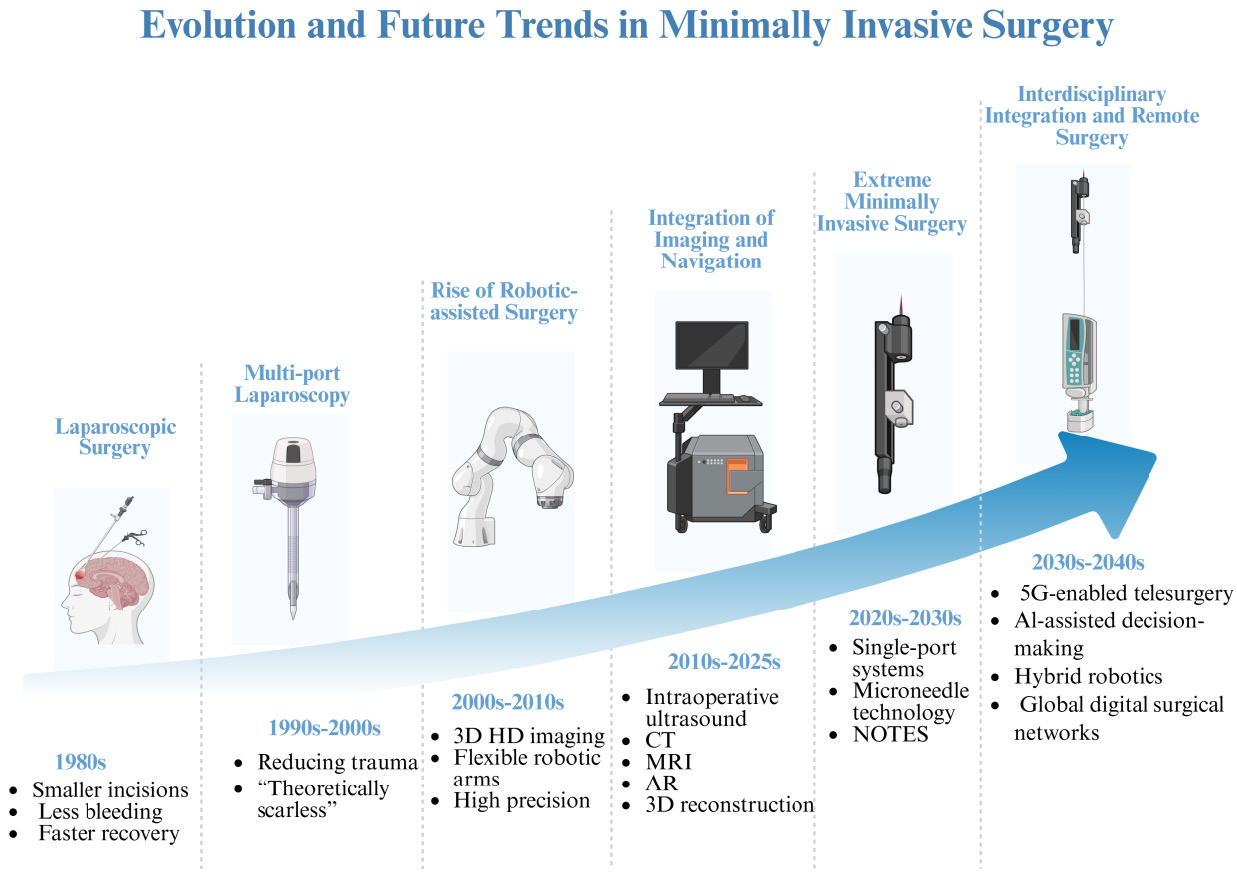
Figure 1. Evolution and future trends of MIS. This figure illustrates the evolution and prospects of MIS technology since the 1980s. Laparoscopic surgery emerged in the 1980s, characterized by small incisions, minimal bleeding, and quick recovery. From the 1990s to the 2000s, multi-port laparoscopic surgery was developed, further reducing trauma. Between 2000s and 2010s, robot-assisted surgery emerged, offering high-definition imaging and high-precision operation. From 2010s to 2025s, the integration of imaging and navigation technologies (such as intraoperative ultrasound, CT, MRI, AR, and 3D reconstruction) has significantly enhanced visualization and accuracy. Looking ahead, from 2020s to 2030s, ultra-MIS is expected to mature, utilizing single-port, microneedle, and NOTES technologies. Finally, from 2030s to 2040s, surgery will enter an interdisciplinary fusion phase, combining 5G remote surgery, AI-assisted decision-making, and a global digital surgical network, thus ushering in a new era of intelligent and remote surgery. 3D, three-dimensional; HD, high-definition; CT, computed tomography; MRI, magnetic resonance imaging; AR, augmented reality; NOTES, natural orifice transluminal endoscopic surgery; 5G, fifth-generation; AI, artificial intelligence.
3.1 The impact of MIS on postoperative recovery
The advantages of MIS are now widely recognized, including reduced incision size, decreased bleeding, and faster recovery. It has been proven that MIS can effectively relieve pain, reduce the infection rate, decrease hospital stay, and speed up rehabilitation. Intraoperative analgesia using an erector spinae plane catheter has been reported to significantly increase the Quality of Recovery-15 questionnaire score within 48 hours after surgery, highlighting the role of evidence-based pain control in patient satisfaction [6].
3.2 Risk reduction strategies for complications in MIS
Management of risks associated with MIS needs to be considered in the context of a ‘triple-decker strategy’ across the pre-, intra-, and post-operative phases. Preoperative holistic evaluation of predisposing factors and imaging features aids in identifying high-risk factors. Intraoperative localization technology including imaging navigation and near-infrared fluorescence imaging improves the accuracy of localization and provides the best approach, thereby minimizing bleeding and anastomosis-related complications [7]. By promoting preoperative evaluation, optimizing intraoperative techniques and strengthening postoperative surveillance, clinicians can significantly decrease the incidence of complications in all stages of the surgery, which may contribute to improving perioperative safety and overall treatment outcome.
3.3 Quantitative analysis of patient feedback and satisfaction
Studies have demonstrated that in different types of surgery such as biliary procedures and arthroscopy, the MIS group experiences greater satisfaction (pain control, scar appearance and quality of life) than conventional surgeries [8]. Through the implementation of standardized questionnaires and follow-up mechanisms, the patient care experience has been measured in an objective manner, contributing to workflow-focused optimization as well as quality management. MIS also improves postoperative recovery and patient psychological comfort. Clinical research outcomes are summarized for comparison in such areas as post-operative pain, recovery time, rates of complications and patient satisfaction (Supplementary Table 1).
4.1 Ethical and legal issues in the widespread adoption of technology in MIS
The widespread but heterogeneous adoption of MIS faces several ethical and legal issues, including informed consent, privacy of data, liability in medical malpractice and resource fairness [9]. The risks and long-term durability of new technologies are not always fully understood by patients. If there is a lack of communication, disputes can arise; this underscores the importance of thorough preoperative risk assessment and clear communication. With the growing amount of cross-border imagery and patient data exchange, data protection becomes an important issue that requires comprehensive security and accountability mechanisms to be in place. MIS should be developed in a healthy environment under strong ethical and legal control to guarantee safety and fairness.
4.2 The necessity of physician training and skill enhancement
For MIS, it is extremely necessary for the surgeon to have sufficient experience and systematic training. Systematic, simulation-based, tiered training platforms incorporating animal experiments and virtual reality can overcome the learning curve, increase surgical accuracy and improve therapeutic outcomes. This emphasizes the role of ongoing education and interdisciplinary cooperation in improving health care quality.
4.3 The impact of healthcare resource allocation and regional disparities
There are economic resource disparities which limit the use of MIS. One of the interesting observations that have emerged from research is that the penetration of MIS is substantially higher in large medical centers than in community hospitals and also varies across patient demographics [10]. For example, Hispanic patients are less likely to accept it [11]. Despite demonstrated more widespread overall utilization of MIS in the surgical staging of endometrial cancer, this practice continues to be applied disproportionately among low-income or vulnerable populations. Notably, shorter hospital stays alone do not equate to full cost-effectiveness, as comprehensive evaluation requires accounting for capital investment, maintenance, consumables, staffing, and long-term clinical outcomes. A practical strategy is to centralize high-cost, advanced MIS platforms in regional hubs and extend their access via referral networks and standardized protocols, thus reducing disparities and ensuring efficient, equitable resource utilization across healthcare settings.
The next phase of MIS will be defined less by any single device and more by integration: imaging that reduces uncertainty, robotics that extends dexterity, and AI that provides context-aware assistance. 3D reconstruction and markerless AR boost anatomical visualization and intraoperative risk assessment, reducing the impact of varying surgical experience. Single incision platforms and more dexterous robotic arms extend RAS to complex reconstruction and high-risk patients, while AI enables data-driven diagnosis, treatment and postoperative follow-up, shifting from experience-driven practice. In the future, MIS will rely on multidisciplinary cooperation, changing not only surgical philosophy but also the practice model of surgery.
Nevertheless, regional and resource issues remain barriers to its widespread implementation. In developed regions, the utilization rate in central hospitals is significantly higher than that in community hospitals, and there are disparities in patient access owing to inequitable socioeconomic status and insurance coverage. Thus, future development will require not only technology innovation but also policy support, educational training, resource optimization, and improved legal and ethical standards to ensure the safe and equitable application of MIS worldwide. At the same time, specialized training on MIS-related technical skills can be conducted for clinical doctors; a regional referral collaboration model can be established; and remote guidance can be used in appropriate scenarios to comprehensively promote the clinical popularization and application of minimally invasive surgery.
Author contributions
Yue Shu and Chunyue Jia contributed to the manuscript writing and figure preparation. Shuya Jiang designed the work. Aimin Jiang supervised the work. All authors have read and approved the final manuscript.
Funding
This research received no external funding.
Data availability
Data sharing is not applicable to this article, as no datasets were generated or analyzed during the current study. All information is derived from publicly available articles and datasets.
Ethics approval and consent to participate
Not applicable. This manuscript does not contain any studies with human participants or animals performed by any of the authors.
Consent for publication
Not applicable. This manuscript does not include details, images, or videos relating to an individual person.
Competing interests
The authors declare that they have no competing interests.
Acknowledgements
Not applicable.
SUPPLEMENTARY METERIAL
[1] Petropoulou T, Evangelou K, Polydorou A. Expanding the boundaries of minimally invasive surgery: The feasibility of robotic natural orifice transluminal extraction colectomy and robotic no-incision colectomy in colorectal practice. Ann Coloproctol. 2025 Aug;41(4):346-353. https://doi.org/10.3393/ac.2025.00647.0092
[2] Schmidt BT, Chen KT, Kim J, Brooks NP. Applications of navigation in full-endoscopic spine surgery. Eur Spine J. 2024 Feb;33(2):429-437. https://doi.org/10.1007/s00586-023-07918-8
[3] Kaouk J, Bertolo R, Eltemamy M, Garisto J. Single-port robot-assisted radical prostatectomy: First clinical experience using the SP surgical system. Urology. 2019 Feb;124:309. https://doi.org/10.1016/j.urology.2018.10.025
[4] Gabrielson A, Li O, Cohen AJ. Robotic-assisted augmented roof ureteroplasty with appendiceal onlay flap. Urology. 2023 Jun;176:243-245. https://doi.org/10.1016/j.urology.2023.02.027
[5] Takeuchi M, Collins T, Ndagijimana A, Kawakubo H, Kitagawa Y, Marescaux J, et al. Automatic surgical phase recognition in laparoscopic inguinal hernia repair with artificial intelligence. Hernia. 2022 Dec;26(6):1669-1678. https://doi.org/10.1007/s10029-022-02621-x
[6] Moorthy A, Ni Eochagain A, Dempsey E, Wall V, Marsh H, Murphy T, et al. Postoperative recovery with continuous erector spinae plane block or video-assisted paravertebral block after minimally invasive thoracic surgery: A prospective, randomised controlled trial. Br J Anaesth. 2023 Jan;130(1):e137-e147. https://doi.org/10.1016/j.bja.2022.07.051
[7] Faber RA, Meijer RPJ, Droogh DHM, Jongbloed JJ, Bijlstra OD, Boersma F, et al. Indocyanine green near-infrared fluorescence bowel perfusion assessment to prevent anastomotic leakage in minimally invasive colorectal surgery (AVOID): A multicentre, randomised, controlled, phase 3 trial. Lancet Gastroenterol Hepatol. 2024 Oct;9(10):924-934. https://doi.org/10.1016/S2468-1253(24)00198-5
[8] Juo YY, Park C, Yoo J, Guerron D, Sudan R, Friedman K, et al. Technical feasibility, outcomes, and patient satisfaction after needlescopic and laparoscopic bariatric surgery: A randomized study. Obes Surg. 2021 Nov;31(11):5085-5091. https://doi.org/10.1007/s11695-021-05675-5
[9] Strong VE, Forde KA, MacFadyen BV, Mellinger JD, Crookes PF, Sillin LF, et al. Ethical considerations regarding the implementation of new technologies and techniques in surgery. Surg Endosc. 2014 Aug;28(8):2272-2276. https://doi.org/10.1007/s00464-014-3644-1
[10] Horsey ML, Lai D, Sparks AD, Herur-Raman A, Borum M, Rao S, et al. Disparities in utilization of robotic surgery for colon cancer: an evaluation of the U.S. national cancer database. J Robot Surg. 2022 Dec;16(6):1299-1306. https://doi.org/10.1007/s11701-022-01371-3
[11] Gabriel E, Thirunavukarasu P, Attwood K, Nurkin SJ. National disparities in minimally invasive surgery for pancreatic tumors. Surg Endosc. 2017 Jan;31(1):398-409. https://doi.org/10.1007/s00464-016-4987-6
ISSN: 2957-5443
Volume 4, Issue 1
March 2026
Pages: 1-148


 Log In

 On This Page
 CITE
CITE