 Log In
Search




 Open Access
 liu134892024@163.comOpen Accessliu134892024@163.com
Perioperative blood pressure (BP) control is a cornerstone of anesthesiology, as it significantly affects organ recovery and the development of postoperative complications. In pediatric patients undergoing cardiopulmonary bypass, brain injury is associated with impaired cerebral autoregulation. Accurate adjustment of mean arterial pressure (MAP) can preserve cerebral perfusion and thus minimize neurological injury [1]. Hypotension often leads to insufficient perfusion of the brain, heart, and kidneys, resulting in complications such as acute kidney injury (AKI) and cerebral ischemia.
Recent advancements have shifted perioperative BP management from empirical to goal-directed approaches. For instance, transcranial Doppler monitors cerebral blood flow following vascular occlusion to prevent hyperperfusion. Tools such as esophageal Doppler and the pressure recording analytical method (PRAM) enable more precise titration of circulatory dynamics. Low-dose continuous norepinephrine (NE) infusion combined with goal-directed fluid therapy has been shown to reduce complications in elective pulmonary surgery [2]. The prophylactic use of vasoactive agents and the renal-protective effects of dexmedetomidine (DEX) provide additional strategies for effective perioperative BP control. Defining personalized safety thresholds and integrating multimodal monitoring remain critical challenges. Notably, lower MAP is strongly associated with postoperative AKI, while post-induction hypotension independently increases the odds of adverse events in transcatheter aortic valve replacement [3].
2.1 Effects of BP fluctuations on organ perfusion
Hemodynamic changes during the perioperative period can exert a significant impact on organ perfusion and function. In patients with aneurysmal subarachnoid hemorrhage, the oxygen reactivity index shows superior sensitivity in detecting perfusion derangements associated with delayed cerebral ischemia [4]. While compensatory microcirculatory mechanisms may preserve certain mucosal functions during hypotension, accurate BP control remains vital for critical organs. Personalized BP control based on dynamic hemodynamic variations may attenuate the risk of perfusion mismatch that leads to organ injury. Current clinical consensus suggests that maintaining MAP within 10% of the patient’s baseline or keeping the cerebral oxygenation index below 0.3 serves as a critical threshold for organ protection.
2.2 Correlation between hypotension and postoperative cerebral complications
Perioperative hypotension contributes to cerebral complications through reduced perfusion pressure and disruption of the blood–brain barrier. Orthostatic hypotension is associated with cognitive impairment and microstructural brain damage. However, personalized protocols that maintain cerebral oxygenation within optimal ranges show promise for reducing neurological complications. In addition, acute water intake has been shown to improve orthostatic tolerance in patients with orthostatic hypotension and reduce performance decline associated with insufficient cerebral perfusion, offering a simple perioperative neuroprotective strategy [5]. A critical threshold is typically defined as an absolute MAP below 65 mmHg or a decrease of more than 20% from the pre-induction baseline, both of which significantly elevate the risk of cognitive impairment.
2.3 BP-related mechanisms of cardiac and renal dysfunction
Perioperative BP variability profoundly impacts hemodynamic stability and organ perfusion, thereby influencing both cardiac and renal function. Intraoperative hypotension—especially a decrease in MAP—can lead to insufficient myocardial perfusion and ischemic damage; therefore, stable BP is essential for cardiac protection. Higher blood pressure variability (BPV) during cardiopulmonary bypass—particularly when MAP fluctuations exceed 30% of the area under the curve—is significantly associated with cardiac surgery-associated AKI in pediatric patients [6]. For adults, a cumulative duration of MAP below 60 mmHg for more than 20 minutes is identified as a critical threshold for stage 1 AKI.
Perioperative hemodynamic instability—characterized by chronic or repeated episodes of hypotension, hypertension, or increased BPV—leads to microcirculatory deterioration and disruption of autoregulatory responses, ultimately resulting in target organ injury (Figure 1). Notably, patients with chronic hypertension are more prone to these variations due to preexisting arteriolosclerosis and impaired renal autoregulation. This cardiorenal interaction illustrates the complex relationship between hemodynamic instability and organ perfusion in a vulnerable state. Such pathophysiological processes highlight the importance of personalized and dynamic BP management to reduce intraoperative shock and improve early postoperative outcomes.

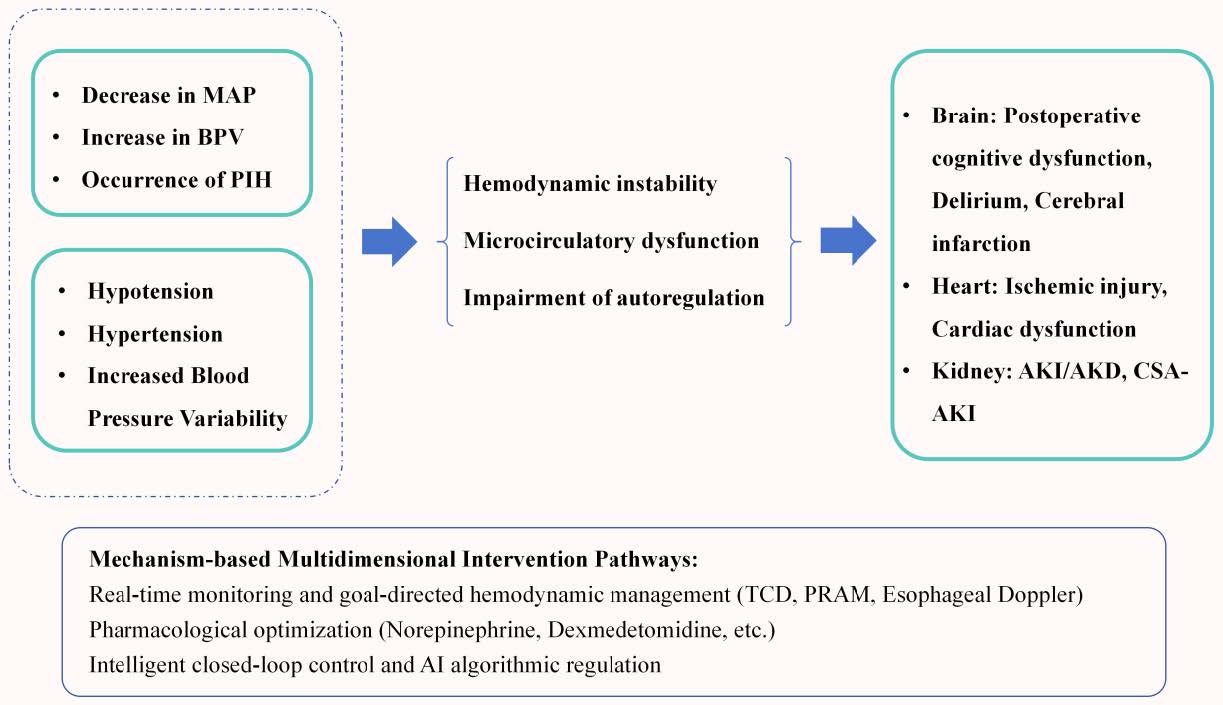
Figure 1. Schematic representation of critical thresholds in perioperative blood pressure management and multi-organ protection strategies. Decreases in MAP, increases in BPV, and PIH lead to hemodynamic instability, microcirculatory disturbances, and impaired autoregulation, resulting in subsequent injury to critical organs such as the brain, heart, and kidneys. Mechanism-based multidimensional intervention strategies include dynamic monitoring and goal-directed hemodynamic therapy (e.g., TCD, PRAM, esophageal Doppler), pharmacological optimization (e.g., norepinephrine, dexmedetomidine), and closed-loop control using artificial intelligence for real-time BP management. This figure was created by the author using Figdraw. MAP, mean arterial pressure; BPV, blood pressure variability; PIH, post-induction hypotension; TCD, transcranial Doppler; PRAM, pressure recording analytical method; BP, blood pressure; AKI, acute kidney injury; AKD, acute kidney disease; CSA-AKI, cardiac surgery-associated acute kidney injury; AI, artificial intelligence.
Individualized BP management guided by real-time monitoring is essential for preventing complications. Esophageal Doppler-guided therapy decreases pulmonary complications and hospital length of stay, while the PRAM facilitates postoperative triage and reduces healthcare costs. Continuous arterial pressure monitoring and AI-based algorithms enable clinicians to dynamically assess circulatory status. Closed-loop control systems further improve hemodynamic stability. Accurate pharmacological regulation effectively protects organ function. Prophylactic NE infusion is superior to bolus epinephrine for reducing post-induction hypotension and complications in major abdominal surgery. Continuous DEX infusion for 24 hours significantly lowers the rate of AKI rates by 29% without hemodynamic risks. Titratable, short-acting α-adrenergic agonists permit stable perfusion and minimize organ injury. Furthermore, closed-loop administration of NE significantly decreases the incidence of postoperative hypotension in ICU patients following cardiac surgery [7].
The integration of continuous BP monitoring with advanced AI algorithms facilitates real-time recognition of hemodynamic changes. Notably, the ClearSight system provides safe, non-invasive arterial pressure measurement via a finger cuff, offering a viable alternative for neurovascular surgery. In the future, these intelligent technologies could be incorporated into a “prediction–prevention–intervention” model to provide more precise control and further reduce perioperative complications [8]. A variety of commonly used perioperative antihypertensive drugs with differentiated administration regimens and corresponding clinical trial outcomes are summarized in Supplementary Table 1.
4.1 Multidisciplinary collaboration in perioperative BP management
Optimization of perioperative BP is an important factor in preventing postoperative organ dysfunction, and collaboration among various disciplines (anesthesiology, surgery, critical care, and nursing) is crucial for its successful implementation. Real-time monitoring-guided, patient-specific BP management strategies may facilitate optimal intraoperative and postoperative decision-making. For instance, intraoperative transcranial Doppler monitoring allows early detection of cerebral hyperperfusion syndrome after carotid endarterectomy, whereas esophageal Doppler and PRAM improve the reliability of hemodynamic data and contribute to continuity of care [9]. With multidisciplinary support, encephaloduroarteriosynangiosis can be optimally performed with further improvements in surgical techniques, strict hemodynamic control during anesthesia, and versatile methods of medical management [10]. In the future, establishing standardized collaborative workflows, improving information exchange, and enhancing team training will be crucial for transitioning BP intervention from isolated treatment to coordinated, whole-process management.
4.2 Key challenges and emerging research priorities
Despite exciting advances in personalized BP management for preventing postoperative organ injury, major hurdles remain in implementing this approach at the bedside. The use of real-time monitoring systems is restricted by their availability and the lack of standardized operating procedures, which hinders their application in primary hospitals. BPV can influence cerebral perfusion and is associated with the development of ICU delirium; however, its mechanistic involvement in organ injury, diagnostic parameters, and therapeutic targets have yet to be elucidated [11]. Combined pharmacological and technological approaches, such as closed-loop NE infusion systems, appear promising for improving BP control; however, there is a lack of evidence regarding their long-term beneficial impact and cost-effectiveness. Furthermore, the ClearSight system enables non-invasive arterial pressure measurement via a finger cuff and may be a safe alternative for use in neurovascular surgery [8]. Future research should focus on intelligent, non-invasive monitoring technologies, multicenter randomized controlled trials, and integrated models that combine biomarkers with hemodynamic parameters to enable precise risk stratification and targeted interventions.
4.3 The role of BP management in overall postoperative recovery
Precise perioperative BP management can markedly lower the incidence of complications in vital organs such as the brain, heart, and kidneys and improve microcirculation and postoperative lung function. These factors contribute to reduced hospital length of stay and improved long-term outcomes. In cardiac surgery, intraoperative DEX can preserve renal function and reduce the use of vasopressors [12]. Goal-directed hemodynamic therapy makes pulmonary recovery more efficient and improves overall rehabilitation. Additionally, combined aerobic and resistance training has been shown to be more effective than aerobic training alone in reducing BP and its variability [13]. Integrating BP management into a comprehensive “surgery–monitoring–rehabilitation” pathway, together with early mobilization and nutritional support, enables the establishment of a patient-centered, multidimensional rehabilitation system that substantially improves the overall quality of perioperative care.
Accurate perioperative BP control is essential for avoiding postoperative multiorgan failure. Although current evidence highlights the critical importance of personalized management, several clinical gaps remain. One major limitation is the lack of universal, high-level evidence that specifically defines “critical thresholds” across diverse surgical populations. Most current studies rely on retrospective data, which may not fully account for individual patient baseline variability [14].
Future research should prioritize multicenter randomized controlled trials to validate the long-term cost-effectiveness and clinical outcomes of intelligent closed-loop infusion systems. Furthermore, integrating non-invasive monitoring technologies with machine-learning algorithms will be crucial for transitioning from reactive treatment to proactive, predictive interventions.
Finally, the successful implementation of these strategies requires robust multidisciplinary collaboration and standardized educational protocols. The ultimate goal is to establish a patient-centered, multidimensional “prediction–prevention–rehabilitation” pathway that ensures safer perioperative recovery, even in resource-limited settings.
MAP, mean arterial pressure; BP, blood pressure; DEX, dexmedetomidine; AI, artificial intelligence; NE, norepinephrine; ICU, intensive care unit; PRAM, pressure recording analytical method; AKI, acute kidney injury; BPV, blood pressure variability.
Author contributions
Yanxi Liu was responsible for the initial conceptualization and design of this article, conducted a comprehensive literature search and content extraction, performed a critical analysis of perioperative blood pressure management strategies, and drafted the original manuscript. The author also undertook the subsequent revisions and final proofreading, and approved the submitted version for publication.
Funding
This research received no specific grant from any funding agency in the public, commercial, or not-for-profit sectors.
Data availability
Data sharing is not applicable to this article, as no new datasets were generated or analyzed during the current study.
Ethics approval and consent to participate
Not applicable.
Consent for publication
Not applicable.
Competing interests
The author declares that there are no competing interests regarding the publication of this paper.
Acknowledgements
The author would like to express sincere gratitude to the editors and anonymous reviewers for their insightful comments and constructive suggestions, which significantly improved the quality of this manuscript. The author also acknowledges the academic resources and support provided by Universiti Sains Malaysia, which facilitated the literature review and synthesis of the current clinical evidence.
[2] Gao Y, Ji D, Fang Q, Li Y, Wang K, Liu J, et al. Effect of low-dose norepinephrine combined with goal-directed fluid therapy on postoperative pulmonary complications in lung surgery: A prospective randomized controlled trial. J Clin Anesth. 2024 Dec;99:111645. https://doi.org/10.1016/j.jclinane.2024.111645
[3] Chen L, Cheng Y, Bu X, Zhang C, Sun J, Liu X, et al. Intraoperative hemodynamics in prediction of postoperative kidney injury after type a aortic dissection surgery: A retrospective cohort study. Ann Med. 2025 Dec;57(1):2474859. https://doi.org/10.1080/07853890.2025.2474859
[4] Kastenholz N, Meghani M, Conzen-Dilger C, Albanna W, Veldeman M, Nametz D, et al. The oxygen reactivity index indicates disturbed local perfusion regulation after aneurysmal subarachnoid hemorrhage: An observational cohort study. Crit Care. 2023 Jun 13;27(1):235. https://doi.org/10.1186/s13054-023-04452-3
[5] Wu Y, Feng W, Chen Q, He M, Bai H, Peng R, et al. Impact of scheduled water intake on mild cognitive impairment in patients with orthostatic hypotension. Sci Rep. 2025 Mar 25;15(1):10269. https://doi.org/10.1038/s41598-025-94818-0
[6] Xiao R, Luo M, Yu H, Zhang Y, Long F, Li W, et al. Relationship between intraoperative blood pressure variability and postoperative acute kidney injury in pediatric cardiac surgery. Pediatr Nephrol. 2025 Jun;40(6):2071-2081. https://doi.org/10.1007/s00467-025-06659-8
[7] Trocheris-Fumery O, Flet T, Scetbon C, Tarpin P, Meynier J, Badaoui R, et al. Early use of norepinephrine in high-risk patients undergoing major abdominal surgery: A randomized controlled trial. Anesthesiology. 2025 Nov 1;143(5):1160-1170. https://doi.org/10.1097/ALN.0000000000005704
[8] Bugarini A, Young AJ, Griessenauer CJ, Dalal SS, Schirmer CM, Vaughan S, et al. Perioperative continuous noninvasive arterial pressure monitoring for neuroendovascular interventions: Prospective study for evaluation of the vascular unloading technique. World Neurosurg. 2021 Sep;153:e195-e203. https://doi.org/10.1016/j.wneu.2021.06.095
[9] Li Q, Hua Y, Liu J, Zhou F, Du L, Li J, et al. Intraoperative transcranial doppler monitoring predicts the risk of cerebral hyperperfusion syndrome after carotid endarterectomy. World Neurosurg. 2022 Sep;165:e571-e580. https://doi.org/10.1016/j.wneu.2022.06.100
[10] Chan JL, Quintero-Consuegra MD, Babadjouni RM, Chang D, Barnard ZR, Martin NA, et al. Encephaloduorarteriosynangiosis operative technique and intraoperative anesthesia management: Treatment from both sides of the curtain. Oper Neurosurg. 2022 Jan 1;22(1):20-27. https://doi.org/10.1227/ONS.0000000000000009
[11] Garbajs NZ, Singh TD, Valencia Morales DJ, Herasevich V, Warner DO, Martin DP, et al. Association of blood pressure variability with short-and long-term cognitive outcomes in patients with critical illness. J Crit Care. 2022 Oct;71:154107. https://doi.org/10.1016/j.jcrc.2022.154107
[12] Shih PY, Wu TT, Chan KC, Hsu RB, Chang CT, Chou WH, et al. Intraoperative dexmedetomidine enhances postoperative microcirculation and reduces acute kidney injury in cardiac surgery: A double-blind randomized trial. Drug Des Devel Ther. 2025 Sep 18;19:8451-8462. https://doi.org/10.2147/dddt.S541433
[13] Caminiti G, Iellamo F, Mancuso A, Cerrito A, Montano M, Manzi V, et al. Effects of 12 weeks of aerobic versus combined aerobic plus resistance exercise training on short-term blood pressure variability in patients with hypertension. J Appl Physiol. 2021 Apr 1;130(4):1085-1092. https://doi.org/10.1152/japplphysiol.00910.2020
[14] Bergholz A, Grüber L, Khader WTAK, Sierzputowski P, Krause L, Hein M, et al. Personalized perioperative blood pressure management in patients having major non-cardiac surgery: A bicentric pilot randomized trial. J Clin Anesth. 2025 Jan;100:111687. https://doi.org/10.1016/j.jclinane.2024.111687
ISSN: 2957-5443
Volume 4, Issue 2
June 2026
Pages: 149-224


 Log In

 On This Page
 CITE
CITE