 Log In
Search




 Open Access
 shafinahas@usm.my
Shafinah Ahmad Suhaimi, Department of Biomedical Sciences, Pusat Kanser Tun Abdullah Ahmad Badawi, Universiti Sains Malaysia, Bertam, Kepala Batas, 13200 Pulau Pinang, Malaysia. E-mail: shafinahas@usm.my.
Received December 21, 2025; Accepted March 12, 2026; Published March 31, 2026
Open Accessshafinahas@usm.myShafinah Ahmad Suhaimi, Department of Biomedical Sciences, Pusat Kanser Tun Abdullah Ahmad Badawi, Universiti Sains Malaysia, Bertam, Kepala Batas, 13200 Pulau Pinang, Malaysia. E-mail: shafinahas@usm.my.
Received December 21, 2025; Accepted March 12, 2026; Published March 31, 2026
Perioperative management is essential for ensuring surgical safety and improving patient outcomes. With increasing surgical complexity and patient heterogeneity, traditional experience-based decision-making is no longer sufficient to meet the demands of precision medicine. Recent advances in artificial intelligence (AI), big data analytics, and large language models (LLMs) provide new opportunities to transform perioperative clinical decision support. AI-driven models enable accurate risk stratification and prediction of perioperative complications, while big data technologies facilitate multimodal data integration, real-time monitoring, and personalized intervention strategies. Meanwhile, LLMs enhance clinical communication, support medical documentation, and assist knowledge-based clinical decision-making through advanced natural language processing capabilities. However, despite rapid technological development, a comprehensive framework integrating AI, big data, and LLMs for perioperative intelligent decision-making remains insufficiently explored. This article reviews emerging applications of AI in preoperative risk assessment, intelligent anesthesia management, and postoperative complication prediction, and summarizes the role of big data in integrated clinical platforms and personalized treatment strategies. It also highlights the potential of LLMs in patient education, clinical decision support systems, and automated knowledge synthesis. Overall, integrating AI, big data, and LLMs may establish an interpretable closed-loop perioperative decision-support ecosystem that improves surgical safety, clinical efficiency, and personalized healthcare delivery.
Keywords: Perioperative management, Artificial intelligence, Big data, Large language model, Clinical decision support, Personalized medicine
Perioperative management encompasses preoperative evaluation, intraoperative care, and postoperative recovery. Its primary goal is to reduce surgical risks and complications while improving overall patient outcomes. Effective perioperative management is therefore essential for enhancing surgical safety, optimizing anesthetic strategies, and improving patient satisfaction. However, with the increasing complexity of surgical procedures and the growing heterogeneity of patient populations, traditional experience-based decision-making is becoming insufficient to meet the requirements of modern precision medicine.
Recent advances in artificial intelligence (AI) and big data analytics are transforming perioperative decision support. By integrating multi-source clinical data—including medical history, imaging results, laboratory examinations, and physiological monitoring data—machine learning (ML) and deep learning models can assist clinicians in predicting intraoperative complications, postoperative infections, and organ dysfunctions with improved accuracy. Compared with conventional statistical or manually assisted models, AI-based frameworks demonstrate greater sensitivity, dynamic learning capacity, and adaptability, thereby supporting more precise perioperative risk assessment, anesthesia management, and postoperative monitoring.
In addition, the rapid development of large language models (LLMs) has further expanded the potential of intelligent clinical decision support. With strong capabilities in natural language understanding and knowledge reasoning, LLMs can generate patient-specific educational materials, provide evidence-based clinical recommendations, and facilitate doctor–patient communication and medical documentation. Recent studies have shown that ChatGPT-assisted communication tools can significantly reduce preoperative anxiety and im-prove patient satisfaction, highlighting the growing potential of human–AI collaboration in perioperative healthcare [1].
2.1 Preoperative risk assessment and predictive modeling
AI has demonstrated substantial potential in perioperative medicine, particularly in risk prediction, anesthesia management, and postoperative monitoring. In preoperative risk assessment, ML and deep learning models can integrate multimodal clinical data—including medical history, laboratory results, imaging findings, and vital signs—to predict intraoperative complications, postoperative infections, and organ dysfunction with improved accuracy [2]. Compared with conventional statistical approaches, AI-based models provide enhanced sensitivity and dynamic learning capacity for risk stratification. Natural language processing (NLP) can further facilitate automated extraction of information from electronic medical records (EMRs), improving data utilization and reducing human error.
2.2 Intelligent anesthesia management systems
In intraoperative management, intelligent anesthesia systems use ML algorithms to analyze physiological monitoring data and optimize anesthetic depth, analgesia intensity, and hemodynamic stability. Studies have shown that AI-assisted systems can shorten stabilization time, reduce bispectral index fluctuations, and decrease propofol consumption during complex surgeries. Advanced approaches such as extreme gradient boosting and fuzzy control logic also contribute to precise anesthetic management and improved outcome prediction [3].
2.3 Postoperative complication monitoring and intervention
For postoperative care, AI models integrating EMRs and physiological parameters enable early detection of complications such as infection, hemorrhage, and respiratory failure. ML-based models combined with interpretability methods such as Shapley Additive explanations have shown effectiveness in predicting postoperative complications and guiding personalized perioperative interventions [4].
3.1 Data integration and analysis platforms
Big data technologies play a fundamental role in perioperative decision support by enabling the integration and real-time sharing of heterogeneous clinical information, including EMRs, physiological monitoring data, imaging results, laboratory findings, and surgical records. Such integrated data platforms provide essential support for preoperative risk assessment, intraoperative management, and postoperative surveillance. By combining structured and unstructured clinical data, these platforms can improve data accessibility, enhance analytical efficiency, and facilitate more accurate and timely clinical decision-making. In addition, clinical decision support systems (CDSS) built on large-scale perioperative data can assist in the early identification of adverse events and postoperative complications. For example, CDSS-based models have been applied to the automatic detection and staging of acute kidney injury, enabling timely alerts and more appropriate interventions [5]. Therefore, the construction of standardized and interoperable perioperative data integration platforms is a key step toward improving the intelligence, efficiency, and reliability of perioperative management.
3.2 Real-time monitoring and feedback
Big data–driven monitoring systems allow real-time analysis of vital signs, anesthesia indicators, and intraoperative parameters, enabling the early warning of abnormal physiological states. Such systems improve perioperative safety and decision accuracy. For instance, ankle pump motion monitoring devices provide real-time feedback to support venous thromboembolism prevention and improve patient compliance. Wearable devices have also been shown to enhance postoperative activity levels and relieve dyspnea in lung cancer surgery patients [6].
3.3 Personalized treatment strategies
Big data further supports personalized perioperative medicine by integrating genomic, imaging, and clinical information. Systems such as the Intelligent Perioperative System can predict surgical complications and generate decision support using high-throughput data processing technologies. Advanced monitoring tools, including brain oxygenation monitoring systems such as Galileo, provide real-time cerebral perfusion and oxygenation data to guide individualized perioperative management (as shown in Supplementary Table 1) [7].
4.1 Preoperative patient education and communication
LLMs can improve preoperative education and communication by generating personalized materials based on patient characteristics and clinical data, helping patients better understand surgical procedures, risks, and precautions. Their natural language interaction supports multilingual communication and enhances clinician–patient engagement. Studies show that ChatGPT-assisted informed consent can reduce perioperative anxiety and improve satisfaction among patients undergoing total knee arthroplasty [8]. However, variations in accuracy and language complexity may limit comprehension for patients with low health literacy, indicating the need for further validation and optimization in medical communication.
4.2 Intelligent CDSS
LLMs are rapidly advancing the intelligence of CDSS. By analyzing EMRs, imaging data, and real-time monitoring information, LLMs can provide evidence-based diagnostic and therapeutic recommendations, supporting faster and more accurate clinical decisions. Systems such as ChatENT demonstrate advantages in medical education and clinical decision support. Techniques such as Structured Query Rewriting further enhance automation and platform independence in clinical decision-making, supporting more intelligent perioperative management (see Figure 1) [9].

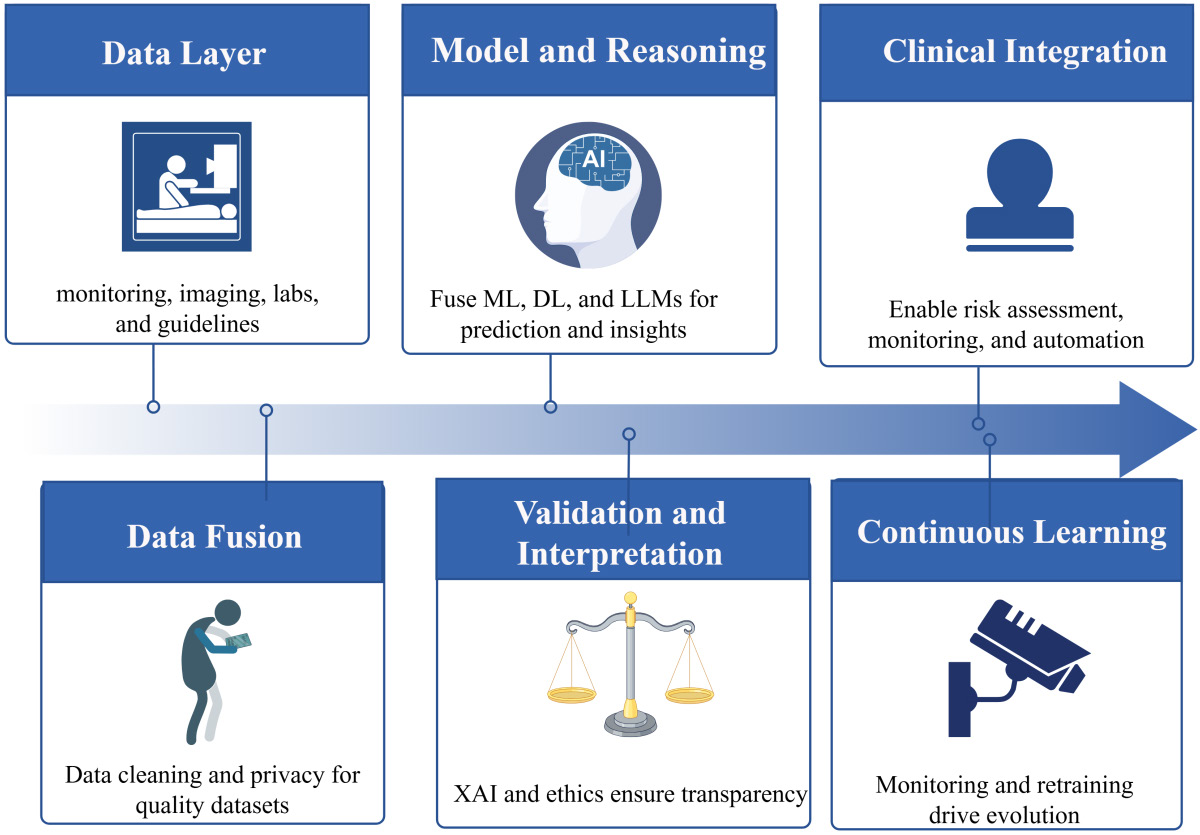
Figure 1. Framework of the Perioperative Intelligent Decision Support System (Created with Biorender). This figure demonstrates the global architecture of the perioperative intelligent decision support system and includes six layers, i.e., data layer, data fusion layer, model and reasoning layer, validation and interpretation layer, clinical integration layer and continuous learning layer. It serves as a platform that merges multimodal data sources from monitoring, imaging, and laboratories to apply ML, deep learning and LLMs for risk prediction and intelligent reasoning. Explainable AI and ethical review processes are embedded to guarantee model transparency and accountability. During clinical integration, the system includes components for risk assessment and automatic decision-making, and incorporates a continuous learning and retraining process for self-optimization of the DSS over time. ML, machine learning; DL, deep learning; LLMs, large language models; XAI, explainable artificial intelligence; DSS, decision support system; AI, artificial intelligence.
4.3 NLP in literature review
NLP enables automated literature screening, topic clustering, and evidence extraction, improving the efficiency and objectivity of systematic reviews. NLP-based living systematic reviews allow real-time updates of emerging evidence. Deep learning models such as BioBERT have shown strong performance in abstract screening, with potential to partially replace manual review processes and improve consistency in systematic reviews [10].
Although big data, AI, and LLMs have shown considerable promise in perioperative decision support, several important challenges remain before these technologies can be widely implemented in routine clinical practice. Current systems still face limitations related to data heterogeneity, model generalizability, interpretability, privacy protection, and ethical governance. In particular, multimodal data integration may increase the risk of privacy leakage and algorithmic bias, highlighting the need for more robust regulatory and technical safeguards.
Future research should focus on several specific directions. First, multicenter prospective studies are needed to validate the performance, robustness, and clinical utility of AI- and LLM-based perioperative decision-support systems across different surgical populations and healthcare settings. Second, more attention should be given to the development of interpretable models that can provide transparent reasoning for risk prediction, treatment recommendation, and intraoperative decision support. Third, privacy-preserving methods, such as differential privacy, federated learning, and secure multiparty computation, should be further integrated into perioperative data platforms to balance data security with model performance. Fourth, future systems should aim to establish closed-loop intelligent frameworks linking preoperative assessment, intraoperative monitoring, and postoperative outcome analysis to support continuous learning and dynamic optimization. In addition, recent studies have suggested that generative AI–assisted clinical systems may improve physicians’ decision-making consistency and efficiency in perioperative care. Overall, the next generation of perioperative intelligent decision-support systems should be developed through close collaboration among clinicians, data scientists, engineers, and ethicists, with the goal of achieving safe, interpretable, and clinically applicable intelligent healthcare systems.
BioBERT, Biomedical Bidirectional Encoder Representations from Transformers; ChatENT, Augmented Large Language Model for Expert Knowledge Retrieval in Otolaryngology-Head and Neck Surgery; EHR, electronic health records; LLM, Large Language Model; LLMs, large language models; ML, Machine Learning.
Author contributions
Di Wang and Shafinah Ahmad Suhaimi contributed to the conception, writing, revision, and final approval of the manuscript. Both authors have read and approved the final version of the manuscript.
Funding
This research received no external funding.
Data availability
Data sharing is not applicable to this article as no datasets were generated or analyzed during the current study. All information is derived from publicly available articles and datasets.
Ethics approval and consent to participate
Not applicable.
Consent for publication
Not applicable.
Competing interests
The authors declare that they have no competing interests.
Acknowledgements
Not applicable.
SUPPLEMENTARY METERIAL
[1] Ayers JW, Poliak A, Dredze M, Leas EC, Zhu Z, Kelley JB, et al. Comparing physician and artificial intelligence chatbot responses to patient questions posted to a public social media forum. JAMA Intern Med. 2023 Jun 1;183(6):589-596. https://doi.org/10.1001/jamainternmed.2023.1838
[2] Tseng PY, Chen YT, Wang CH, Chiu KM, Peng YS, Hsu SP, et al. Prediction of the development of acute kidney injury following cardiac surgery by machine learning. Crit Care. 2020 Jul 31;24(1):478. https://doi.org/10.1186/s13054-020-03179-9
[3] Mendez JA, Leon A, Marrero A, Gonzalez-Cava JM, Reboso JA, Estevez JI, et al. Improving the anesthetic process by a fuzzy rule based medical decision system. Artif Intell Med. 2018 Jan;84:159-170. https://doi.org/10.1016/j.artmed.2017.12.005
[4] Anania G, Mascagni P, Chiozza M, Resta G, Campagnaro A, Pedon S, et al. Deep learning neural network prediction of postoperative complications in patients undergoing laparoscopic right hemicolectomy with or without CME and CVL for colon cancer: insights from SICE (Società Italiana di Chirurgia Endoscopica) CoDIG data. Tech Coloproctol. 2025 Jun 11;29(1):135. https://doi.org/10.1007/s10151-025-03165-9
[5] Wachenbrunner J, Mast M, Böhnke J, Rübsamen N, Bode L, Karch A, et al. A rule-based clinical decision support system for detection of acute kidney injury after pediatric cardiac surgery. Comput Biol Med. 2025 Jul;193:110382. https://doi.org/10.1016/j.compbiomed.2025.110382
[6] Lee J, Kong S, Shin S, Lee G, Kim HK, Shim YM, et al. Wearable device-based intervention for promoting patient physical activity after lung cancer surgery: A nonrandomized clinical trial. JAMA Netw Open. 2024 Sep 3;7(9):e2434180. https://doi.org/10.1001/jamanetworkopen.2024.34180
[7] Si J, Li M, Zhang X, Han R, Ji X, Jiang T. Cerebral tissue oximeter suitable for real-time regional oxygen saturation monitoring in multiple clinical settings. Cogn Neurodyn. 2023 Jun;17(3):563-574. https://doi.org/10.1007/s11571-022-09847-6
[8] Gan W, Ouyang J, She G, Xue Z, Zhu L, Lin A, et al. ChatGPT’s role in alleviating anxiety in total knee arthroplasty consent process: a randomized controlled trial pilot study. Int J Surg. 2025 Mar 1;111(3):2546-2557. https://doi.org/10.1097/js9.0000000000002223
[9] Prabha S, Gomez-Cabello CA, Haider SA, Genovese A, Trabilsy M, Wood NG, et al. Enhancing clinical decision support with adaptive iterative self-query retrieval for retrieval-augmented large language models. Bioengineering (Basel). 2025 Aug 21;12(8):895. https://doi.org/10.3390/bioengineering12080895
[10] Masoumi S, Amirkhani H, Sadeghian N, Shahraz S. Natural language processing (NLP) to facilitate abstract review in medical research: the application of BioBERT to exploring the 20-year use of NLP in medical research. Syst Rev. 2024 Apr 15;13(1):107. https://doi.org/10.1186/s13643-024-02470-y
ISSN: 2957-5443
Volume 4, Issue 1
March 2026
Pages: 1-148


 Log In

 On This Page
 CITE
CITE