 Log In
Search




 Open Access
 ping.zhou@muhn.edu.cn
Ping Zhou, Radiotherapy Department II, Key Laboratory of Emergency and Trauma of Ministry of Education, The First Affiliated Hospital, The First Clinical College, Hainan Medical University, No. 31 Longhua Road, Xinhua District, Haikou 570100, Hainan, China. E-mail: ping.zhou@muhn.edu.cn.
Received December 21, 2025; Accepted March 13, 2026; Published March 31, 2026
Open Accessping.zhou@muhn.edu.cnPing Zhou, Radiotherapy Department II, Key Laboratory of Emergency and Trauma of Ministry of Education, The First Affiliated Hospital, The First Clinical College, Hainan Medical University, No. 31 Longhua Road, Xinhua District, Haikou 570100, Hainan, China. E-mail: ping.zhou@muhn.edu.cn.
Received December 21, 2025; Accepted March 13, 2026; Published March 31, 2026
Emergency surgery anesthesia is performed in an extremely time-critical and high-risk setting, where delayed or inaccurate assessment may lead to severe perioperative complications. Patients often present with hemodynamic instability, limited preoperative information, and complex comorbidities, creating major challenges for anesthesiologists to rapidly evaluate airway, circulation, and physiological reserve. Although multiple assessment tools exist, conventional approaches remain fragmented and insufficient for dynamic, real-time decision-making in emergency contexts. There is a clear need for an integrated rapid anesthesia assessment framework that combines advanced monitoring, intelligent decision support, and team-based coordination. This perspective article systematically analyzes rapid assessment models that integrate multimodal point-of-care ultrasound, artificial intelligence–assisted regulation, and closed-loop clinical decision support system (CDSS) protocols. Key applications in perioperative airway management, hemodynamic and respiratory assessment, and risk stratification for special populations, including elderly and pediatric patients, are discussed. We further summarize the rapid titration and hemodynamic advantages of novel anesthetic agents in emergency induction, the role of CDSS and closed-loop communication in clinical emergency management, and the optimization of team collaboration using standardized tools such as Situation–Background–Assessment–Recommendation. Ethical and legal considerations, including informed consent, presumed consent, and proxy decision-making in time-sensitive scenarios, are also addressed. Overall, integrated rapid assessment strategies supported by technology, interdisciplinary teamwork, and ethical safeguards may substantially enhance the safety, efficiency, and clinical outcomes of anesthesia management in emergency surgery, providing a practical framework for future perioperative practice and multicenter validation.
Keywords: Emergency surgery anesthesia, Rapid assessment, Clinical emergency management, Point-of-care ultrasound, Decision support systems, Team collaboration
Emergency surgery is often performed under extreme time pressure and marked physiological uncertainty, making it a high-stakes environment for anesthesiologists. Patients frequently present with hemodynamic instability, limited preoperative data, and multiple comorbidities, all of which require anesthesiologists to make rapid yet accurate decisions. While airway predictors such as Modified Mallampati Grading and ultrasound-based measurements (e.g., skin-to-hyoid and skin-to-thyroid distances) are commonly used in elective surgeries, their routine application in emergency settings is often impractical due to time constraints and the urgency of the situation [1].
In these high-pressure conditions, effective anesthesia management depends not only on individual expertise but also on strong interdisciplinary coordination. However, communication barriers, cognitive conflicts, hierarchical structures, and resource constraints frequently undermine team performance. Delays or failures in anesthesia induction, airway control, or circulatory stabilization can lead to catastrophic outcomes, underscoring the critical need for efficient and precise management in emergency scenarios. Consequently, emergency anesthesia assessment must prioritize speed, accuracy, adaptability, and continuous reassessment, which are essential for supporting safe perioperative decision-making.
A key component of emergency anesthesia assessment is the rapid identification of high-risk conditions, including airway compromise, circulatory failure, and the loss of respiratory or metabolic reserve. A persistent imbalance between oxygen delivery and consumption may lead to oxygen debt, a condition strongly associated with adverse perioperative outcomes [2]. Early recognition of these risks allows anesthesiologists to tailor anesthesia plans to the individual patient's needs and ensure timely intervention.
Recent advances in monitoring technologies have significantly enhanced the scope of emergency anesthesia assessment. For instance, quantitative electroencephalography can be used to estimate anesthetic depth in neonates, and burst suppression patterns can indicate global cerebral dysfunction [3]. Additionally, bedside ultrasound provides a rapid, noninvasive means of evaluating cardiopulmonary function. When combined with artificial intelligence (AI)-assisted decision-support systems that integrate dynamic physiological data and risk stratification, these technologies improve real-time clinical judgment, further enhancing the safety and efficacy of emergency anesthesia management.
2.1 Rapid assessment models and tools
Conventional assessment methods are often insufficient in emergency surgery due to rapidly evolving clinical conditions. Integrated rapid assessment models combine multimodal monitoring to support timely decision-making. The X-Porte ultrasound system enables multi-angle lung ultrasound to assess pulmonary status and detect atelectasis or pulmonary edema at the bedside. Portable gastric ultrasound using the Perlas method estimates gastric volume and aspiration risk through measurement of gastric cross-sectional area.
Cardiac function and volume status can be evaluated using phased-array and convex probes, while vascular access and vessel patency are assessed with high-frequency linear probes. The DoCare Anesthesia Clinical Information System (Ver5.0) integrates hemodynamic and hemorheological data from positive-pressure blood flow systems, allowing continuous monitoring and trend analysis [4]. Collectively, these tools improve perioperative safety.
2.2 Heart function and respiratory status assessment strategies
Rapid assessment of cardiopulmonary function is critical for determining anesthetic safety. Continuous monitoring of systolic blood pressure, diastolic blood pressure, mean arterial pressure, heart rate, and oxygenation provides an initial evaluation of circulatory and respiratory status. Airway risk assessment can be refined by integrating anatomical features, airway scores, and medical history.
Ventilation effectiveness is evaluated using tidal volume measurements during initial mask ventilation attempts, followed by continuous monitoring of CO₂ waveforms after airway device placement. Classification of waveform patterns (V1-V3) assists in validating ventilation quality and detecting airway obstruction [5]. This structured approach reduces perioperative risk and supports evidence-based anesthesia management.
2.3 Innovations in assessment for special populations (e.g., elderly, children)
Elderly patients exhibit reduced physiological reserve and altered pharmacokinetics, necessitating careful assessment of cardiovascular, respiratory, and renal function. Cognitive and psychological status can be evaluated using tools such as the 3-Minute Diagnostic Interview for Confusion Assessment Method, the Mini-Mental State Examination, and the Hospital Anxiety and Depression Scale, combined with hemodynamic monitoring to optimize perioperative management [6].
Pediatric emergency anesthesia is complicated by higher heart rates, lower blood pressure, and immature autonomic regulation. Novel anesthetic depth monitors enable continuous assessment of oxygenation and peripheral perfusion, contributing to safer and more precise anesthesia control in time-limited settings.
3.1 Application of rapid decision support systems
Clinical decision support systems (CDSS) integrate patient history and real-time physiological data to enhance anesthesia assessment. Models incorporating age, Mallampati score, and respiratory indices can predict difficult mask ventilation. Continuous monitoring of vital signs enables early detection of instability and timely intervention.
Advanced CDSS platforms further employ end-tidal carbon dioxide–based algorithms to estimate arterial carbon dioxide levels, improving ventilation management [7]. Closed-loop systems integrate data acquisition, risk prediction, and feedback mechanisms, enabling dynamic adjustment of anesthesia strategies. These technologies enhance interdisciplinary collaboration and support complex decision-making in emergency settings (see Figure 1).

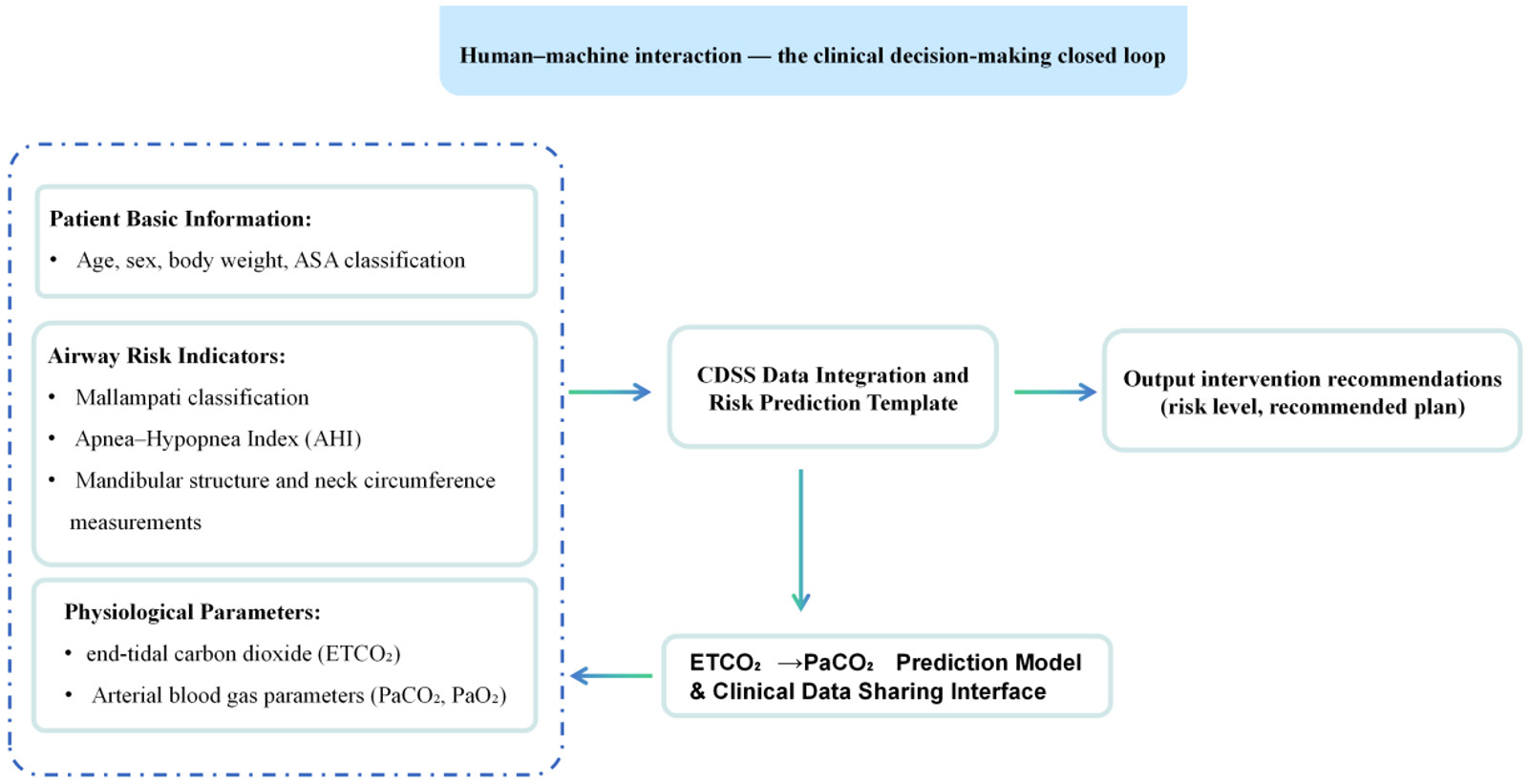
Figure 1. Human-machine interaction–clinical decision making feedback loop. This interface incorporates basic patient information (age, sex, weight, ASA grade), airway risk score (Mallampati classification and disease anatomic profile comprising the AHI, mandibular length, and neck circumference measurements), and physiological data: ETCO₂, arterial blood gas parameters including PaCO₂ and PaO₂. Once data have been entered into the CDSS integration database and risk prediction template, recommendations (risk category and recommended action) are produced. Feedback updates are realized through the ETCO₂–PaCO₂ prediction model and clinical presenting interface, constituting an intelligent clinical decision-making feedback cycle. ASA, American Society of Anesthesiologists; AHI, Apnea-Hypopnea Index; ETCO₂, end-tidal carbon dioxide; PaCO₂, partial pressure of arterial carbon dioxide; PaO₂, partial pressure of arterial oxygen; CDSS, clinical decision support system.
3.2 The rapid application and adjustment of novel anesthetic drugs
In emergency surgery, rapid titration and hemodynamic stability are essential. Newer anesthetic agents such as ciprofol demonstrate reduced cardiovascular variability and allow precise control of sedation depth. The use of intranasal or intravenous dexmedetomidine in combination regimens offers stable hemodynamics and improved recovery profiles in short or high-risk procedures [8]. These agents represent important advances in emergency anesthesia pharmacology. Supplementary Table 1 provides a comprehensive comparative analysis of various anesthetic drugs.
3.3 Optimization of team collaboration and communication in emergency situations
Effective teamwork is fundamental to emergency anesthesia management. Closed-loop communication improves task execution and reduces errors, particularly in high-stress environments. Standardized communication tools such as Situation–Background–Assessment–Recommendation provide a structured framework for information exchange among anesthesiologists, surgeons, and nursing staff. Situation–Background–Assessment–Recommendation enhances clarity, reduces miscommunication, and supports rapid decision-making. Inter-disciplinary simulation training further strengthens team coordination and protocol adherence [9].
4.1 Informed consent and patient rights in emergency situations
Emergency anesthesia frequently involves patients without decision-making capacity, particularly during airway emergencies. When immediate intervention is required to prevent harm, presumed consent may be ethically justified. In such cases, clinicians should document clinical urgency and decision rationale while involving proxy decision-makers whenever feasible [10].
4.2 Legal responsibility and protection of healthcare workers
During emergency airway management, anesthesiologists must balance rapid action with respect for patient autonomy. Practical strategies include brief verbal explanations, proxy consent from family members, and post-event disclosure once the patient stabilizes. Hospitals should establish clear protocols for presumed consent and proxy decision-making to enhance transparency and legal protection [11].
4.3 Ethical conflicts and solutions in emergency decision-making
Ethical decision-making should emphasize beneficence, proportionality, and team-based judgment. Structured documentation and institutional support systems are essential to protect both patient rights and healthcare providers in high-risk scenarios [12].
This perspective article synthesizes current evidence on rapid anesthesia assessment and clinical emergency management, emphasizing the integration of bedside ultrasound, AI-assisted monitoring, and CDSS-based decision support. These technologies collectively address the limitations of fragmented traditional assessments and enable real-time, patient-specific risk stratification.
Despite promising advances, several limitations remain. Most integrated assessment models lack large-scale clinical validation, and evidence is often derived from single-center or observational studies. Interoperability between monitoring systems and CDSS platforms also remains a technical challenge. Furthermore, the implementation of AI-driven tools requires clinician training and institutional support to avoid overreliance on automated recommendations.
Future research should prioritize multicenter prospective studies to evaluate clinical outcomes, cost-effectiveness, and workflow integration. Standardized protocols combining technology, pharmacological innovation, and team communication are needed to ensure reproducibility and scalability.
In conclusion, rapid anesthesia assessment supported by technological integration, interdisciplinary collaboration, and ethical safeguards represents a transformative approach to emergency surgery. With continued validation and refinement, intelligent anesthesia decision-making systems may become a cornerstone of safe and effective emergency perioperative care.
Author contributions
Songxiao Yang contributed to the conception and design of the study, data collection, analysis, and interpretation, and was responsible for drafting the manuscript; and Ping Zhou revised it critically for important intellectual content.
Funding
This project was supported by the National Natural Science Foundation of China [82260474, 82303935], the Hainan Province Key Research and Development Program [ZDYF2022SHFZ132, ZDYF2024SHFZ045], and the Hainan Province Clinical Medical Center Construction Project.
Data availability
Data sharing is not applicable to this article as no datasets were generated or analyzed during the current study. All information is derived from publicly available articles and datasets.
Ethics approval and consent to participate
Not applicable.
Consent for publication
Not applicable.
Competing interests
The authors declare that they have no competing interests.
Acknowledgements
Not applicable.
SUPPLEMENTARY METERIAL
[1] Harjai M, Alam S, Rastogi S, Kumar S. Effectiveness and validity of preoperative ultrasonographic airway assessment and clinical screening tests to predict difficult laryngoscopy: A prospective, observational study. Cureus. 2023 Jul;15(7):e41933. https://doi.org/10.7759/cureus.41933
[2] Papagiannakis N, Ragias D, Ntalarizou N, Laou E, Kyriakaki A, Mavridis T, et al. Transitions from aerobic to anaerobic metabolism and oxygen debt during elective major and emergency non-cardiac surgery. Biomedicines. 2024 Aug 5;12(8):1754. https://doi.org/10.3390/biomedicines12081754
[3] Kumar R, Skowno J, von Ungern-Sternberg BS, Davidson A, Xu T, Zhang J, et al. Quantitative electroencephalogram and machine learning to predict expired sevoflurane concentration in infants. J Clin Monit Comput. 2025 Oct;39(5):999-1014. https://doi.org/10.1007/s10877-025-01301-2
[4] Liu D, Chen K, Yao Y, Sun J. A randomized controlled trial of bedside ultrasound RUSH process to improve the quality of anesthesia for elderly emergency surgery patients. Pak J Med Sci. 2022 Jul-Aug;38(6):1696-1702. https://doi.org/10.12669/pjms.38.6.5104
[5] Sato S, Hasegawa M, Okuyama M, Okazaki J, Kitamura Y, Sato Y, et al. Mask ventilation during induction of general anesthesia: Influences of obstructive sleep apnea. Anesthesiology. 2017 Jan;126(1):28-38. https://doi.org/10.1097/aln.0000000000001407
[6] Zhang Y, Chen R, Tang S, Sun T, Yu Y, Shi R, et al. Diurnal variation of postoperative delirium in elderly patients undergoing esketamine anesthesia for elective noncardiac surgery: A randomized clinical trial. Int J Surg. 2024 Sep 1;110(9):5496-5504. https://doi.org/10.1097/js9.0000000000001642
[7] Lee AR, Lee JH, Yoo S, Lee HY, Kim HH. Real-time estima-tion of arterial partial pressure of carbon dioxide in patients undergoing general anesthesia: Predictive modeling study. JMIR Med Inform. 2025 Sep 16;13:e64855. https://doi.org/10.2196/64855
[8] Li Y, Yuan M, Zhang P, Zhou T, Zhang M, Xu J. Efficacy and safety of ciprofol for anesthesia in painless colonoscopy with varying body mass indices patients: A prospective, single-center, observational study. Drug Des Devel Ther. 2025 Jan 3;19:1-9. https://doi.org/10.2147/DDDT.S496783
[9] Greer JA, Lutgendorf MA, Ennen CS, Van Petten L, Modzik A, Salas D, et al. Obstetric simulation training and teamwork: Immediate impact on knowledge, teamwork, and adherence to hemorrhage protocols. Simul Healthc. 2023 Feb 1;18(1):32-41. https://doi.org/10.1097/sih.0000000000000641
[10] Long KL, Ingraham AM, Wendt EM, Saucke MC, Balentine C, Orne J, et al. Informed consent and informed decision-making in high-risk surgery: A quantitative analysis. J Am Coll Surg. 2021 Sep;233(3):337-345. https://doi.org/10.1016/j.jamcollsurg.2021.05.029
[11] Nanu CA, Plaiasu MC, Edu A. Geographic and specialty-specific disparities in physicians' legal compliance: A national-scale assessment of romanian medical practice. Healthcare (Basel). 2023 Feb 8;11(4):499. https://doi.org/10.3390/healthcare11040499
[12] Kebede E, Tasew T, Worku D. Surgical informed consent in clinical practice: Patients' perspective undergoing cesarean section at three teaching hospitals in Addis Ababa, Ethiopia. Ethiop J Health Sci. 2023 Jul;33(4):671-680. https://doi.org/10.4314/ejhs.v33i4.13
ISSN: 2957-5443
Volume 4, Issue 1
March 2026
Pages: 1-148


 Log In

 On This Page
 CITE
CITE