 Log In
Search




 Open Access
 xjj1099@shchest.org
Jinjing Xia, Shanghai Chest Hospital, Shanghai Jiao Tong University School of Medicine, No. 241 Huaihai West Road, Xuhui District, Shanghai 200030, China. E-mail: xjj1099@shchest.org.
Received October 27, 2025; Accepted December 4, 2025; Published March 31, 2026
Open Accessxjj1099@shchest.orgJinjing Xia, Shanghai Chest Hospital, Shanghai Jiao Tong University School of Medicine, No. 241 Huaihai West Road, Xuhui District, Shanghai 200030, China. E-mail: xjj1099@shchest.org.
Received October 27, 2025; Accepted December 4, 2025; Published March 31, 2026
Fractional exhaled nitric oxide (FeNO) is a simple, sensitive and non-invasive marker that can monitor eosinophilic airway inflammation. Its levels are influenced by height, weight, gender, ethnicity and smoking status. FeNO was first introduced as a biomarker to assist in asthma detection, and now plays an important auxiliary role in its diagnosis, management, and prognosis evaluation, including treatment guidance and drug efficacy assessment. With continuous exploration, exhaled nitric oxide has demonstrated utility in a variety of respiratory diseases, including chronic obstructive pulmonary disease, chronic cough and interstitial lung disease. It can also serve as a biomarker after lung surgery to indicate the risk of postoperative complications and impaired lung function. This article summarizes the clinical value of exhaled nitric oxide in common pulmonary diseases, aiming to provide a reference for its clinical application.
Keywords: Fractional exhaled nitric oxide, Asthma, Interstitial lung disease, Postoperative recovery, Clinical application
Fractional exhaled nitric oxide (FeNO) is a non-invasive biomarker generated by the airway epithelium and pulmonary parenchyma. Its concentration closely correlates with type-2 inflammation, reflects eosinophilic airway inflammation and airway hyper-responsiveness (AHR), and plays a pivotal role
in the pathophysiology of airway inflammatory diseases [1]. In recent years, FeNO has emerged as a non-invasive and highly sensitive biomarker, with its clinical utility in respiratory diseases being increasingly recognized. This review synthesizes the current evidence on the value of FeNO in common pulmonary disorders and aims to provide evidence-based recommendations for the diagnosis and management of these conditions.
2.1 Mechanisms of nitric oxide (NO) generation and its biological significance
FeNO measurement quantifies the NO concentration in exhaled breath, thereby providing an objective estimate of airway inflammation. It is particularly applicable to type-2 inflammation driven by T-helper-2 cells and their downstream cytokines. During eosinophilic airway inflammation, inducible nitric oxide synthase (iNOS) is markedly up-regulated, resulting in elevated FeNO levels and establishing FeNO as an internationally recognized biomarker of type-2 airway inflammation. Beyond reflecting inflammatory activity, FeNO reliably predicts the therapeutic response to inhaled corticosteroids (ICS) and to biologics targeting the type-2 inflammatory pathway. Non-invasive and easy to perform, FeNO testing has become a routine tool for diagnosis, phenotyping, and management of respiratory diseases—especially asthma [2].
2.2 Determinants
Determinants of FeNO can be broadly classified into short-term and long-term influences (Figure 1).
Short-term determinants
The ingestion of nitrite-rich foods, alcohol, or caffeine produces transient changes in FeNO within 3 h. Nitrite is rapidly reduced to NO by oral commensal bacteria, leading to an acute rise in exhaled NO. By contrast, both alcohol and caffeine down-regulate iNOS activity, causing a brief fall in FeNO.
Long-term determinants
Demographic variables: FeNO increases with age and height, particularly in males, and exhibits significant inter-ethnic variation [3].
Tobacco and vaping: Cigarette smoking lowers FeNO in a dose-dependent manner [4]. The high NO concentration in smoke induces negative-feedback inhibition of iNOS, thereby reducing endogenous NO production. Consequently, the FeNO cut-offs that yield 90% specificity or 90% sensitivity are approximately 30% lower in current or former smokers than in never-smokers [5].
Biphasic effect of electronic cigarettes: Rizik et al. reported an acute fall in FeNO (median 11 parts per billion [ppb] vs 9.7 ppb, p=0.024) 30 min after a single vaping session in healthy volunteers, whereas Sompa et al. observed higher FeNO in chronic users (median 11 ppb vs 14 ppb, p=0.04), a finding consistent with airway inflammation after prolonged exposure [6, 7].
Perennial allergens: Long-term sensitisation, distinct from seasonal exposure, markedly elevates FeNO. Two large Swedish prospective cohorts—one in adults and one in adolescents—demonstrated significant increases in FeNO in individuals sensitised to animal dander, house-dust mite, or pollen, underscoring the need to consider allergen exposure when interpreting FeNO values [8, 9].

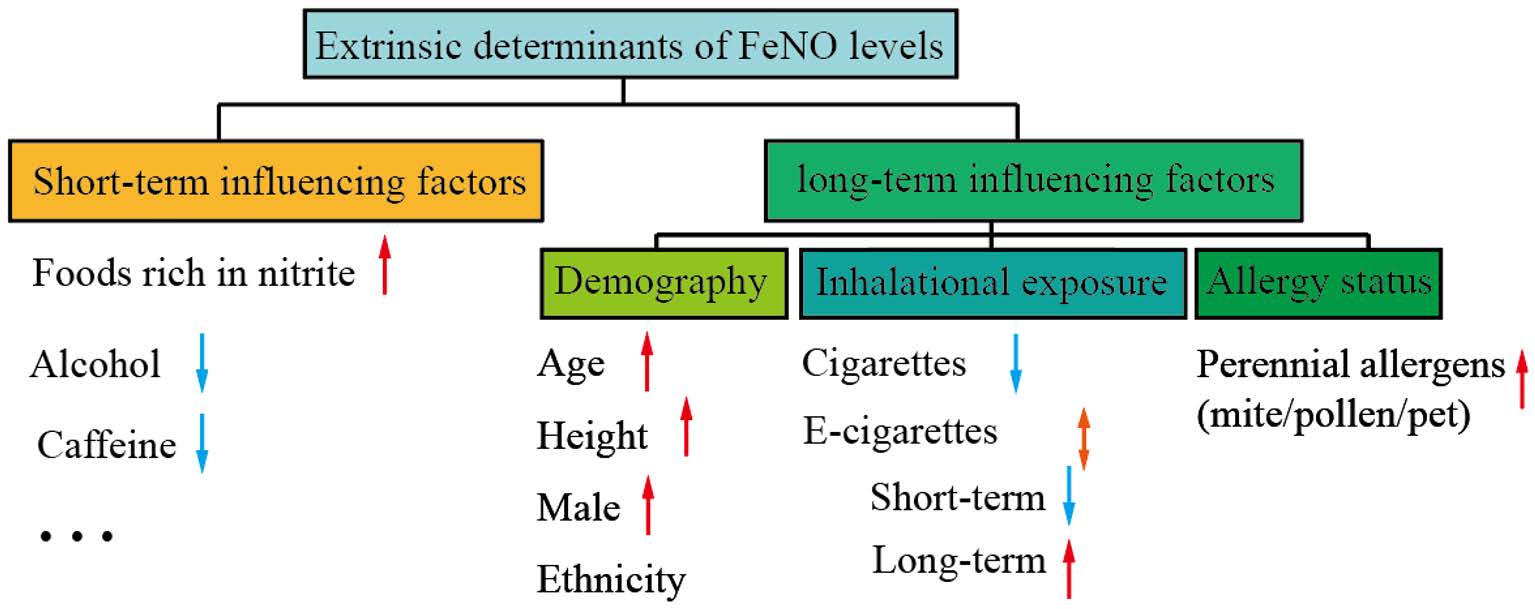
Figure 1. Determinants of FeNO. Short-term determinants: nitrite-rich foods acutely raise FeNO, whereas alcohol and caffeine transiently reduce it; long-term determinants: advancing age, greater height, male sex, chronic e-cigarette use and perennial allergen sensitization in crease FeNO; conversely, cigarette smoking and short-term vaping lower FeNO. FeNO, Fractional exhaled Nitric Oxide.
2.3 Clinical interpretation criteria for FeNO
The American Thoracic Society and the European Respiratory Society have established technical standards for FeNO measurement: The subject is required to exhale into the analyzer at a constant flow rate of 50 mL/s for at least 6 seconds if they are adolescents or adults (≥12 years), and for at least 4 seconds if they are children (<12 years). The results from repeated maneuvers are averaged and expressed in ppb. Reference ranges are 5-20 ppb for children and 5-25 ppb for adults [10].
Building on these standards, the 2017 European Respiratory Society guidelines further refined the assessment of NO from different airway compartments by specifying protocols for:
Concentration of alveolar exhaled nitric oxide (CaNO).
Fractional exhaled nitric oxide at an expiratory flow rate of 200 mL/s (FeNO 200).
Fractional nasally exhaled nitric oxide (FnNO).
These additions enable a comprehensive evaluation of both central and peripheral airway inflammation.
3.1 FeNO in bronchial asthma
3.1.1 FeNO and the pathobiology of asthma
Bronchial asthma is a chronic respiratory disease characterised by airway inflammation, AHR and remodelling. Type-2 inflammation is driven by interleukin (IL)-4, IL-5 and IL-13 released from T-helper 2 cells and group 2 innate lymphoid cells, resulting in eosinophilic infiltration, goblet-cell hyperplasia, AHR and IgE synthesis [11]. Type-2 airway inflammation is present even when symptoms are quiescent [12]. Pulmonary-function indices reflect airflow limitation but correlate weakly with the intensity of airway inflammation; consequently, a practical, non-invasive marker of active inflammation is required [13, 14].
FeNO is produced by nitric-oxide synthase (NOS)-2 induced by Type-2 cytokines. Compared with other Type-2 biomarkers (blood eosinophils, total IgE, periostin), FeNO is non-invasive, repeatable and obtainable even in patients with severe airflow obstruction [15]. FeNO correlates closely with sputum eosinophilia and methacholine AHR, and is recommended by Global Initiative for Asthma and Global Initiative for Chronic Obstructive Lung Disease to discriminate asthma from chronic obstructive pulmonary disease (COPD) [16-18]. Limitations must, however, be recognised: non-Type-2 asthma is accompanied by normal FeNO values, and overlap exists between asthmatic and healthy populations. A high FeNO increases the probability of asthma, but a low FeNO does not exclude it. The value of FeNO in asthma is summarized in Table 1.
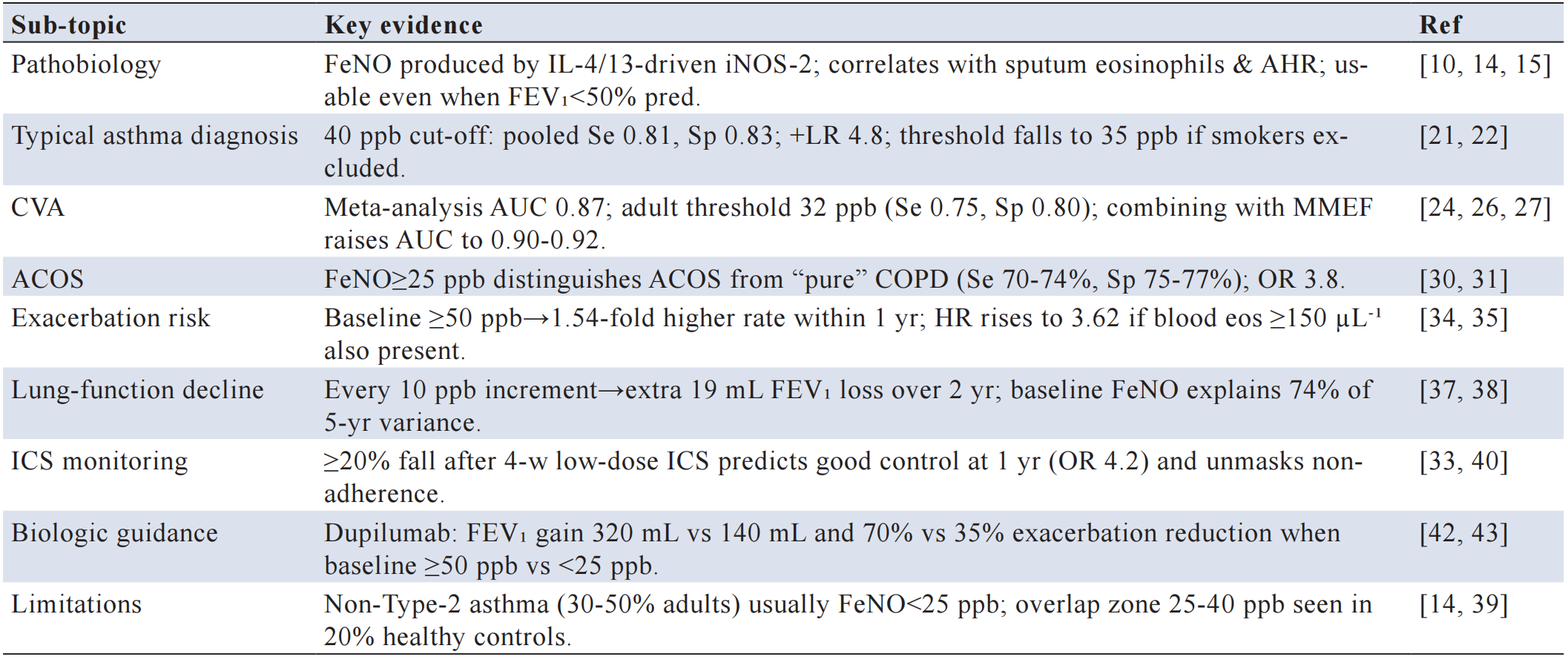
Note: CVA, Cough-Variant Asthma; ACOS, Asthma–COPD Overlap Syndrome; AHR, Airway Hyperresponsiveness; AUC, Area Under the Curve; COPD, Chronic Obstructive Pulmonary Disease; Eos, Eosinophils; FEV₁, Forced Expiratory Volume in the first second; HR, Hazard Ratio; ICS, Inhaled Corticosteroid(s); IL-4/13, Interleukin-4/Interleukin-13; iNOS-2, Inducible Nitric Oxide Synthase 2; LR, Likelihood Ratio; MMEF, Maximal Mid-Expiratory Flow; OR, Odds Ratio; Pred., Predicted (value); SE, Sensitivity; SP, Specificity.
3.1.2 FeNO in phenotyping and differential diagnosis
3.1.2.1 Bronchial asthma
Meta-analyses indicate moderate diagnostic accuracy for asthma [19]. In adults, an FeNO cut-off of 40 ppb yields sensitivities of 74-88% and specificities of 72-83% [20]. FeNO has been shown to correlate with exacerbation frequency and can therefore be used to supplement spirometry during initial evaluation.
3.1.2.2 Cough-variant asthma (CVA)
CVA is characterised by small-airway dysfunction without overt airflow limitation [21]. A research (nine studies, 1,046 patients) found an area under the curve (AUC) of 0.87 for FeNO [22]. Paediatric thresholds range from 28.5 ppb (sensitivity 61%, specificity 83%) to 39.8 ppb (sensitivity 77%, specificity 68%) [11]. Combining FeNO with small-airway indices (maximal mid-expiratory flow, mid-expiratory flow at 25-75% of forced vital capacity, forced expiratory flow at 25% of forced vital capacity [FEF25%], the difference between resistance at 5 Hz and 20 Hz, and reactance at 5 Hz) raises the AUC to 0.90-0.92 and significantly reduces false-negative results [23-25].
3.1.2.3 Asthma–COPD overlap syndrome (ACOS)
ACOS exhibits features of both diseases. In elderly patients with chronic airway symptoms, FeNO distinguishes ACOS from “pure” COPD [26]. Two prospective studies identified optimal thresholds of 22.5 ppb and 25.5 ppb (sensitivity 70-74%, specificity 75-77%) [27, 28]. An FeNO cut-off of 27 ppb was recorded in 83% of ACOS patients versus 52% of COPD patients and 21% of controls (p<0.01), without significant difference from the asthma group (88.6%) [15].
3.1.3 FeNO-guided prognosis
Longitudinal cohort studies have shown that FeNO falls progressively during the first 12 months of guideline-based asthma therapy, mirroring the waning of airway inflammation [29]. In the BUSSE cohort (n=1,026 moderate-to-severe asthma), patients with baseline FeNO≥50 ppb experienced a 1.54-fold higher exacerbation rate over the following year than those with FeNO<25 ppb; the hazard ratio was 1.33 for the intermediate group (25-50 ppb) [30]. When FeNO≥25 ppb was combined with peripheral-blood eosinophils ≥150 cells cells/µL, the exacerbation risk rose to 3.62-fold relative to patients with both values below these cut-points [31]. In head-to-head comparisons, FeNO outperformed blood eosinophils and serum periostin as a predictor of future exacerbations [32].
Elevated FeNO is also associated with accelerated forced expiratory volume in the 1st second (FEV₁) decline. In the 3751-patient PORSBJERG cohort, FeNO alone explained 74.3% of the variance in five-year FEV₁ loss; adding blood eosinophils marginally improved the model (adjusted R²=0.751) [33]. Similarly, Nerpin et al. reported that every 10-ppb increment in FeNO was linked to an additional 19 mL decline in FEV₁ over two years [34].
Cross-sectional data, however, do not support the use of FeNO to grade current clinical severity. Naranjo-Vallejo found no difference in mean FeNO between Global Initiative for Asthma-defined mild (62.7 ppb) and moderate (54.8 ppb) asthma, and no correlation with Asthma Control Test scores [35].
Collectively, these data indicate that—while a raised FeNO forecasts future exacerbations and lung-function decline—it cannot standalone stratify current symptom severity and should be interpreted alongside other biomarkers.
3.1.4 FeNO for monitoring pharmacotherapy
ICS suppress Type-2 airway inflammation and rapidly reduce FeNO. A ≥20% fall in FeNO after 4 weeks of low-dose ICS predicts good long-term control and adherence [36]. The Scottish Consensus advocates a “FeNO-suppression test” (repeat measurement after 4 weeks ICS) to uncover non-adherence or incorrect inhaler technique [37].
Baseline FeNO is a continuous modifier of ICS responsiveness: the higher the pretreatment value, the greater the clinical and anti-inflammatory gain. A meta-analysis of six ICS trials in COPD showed a mean ~6.3 ppb reduction in FeNO overall, but a reduction of -14.6 ppb in the subgroup with baseline FeNO≥25 ppb [38].
FeNO is equally useful when biologics are introduced. In a real-world study of 30 severe asthma patients receiving tezepelumab, median FeNO fell from 35 ppb to 19 ppb by 24 weeks, concomitant with improved FEV₁ and reduced exacerbations [39]. For dupilumab, the greatest FEV₁ gain (~320 mL) and exacerbation reduction were observed when baseline FeNO exceeded 50 ppb, although benefit was already evident above 20 ppb [40].
Thus, FeNO serves as a dynamic read-out of both ICS and biologic efficacy, and can guide escalation or de-escalation decisions within a treatable-traits framework.
3.2 Inflammatory assessment in COPD
COPD is a prevalent obstructive lung disorder that affects approximately 300 million people worldwide [41]. The pathological spectrum comprises obstructive bronchiolitis, emphysema, or a combination of both, with the small airways and lung parenchyma representing major sites of inflammation [42, 43].
Early investigations suggested an association between COPD and elevated exhaled NO; however, subsequent studies have challenged this view. Lehouck et al. observed that multiple-flow exhaled NO measurements did not discriminate COPD among 151 current or former smokers, and Bazeghi et al. questioned the utility of FeNO as a marker of local COPD-related inflammation [44-46]. A plausible explanation is that early-stage COPD generates a localized inflammatory milieu that fails to up-regulate iNOS, thereby leaving FeNO unchanged.
Nevertheless, a high FeNO value constitutes an independent risk factor for incident COPD [47]. During acute exacerbations, intensified and disseminated airway inflammation can raise FeNO, providing a window on disease severity. In a two-year longitudinal cohort, Högman et al. demonstrated that persistently abnormal FeNO was associated with significantly lower lung function and more extensive airway obstruction/destruction [48]. Similarly, Romero-Linares reported that patients with elevated FeNO exhibited markedly reduced survival and a three-fold higher risk of moderate-to-severe exacerbations (HR 3.01, 95% CI 1.83-4.93; p<0.001) [49].
Collectively, these data indicate that while FeNO is not elevated in all COPD patients, chronically increased FeNO identifies a distinct inflammatory phenotype characterized by accelerated lung-function decline and adverse clinical outcomes. This discrepancy may stem from the heterogeneous inflammatory profiles observed in COPD, which encompass macrophagic, neutrophilic, eosinophilic, T-cell- and B-cell-driven patterns in varying combinations. As reported by David et al., only 20-40% of patients exhibit a type-2 inflammatory endotype characterized by elevated airway eosinophils [50]. The precise mechanisms underlying type-2 inflammation in COPD remain elusive; nevertheless, this endotype is more prevalent during acute exacerbations [51]. Consequently, elevated FeNO appears to be a discriminative biomarker specifically in acute exacerbations of COPD (AECOPD) rather than in stable disease, underscoring its potential as a prognostic biomarker in COPD management (Figure 2).
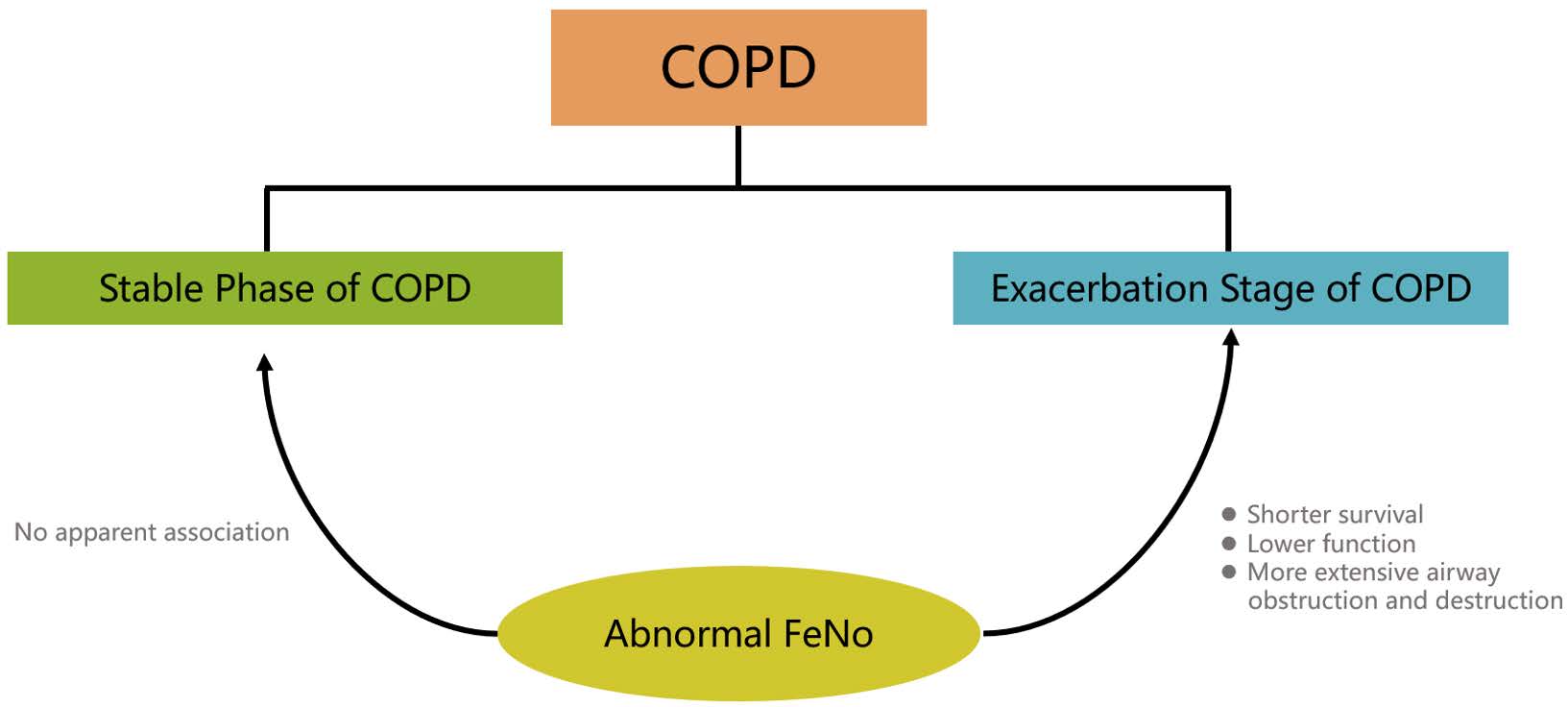
Figure 2. Utility of FeNO in COPD. Abnormal FeNO exerts no significant influence on patients with stable COPD; however, during acute exacerbations, it is associated with shortened survival, lower lung function, and more extensive airway obstruction and destruction. FeNO, Fractional exhaled Nitric Oxide; COPD, Chronic Obstructive Pulmonary Disease.
3.3 Application of FeNO in the differential diagnosis of chronic cough
Chronic cough is defined as cough lasting more than 8 weeks in adults. The most common aetiologies in adults are upper-airway cough syndrome, CVA, eosinophilic bronchitis (EB), and gastro-oesophageal reflux-related cough (GERC) [52]. CVA has been detailed in Section 3.1.3 and is not repeated here.
Experimental data indicate that eosinophil-derived airway hyper-innervation, stimulation of vagal C-fibres, and the interaction between major basic protein and the TRPV1 receptor may contribute to chronic cough. FeNO, reflecting airway eosinophilic inflammation, has therefore been investigated as a non-invasive tool for identifying the underlying cause and predicting cough severity [53]. Beck et al. reported a positive correlation between FeNO and mucus-plug scores [54].
EB is characterised by irritative dry cough or scanty sputum, with a sputum eosinophil count ≥2.5%. Ninety percent of EB patients exhibit elevated FeNO, and serial FeNO measurements track airway inflammation and forecast responsiveness to ICS [55].
GERC is another major cause of chronic cough, presumably via reflux-mediated activation of the oesophago-bronchial vagal pathway or micro-aspiration into the upper airways. Recent work showed that proximal-airway nitric oxide (CaNO) is significantly higher in GERC patients; higher CaNO values were associated with more frequent proximal reflux episodes and elevated pepsin levels in induced-sputum supernatants. Furthermore, CaNO exhibited moderate predictive value for the efficacy of intensive anti-reflux therapy; after a course of treatment, CaNO declined in parallel with cough resolution, suggesting that CaNO may serve as a non-invasive biomarker of peripheral-airway inflammation in GERC [56].
In summary, FeNO has demonstrated modest utility in the diagnosis and prognosis of selected chronic-cough phenotypes; however, large-scale studies investigating its pathogenic mechanisms and discriminative value across the major chronic-cough subtypes are still lacking and should be the focus of future research.
3.4 FeNO in interstitial lung diseases (ILDs)
3.4.1 CaNO overview
CaNO, a sub-fraction of exhaled NO obtained at low expiratory flow rates, is a simple and non-invasive index of small-airway dysfunction. At a cut-off of 5.3 ppb, CaNO predicts small-airway impairment with 72% sensitivity and 92% specificity [57]. ILDs comprise a heterogeneous group of diffuse parenchymal disorders associated with high morbidity and mortality [58]. The current classification distinguishes major, rare and unclassifiable entities, each encompassing numerous disorders. To date, most NO-ILD research has focused on two prototypic disorders: systemic-sclerosis-related ILD (SSc-ILD) and idiopathic pulmonary fibrosis (IPF). The following sections summarize the evidence for CaNO in these conditions.
3.4.2 SSc-ILD
Systemic sclerosis (SSc) is a heterogeneous connective-tissue disease in which ILD represents the leading cause of death [59, 60]. Early studies documented abnormally elevated CaNO in patients with SSc-ILD [61]. Building on this observation, Tiev et al. proposed CaNO as a diagnostic biomarker, reporting a threshold of 4.3 ppb (sensitivity 87%, specificity 59%) for detecting SSc-ILD [62].
Subsequent work has explored CaNO for monitoring disease trajectory. CaNO accurately identifies patients at risk of clinical deterioration; levels correlate directly with ILD extent and inversely with diffusing capacity for carbon monoxide, although associations with overall lung function remain inconsistent [61, 63]. According to the 2020 European consensus on SSc-ILD, high-resolution computed tomography (HRCT) is the reference standard [60]. Hoang-Duc demonstrated that changes in HRCT scores (ΔWarrick and ΔGoldin) correlated strongly with ΔCaNO (R=0.783, p<0.01), and combining CaNO with HRCT improved diagnostic accuracy [64]. Collectively, elevated CaNO reflects greater pulmonary involvement and may track SSc-ILD progression.
Notably, Wuttge observed no difference in CaNO between early-stage SSc patients with and without radiological ILD, suggesting that CaNO elevation may precede imaging abnormalities and serve as an early marker of pulmonary involvement [65]. Murine data from Hua-Huy support this concept, showing that pulmonary inflammation occurs in early SSc and that early treatment attenuates disease development [66].
In summary, CaNO exhibits excellent sensitivity in patients with SSc-ILD, making it a valuable tool for initial disease screening; however, its suboptimal specificity necessitates combination with other diagnostic modalities to improve diagnostic accuracy. A current limitation is the absence of head-to-head comparisons between CaNO and other prognostic biomarkers in SSc-ILD [67].
3.4.3 IPF
IPF is a chronic, progressive fibrosing interstitial pneumonia that culminates in respiratory failure within 2-5 years of diagnosis [67, 68]. Periostin has emerged as a promising biomarker of disease activity and a potential therapeutic target, performing comparably to established markers KL-6 and SP-D [69].
Initial studies indicated that FeNO₅₀ is not useful for IPF diagnosis, whereas CaNO showed greater potential. A systematic review pooling three studies demonstrated significantly higher CaNO in IPF patients (8.5±5.5 ppb) than in controls (4.4±2.2 ppb) [70]. Cameli et al. further performed survival and progression analyses, revealing that CaNO≥9 ppb was associated with earlier mortality and disease progression; thresholds of 6 ppb and 9 ppb independently predicted death and progression, respectively [68]. In a subsequent study, the same group reported a significant correlation between CaNO and serum periostin levels, suggesting convergent biological pathways linking alveolar inflammation to fibroproliferation in IPF [71].
Although encouraging findings have emerged for CaNO in IPF, the current evidence is constrained by small, single-center retrospective studies that lack external validation cohorts. To date, only an observational association between CaNO and periostin has been demonstrated; causal mechanisms and longitudinal comparative data remain unavailable. Future investigations should delineate the specific signaling pathways linking CaNO to periostin and conduct prospective head-to-head longitudinal analyses that concurrently evaluate CaNO, periostin, KL-6, and SP-D.
4.1 Peri-operative risk stratification and pulmonary rehabilitation
4.1.1 Peri-operative value of FeNO in pulmonary resection
Pulmonary resection, the most commonly employed thoracic surgical technique, entails the excision of diseased lung tissue to achieve therapeutic goals [72]. However, the consequent reduction in lung volume frequently disturbs respiratory physiology; conventional thoracotomy, for example, may diminish post-operative pulmonary function by 10-40% [73]. Inflammatory cascades are triggered through multiple mechanisms, including pre-existing comorbidities and intra-operative mechanical stress (compression, retraction, and transection), which release pro-inflammatory mediators such as IL-6 and IL-8 [74, 75]. These cascades, in which type-2 inflammation is prominent, contribute to acute lung injury, impede functional recovery, and may culminate in systemic inflammatory response syndrome and post-operative pulmonary complications (PPCs) such as pneumonia and atelectasis [76].
Pre-operative FeNO can be used as an inflammatory biomarker to inform surgical planning. The Japanese Respiratory Society advocates that screening FeNO identifies covert airway inflammation and thereby facilitates optimisation of pre-operative preparation and choice of procedure [77]. Elevated pre-operative FeNO may impair early functional recovery after lobectomy. Okamoto et al. reported that lung-cancer patients with pre-operative FeNO>25 ppb exhibited lower FEV₁ and VC than controls, indicating that abnormal FeNO is associated with both obstructive and restrictive defects; spirometric indices remained inferior at 1 and 3 months post-surgery, suggesting delayed recovery [78]. By 6 months, however, the two groups converged, presumably because recovery in the normal-FeNO cohort had plateaued after the third month [79].
Abnormal FeNO also predicts PPCs with high specificity. He et al. identified pre-operative FeNO as an independent predictor of PPCs under general anaesthesia (AUC 0.835, sensitivity 62.5%, specificity 92.3%) [80]. Post-operative cough—defined as persistent cough for ~3 months and occurring in 50-94.7% of thoracic surgical patients—delays rehabilitation [81]. In Lin’s prospective study of 128 non-small-cell lung-cancer patients undergoing pulmonary resection, pre-operative FeNO independently predicted post-operative cough (OR 1.106, 95% CI 1.076-1.137, p<0.001); participants with low FeNO reported significantly higher LCQ-MC scores at 1 month and achieved faster recovery in physical (28 vs 91 days), psychological (28 vs 60 days), social (28 vs 80 days), and total (28 vs 91 days) domains (p<0.05), implying that lower airway inflammation facilitates resolution of surgery-related airway irritation [82].
Collectively, pre-operative FeNO assists surgical decision-making—although it should not be the sole determinant—and predicts both functional recovery and post-operative morbidity. Nevertheless, current evidence is limited: apart from Lin’s cohort, most studies address composite PPC endpoints rather than the pathobiology of individual complications, and the mechanisms through which pre-operative FeNO forecasts specific PPCs remain unexplored. Future work should elucidate these mechanisms to refine clinical practice. Moreover, although serial post-operative FeNO monitoring could provide valuable guidance for peri-operative management, relevant evidence remains scarce. This gap largely reflects poor patient compliance with follow-up during the post-surgical period and the prevailing reliance on conventional spirometric indices for longitudinal assessment of pulmonary function [73, 83]. Consequently, studies specifically evaluating prolonged FeNO surveillance after lung resection are limited. Future investigations should therefore clarify the relationships between post-operative FeNO trajectories, pharmacological requirements, functional recovery, and the development of specific complications, so as to consolidate the clinical utility of this biomarker.
4.1.2 FeNO in lung transplantation
Lung transplantation is the definitive therapy for end-stage lung disease [84]. Mechanical trauma during procurement and implantation, together with allo-immune responses, injures airway epithelium and incites inflammation [85]. Recipients are at risk of early primary graft dysfunction and chronic complications, including allograft rejection and bronchiolitis obliterans syndrome (BOS) [86]. BOS—a fibro-proliferative obliteration of small airways mediated by immune injury, inflammatory-cell infiltration, excessive extracellular-matrix deposition, and aberrant epithelial repair—is the leading cause of late morbidity and mortality; its incidence correlates with primary graft dysfunction severity [87].
Short-term elevation of pro-inflammatory cytokines such as IL-6 predicts BOS, rejection, and reduced survival, prompting interest in early inflammatory biomarkers for risk stratification and pre-emptive therapy [88].
FeNO, a non-invasive marker of airway inflammation, may facilitate detection of acute complications after transplantation. Gashouta et al. reported an AUC of 0.93 (p<0.001) for post-operative FeNO>10 ppb in predicting early graft complications (sensitivity 82%, specificity 100%, positive predictive value 100%, negative predictive value 97.5%), underscoring its diagnostic utility for infection-related airway inflammation [89].
Most transplant studies have focused on FeNO for BOS prediction. Pulmonary infection and lymphocytic bronchiolitis are pivotal antecedents. Vos et al. observed elevated FeNO in patients with lymphocytic bronchiolitis, which normalised after azithromycin therapy [90].
FeNO exhibits excellent negative but modest positive predictive value for BOS. Neurohr et al., in a cohort of 116 patients with BOS, reported higher FeNO in unstable than in stable BOS (32.5±1.3 ppb vs 15.3±0.8 ppb); the threshold >20 ppb yielded positive and negative predictive values of 69.0% and 96.9%, respectively, supporting its utility for longitudinal risk stratification [91]. Cameli et al. proposed CaNO as a potential BOS biomarker; however, this finding is based on a small sample (27 stable transplant recipients) and awaits independent validation [92].
In summary, FeNO may facilitate early detection of pulmonary infection and lymphocytic bronchiolitis, thereby enabling pre-emptive intervention against BOS, and offers excellent negative predictive value for established BOS. Nevertheless, its modest sensitivity and positive predictive value necessitate integration with additional biomarkers, and larger, long-term prospective studies are required to fully delineate FeNO's role in the longitudinal management of lung-transplant recipients.
4.2 Predicting post-coronavirus disease 2019 (COVID-19) sequelae
Severe acute respiratory syndrome coronavirus 2 (SARS-CoV-2), a highly transmissible and pathogenic coronavirus that emerged at the end of 2019, has caused a global pandemic of acute respiratory disease termed COVID-19, posing a major threat to public health [93]. A substantial proportion of survivors continue to experience chronic respiratory symptoms and persistent airway inflammation, and individuals with comorbidities such as COPD or bronchial asthma are more prone to severe COVID-19 manifestations [94, 95]. Kerget et al. demonstrated that FeNO levels were significantly higher in SARS-CoV-2-infected patients than in healthy controls (p<0.001) and showed a strong association with macrophage activation syndrome. Their findings indicate that SARS-CoV-2 infection up-regulates airway NOS, a process closely linked to type-2 inflammation [96].
In a subsequent study, Lior et al. stratified SARS-CoV-2-infected patients into mild-to-moderate, severe, and critical subgroups and evaluated the utility of FeNO alongside standard spirometric indices—FVC%, FEV1%, and FEF25–75%—for evaluating disease severity. FeNO and the small-airway parameter FEF25–75% were significantly lower in the severe group compared with the mild-to-moderate cohort, whereas FEV1% did not decline significantly until the critical stage. These findings indicate that FeNO, in conjunction with FEF25–75%, may serve as an early-to-mid-phase biomarker of SARS-CoV-2 progression [97]. Moreover, FeNO has the potential to predict post-recovery complications in patients with COVID-19, in whom pulmonary fibrosis represents the dominant long-term sequela of severe SARS-CoV-2 pneumonia. In a study by Ferrer-Pargada et al. that enrolled 335 patients hospitalized for severe COVID-19 pneumonia, individuals who developed fibrotic interstitial sequelae exhibited higher FeNO levels (mean 24.3 ppb versus 19.8 ppb, p=0.002). They established a prediction model incorporating six variables—including FeNO—which demonstrated good discriminative performance for fibrotic interstitial sequelae (AUC 0.81 for continuous FeNO, AUC 0.82 for dichotomized FeNO), highlighting the utility of FeNO in forecasting post-COVID-19 lung fibrosis [98].
4.3 Clinical application in pulmonary hypertension (PH)
PH is characterized by pathologically elevated pulmonary vascular pressure, accompanied by obstructive, sclerotic, and vasoconstrictive remodeling of the pulmonary vasculature; dyspnea is the predominant symptom [99]. Accumulating evidence indicates that inflammation underlies all forms of PH [100].
FeNO may aid in diagnosing PH when combined with other clinical entities. Xu et al. evaluated FeNO levels in 54 patients with idiopathic pulmonary arterial hypertension (IPAH) and 78 with mixed connective-tissue-disease-associated PH; FeNO was significantly higher in the IPAH cohort. Within the IPAH group, FeNO values were lower in patients with severe disease than in those with mild PH (p=0.024) [101]. Guo and colleagues assessed FeNO for detecting PH during AECOPD; FeNO was significantly lower in AECOPD patients with concomitant PH than in those without (p=0.022) [102]. Taken together, these data suggest that FeNO may serve as a non-invasive inflammatory biomarker to facilitate phenotyping and risk stratification of PH across diverse clinical contexts.
Exhaled NO, synthesized by NOS, offers a rapid and non-invasive window onto airway inflammation. In traditional respiratory medicine, FeNO was first exploited to identify type-2 asthma and is now validated for phenotyping asthma subtypes, stratifying exacerbation risk, forecasting lung-function decline, guiding ICS dosing, and monitoring biologic therapy. Beyond its use in asthma, FeNO has emerged as a useful adjunct in COPD, chronic cough, and ILD. While it cannot distinguish COPD from other entities, it predicts severe outcomes of AECOPD; in chronic cough, preliminary data—while scarce and fragmented—suggest diagnostic and prognostic value for selected phenotypes; and CaNO, reflecting alveolar NO flux, can differentiate SSc-ILD and IPF from healthy controls and correlates with disease progression.
Novel applications are now being explored. During the peri-operative phase of lung resection, FeNO serves as an inflammatory biomarker to help select the surgical approach and to predict post-operative FEV₁ decline and complications. After lung transplantation, FeNO exhibits excellent negative-predictive value for BOS and, when combined with other biomarkers, may reduce mortality. In SARS-CoV-2 infection, FeNO assists in identifying severe disease and in forecasting selected long-term sequelae. Emerging data also hint at diagnostic utility in PH.
As a biomarker of type-2 inflammation, FeNO is sensitive to this pathway, non-invasive, rapid, and office-friendly. However, important limitations remain. Reliable measurement demands adequate patient cooperation; individuals with cognitive or severe physical impairment often cannot perform the the required maneuver. Current analysers are bulky and non-portable, excluding bed-bound or ventilated patients. Future development should therefore focus on simplified, miniaturised devices. Moreover, NO reflects only type-2 inflammation; expanding the exhaled panel to include CO, H₂S, and other volatile species could broaden the clinical spectrum of breath analysis.
Overall, exhaled NO analysis is a convenient, reproducible, and sensitive tool whose indications now extend from outpatient asthma care to a wide array of respiratory diseases and peri-operative settings, and continue to grow.
Author contributions
Chong Zhou: conceptualization, literature search, manuscript drafting and revision. Xiao Qi Li: data curation, figure preparation, and critical review. Jinjing Xia: supervision, project administration, and final approval of the manuscript. Menglan Hao: Provided valuable suggestions on the structure and content of the article. Shuqing Chang: Provided valuable suggestions on the structure and content of the article. All authors read and approved the final version.
Funding
The authors declare that they have no funding Information.
Data availability
Not applicable.
Ethics approval and consent to participate
Not applicable.
Consent for publication
On behalf of all co-authors, I confirm that this manuscript has not been published elsewhere (except in the form of an abstract, a published lecture, or an academic thesis) and is not currently under consideration for publication in any other journal. All authors have read and approved the final version of the manuscript and agree to its submission to PPM.
Competing interests
The authors declare that they have no competing interests.
Acknowledgements
We thank all individuals who contributed to this work: the study participants for their generosity, our colleagues for their insightful suggestions, and the laboratory and administrative staff for their steadfast support throughout every stage of the project.
[1] Chinese Thoracic Society, Pulmonary Function Group. Expert consensus on the procedure and clinical application of exhaled nitric oxide testing (2025 edition). International Journal of Respiration. 2025:45(5):369-381. https://doi.org/10.3760/cma.j.cn131368-20241223-00800
[2] China Medical Education Association, Chronic Airway Diseases Committee, China Asthma Alliance. Chinese expert consensus on fractional exhaled nitric oxide testing and its application in the diagnosis and management of airway diseases. National Medical Journal of China. 2021;101(38):3092-3114. https://doi.org/10.3760/cma.j.cn112137-20210210-00408
[3] Khatri SB, Iaccarino JM, Barochia A, Soghier I, Akuthota P, Brady A, et al. Use of fractional exhaled nitric oxide to guide the treatment of asthma: An official american thoracic society clinical practice guideline. Am J Respir Crit Care Med. 2021 Nov 15;204(10):e97-e109. https://doi.org/10.1164/rccm.202109-2093ST
[4] Biener L, Stoshikj S, Brugger J, Krall C, Buhl R, Hamelmann E, et al. The impact of smoking history on baseline characteristic in patients with severe asthma in the German Asthma Net (GAN). J Allergy Clin Immunol Pract. 2025 May;13(5):1139-1153.e1. https://doi.org/10.1016/j.jaip.2025.01.024
[5] Malinovschi A, Backer V, Harving H, Porsbjerg C. The value of exhaled nitric oxide to identify asthma in smoking patients with asthma-like symptoms. Respir Med. 2012 Jun;106(6):794-801. https://doi.org/10.1016/j.rmed.2012.02.009
[6] Rizik S, Bar-Yoseph R, Hanna M, Hakim F, Broza Y, Sader A, et al. Short-term effects of electronic cigarette smoking on cardiorespiratory parameters, volatile organic compounds and inflammatory markers. ERJ Open Res. 2025 Jun 9;11(3):01096-2024. https://doi.org/10.1183/23120541.01096-2024
[7] Sompa SI, Ji J, Rahman M, Sjogren B, Upadhyay S, Ganguly K, et al. Local and systemic effects in e-cigarette users compared to cigarette smokers, dual users, and non-smokers. Respir Res. 2025 Jun 4;26(1):207. https://doi.org/10.1186/s12931-025-03289-4
[8] Zaigham S, Zhou X, Molin M, Sjolander A, Moverare R, Janson C, et al. Importance of type and degree of IgE sensitisation for defining fractional exhaled nitric oxide reference values. Respir Med. 2021 Nov;188:106621. https://doi.org/10.1016/j.rmed.2021.106621
[9] Hallberg J, Wang G, Bergstrom A, Kull I, Melen E, Malinovschi A. Importance of allergic sensitisation for normal range of fractional exhaled nitric oxide in adolescents. Pediatr Allergy Immunol. 2025 Aug;36(8):e70154. https://doi.org/10.1111/pai.70154
[10] American Thoracic Society; European Respiratory Society. ATS/ERS recommendations for standardized procedures for the online and offline measurement of exhaled lower respiratory nitric oxide and nasal nitric oxide, 2005. Am J Respir Crit Care Med. 2005 Apr 15;171(8):912-930. https://doi.org/10.1164/rccm.200406-710ST
[11] Hammad H, Lambrecht BN. The basic immunology of asthma. Cell. 2021 Mar 18;184(6):1469-1485. https://doi.org/10.1016/j.cell.2021.02.016
[12] Ercan S, Abohalaka R, Ilmarinen P, Lehtimaki L, Ermis SSO, Lisik D, et al. Characteristics of adult asthma based on type 2 inflammation markers: A population-based study. J Allergy Clin Immunol Pract. 2025 Nov;13(11):2970-2979.e6. https://doi.org/10.1016/j.jaip.2025.07.009
[13] Kwok WC, Ip MSM, Tam TCC, Ho JCM, Lam DCL, Wang KLJ. Correlation of FE(NO) with spirometric measurements and blood eosinophil level in patients with severe asthma. Clin Respir J. 2025 Jul;19(7):e70094. https://doi.org/10.1111/crj.70094
[14] Kanagaraj A, Ramachandran S, Ranganadin P, Mohan A. Relationship between fractional exhaled nitric oxide, asthma control test, and spirometry measurement in individuals with asthma receiving treatment. Monaldi Arch Chest Dis. 2025 Jul 18. https://doi.org/10.4081/monaldi.2025.3300
[15] Marcos MC, Cisneros Serrano C. What is the added value of FeNO as T2 biomarker? Front Allergy. 2022 Aug 11;3:957106. https://doi.org/10.3389/falgy.2022.957106
[16] Kim SJ, Choi YJ, Han MY, Hwang IT, Baek HS. Evaluating serum periostin and YKL-40 as biomarkers for airway remodeling and hyperresponsiveness in pediatric asthma. World Allergy Organ J. 2024 Oct 30;17(11):100991. https://doi.org/10.1016/j.waojou.2024.100991
[17] Roman-Rodriguez M, Kaplan A. GOLD 2021 strategy report: implications for asthma-COPD overlap. Int J Chron Obstruct Pulmon Dis. 2021 Jun 14;16:1709-1715. https://doi.org/10.2147/COPD.S300902
[18] Venkatesan P. 2025 GINA report for asthma. Lancet Respir Med. 2025 Jun 26;S2213-2600(25)00242-5. https://doi.org/10.1016/S2213-2600(25)00242-5
[19] Korevaar DA, Westerhof GA, Wang J, Cohen JF, Spijker R, Sterk PJ, et al. Diagnostic accuracy of minimally invasive markers for detection of airway eosinophilia in asthma: A systematic review and meta-analysis. Lancet Respir Med. 2015 Apr;3(4):290-300. https://doi.org/10.1016/S2213-2600(15)00050-8
[20] Pedrosa M, Cancelliere N, Barranco P, Lopez-Carrasco V, Quirce S. Usefulness of exhaled nitric oxide for diagnosing asthma. J Asthma. 2010 Sep;47(7):817-821. https://doi.org/10.3109/02770903.2010.491147
[21] Cox JK, Lockey R, Cardet JC. Cough-variant asthma: A review of clinical characteristics, diagnosis, and pathophysiology. J Allergy Clin Immunol Pract. 2025 Mar;13(3):490-498. https://doi.org/10.1016/j.jaip.2024.11.005
[22] Song WJ, Kim HJ, Shim JS, Won HK, Kang SY, Sohn KH, et al. Diagnostic accuracy of fractional exhaled nitric oxide measurement in predicting cough-variant asthma and eosinophilic bronchitis in adults with chronic cough: A systematic review and meta-analysis. J Allergy Clin Immunol. 2017 Sep;140(3):701-709. https://doi.org/10.1016/j.jaci.2016.11.037
[23] Wang Y, Zhao L, Chen F, Guo Y, Ma H, Han B, et al. Diagnostic value of fractional exhaled nitric oxide and small airway function in differentiating cough-variant asthma from typical asthma. Can Respir J. 2021 Aug 20;2021:9954411. https://doi.org/10.1155/2021/9954411
[24] Zhu H, Zhang R, Hao C, Yu X, Tian Z, Yuan Y. Fractional exhaled Nitric Oxide (FeNO) combined with pulmonary function parameters shows increased sensitivity and specificity for the diagnosis of cough variant asthma in children. Med Sci Monit. 2019 May 23;25:3832-3838. https://doi.org/10.12659/MSM.913761
[25] Chen LC, Zeng GS, Wu LL, Zi M, Fang ZK, Fan HZ, et al. Diagnostic value of FeNO and MMEF for predicting cough variant asthma in chronic cough patients with or without allergic rhinitis. J Asthma. 2021 Mar;58(3):326-333. https://doi.org/10.1080/02770903.2019.1694035
[26] Tho NV, Park HY, Nakano Y. Asthma-COPD overlap syndrome (ACOS): A diagnostic challenge. Respirology. 2016 Apr;21(3):410-418. https://doi.org/10.1111/resp.12653
[27] Chen FJ, Huang XY, Liu YL, Lin GP, Xie CM. Importance of fractional exhaled nitric oxide in the differentiation of asthma-COPD overlap syndrome, asthma, and COPD. Int J Chron Obstruct Pulmon Dis. 2016 Sep 26;11:2385-2390. https://doi.org/10.2147/COPD.S115378
[28] Guo Y, Hong C, Liu Y, Chen H, Huang X, Hong M. Diagnostic value of fractional exhaled nitric oxide for asthma-chronic obstructive pulmonary disease overlap syndrome. Medicine (Baltimore). 2018 Jun;97(23):e10857. https://doi.org/10.1097/MD.0000000000010857
[29] Price D, Ryan D, Burden A, Von Ziegenweidt J, Gould S, Freeman D, et al. Using fractional exhaled nitric oxide (FeNO) to diagnose steroid-responsive disease and guide asthma management in routine care. Clin Transl Allergy. 2013 Nov 7;3(1):37. https://doi.org/10.1186/2045-7022-3-37
[30] Busse WW, Wenzel SE, Casale TB, FitzGerald JM, Rice MS, Daizadeh N, et al. Baseline FeNO as a prognostic biomarker for subsequent severe asthma exacerbations in patients with uncontrolled, moderate-to-severe asthma receiving placebo in the LIBERTY ASTHMA QUEST study: A post-hoc analysis. Lancet Respir Med. 2021 Oct;9(10):1165-1173. https://doi.org/10.1016/S2213-2600(21)00124-7
[31] Chung KF. Increasing utility of FeNO as a biomarker of type-2 inflammation in severe asthma. Lancet Respir Med. 2021 Oct;9(10):1083-1084. https://doi.org/10.1016/S2213-2600(21)00170-3
[32] Mansur AH, Srivastava S, Sahal A. Disconnect of type 2 biomarkers in severe asthma; dominated by FeNO as a predictor of exacerbations and periostin as predictor of reduced lung function. Respir Med. 2018 Oct;143:31-38. https://doi.org/10.1016/j.rmed.2018.08.005
[33] Porsbjerg CM, Townend J, Bergeron C, Christoff GC, Katsoulotos GP, Larenas-Linnemann D, et al. Association between pre-biologic T2-biomarker combinations and response to biologics in patients with severe asthma. Front Immunol. 2024 Apr 19;15:1361891. https://doi.org/10.3389/fimmu.2024.1361891
[34] Nerpin E, Ferreira DS, Weyler J, Schlunnsen V, Jogi R, Raherison Semjen C, et al. Bronchodilator response and lung function decline: Associations with exhaled nitric oxide with regard to sex and smoking status. World Allergy Organ J. 2021 May 18;14(5):100544. https://doi.org/10.1016/j.waojou.2021.100544
[35] Naranjo-Vallejo JA, Rios-Lopez JJ, Lopez-Garcia AI, Rivero-Yeverino D, Caballero-Lopez CG, Papaqui-Tapia JS. [Relationship between FeNO levels and asthma severity: A cross-sectional study at the University Hospital of Puebla]. Rev Alerg Mex. 2025 Sep 30;72(3):79. https://doi.org/10.29262/ram.v72i3.1517
[36] Ricciardolo FL, Sterk PJ, Gaston B, Folkerts G. Nitric oxide in health and disease of the respiratory system. Physiol Rev. 2004 Jul;84(3):731-765. https://doi.org/10.1152/physrev.00034.2003
[37] Kuo CR, Spears M, Haughney J, Smith A, Miller J, Bradshaw T, et al. Scottish consensus statement on the role of FeNO in adult asthma. Respir Med. 2019 Aug;155:54-57. https://doi.org/10.1016/j.rmed.2019.07.010
[38] Lee J, Song JU. Predictors of fractional exhaled nitric oxide response to inhaled corticosteroid therapy in chronic obstructive pulmonary disease: A systematic review and meta-analysis. Medicine (Baltimore). 2025 Sep 12;104(37):e44307. https://doi.org/10.1097/MD.0000000000044307
[39] Poto R, Manganello G, di Salvatore A, Capitelli L, Lagnese G, Messuri C, et al. Effectiveness of tezepelumab in severe asthma: A multicenter real-world study. Eur J Intern Med. 2026 Jan;143:106528. https://doi.org/10.1016/j.ejim.2025.106528
[40] D'Amato M, Pastore D, Lupia C, Candia C, Bruni A, Garofalo E, et al. Biologic therapy in severe asthma: A phenotype-driven and targeted approach. J Clin Med. 2025 Jul 4;14(13):4749. https://doi.org/10.3390/jcm14134749
[41] Christenson SA, Smith BM, Bafadhel M, Putcha N. Chronic obstructive pulmonary disease. Lancet. 2022 Jun 11;399(10342): 2227-2242. https://doi.org/10.1016/S0140-6736(22)00470-6
[42] Fabbri LM, Celli BR, Agusti A, Criner GJ, Dransfield MT, Divo M, et al. COPD and multimorbidity: Recognising and addressing a syndemic occurrence. Lancet Respir Med. 2023 Nov;11(11):1020-1034. https://doi.org/10.1016/S2213-2600(23)00261-8
[43] Stolz D, Mkorombindo T, Schumann DM, Agusti A, Ash SY, Bafadhel M, et al. Towards the elimination of chronic obstructive pulmonary disease: A lancet commission. Lancet. 2022 Sep 17;400(10356):921-972. https://doi.org/10.1016/S0140-6736(22)01273-9
[44] Liu J, Sandrini A, Thurston MC, Yates DH, Thomas PS. Nitric oxide and exhaled breath nitrite/nitrates in chronic obstructive pulmonary disease patients. Respiration. 2007;74(6):617-623. https://doi.org/10.1159/000106379
[45] Lehouck A, Carremans C, De Bent K, Decramer M, Janssens W. Alveolar and bronchial exhaled nitric oxide in chronic obstructive pulmonary disease. Respir Med. 2010 Jul;104(7):1020-1026. https://doi.org/10.1016/j.rmed.2010.01.001
[46] Bazeghi N, Gerds TA, Budtz-Jorgensen E, Hove J, Vestbo J. Exhaled nitric oxide measure using multiple flows in clinically relevant subgroups of COPD. Respir Med. 2011 Sep;105(9):1338-1344. https://doi.org/10.1016/j.rmed.2011.03.015
[47] Li L, Gong Y, Hou D, Song Y, Bi J, Li M, et al. Contribution of small airway inflammation to the development of COPD. BMC Pulm Med. 2024 Mar 5;24(1):116. https://doi.org/10.1186/s12890-024-02911-3
[48] Hogman M, Janson C, Palm A, Stallberg B, Broms K, Lisspers K, et al. Exhaled nitric oxide stability over two years in relation to COPD outcomes. J Breath Res. 2025 Aug 29;19(4). https://doi.org/10.1088/1752-7163/adfd04
[49] Romero-Linares A, Alvarez-Muro L, Hammadi A, Hoyas-Sanchez C, Jimenez-Anton A, Almansa-Lopez A, et al. Short term exacerbation risk and exhaled nitric oxide in COPD. Respir Med. 2025 Jul;243:108134. https://doi.org/10.1016/j.rmed.2025.108134
[50] David B, Bafadhel M, Koenderman L, De Soyza A. Eosinophilic inflammation in COPD: From an inflammatory marker to a treatable trait. Thorax. 2021 Feb;76(2):188-195. https://doi.org/10.1136/thoraxjnl-2020-215167
[51] Xu J, Zeng Q, Li S, Su Q, Fan H. Inflammation mechanism and research progress of COPD. Front Immunol. 2024 Aug 9;15:1404615. https://doi.org/10.3389/fimmu.2024.1404615
[52] Sonoda K, Nayak R. Chronic cough: Evaluation and management. Am Fam Physician. 2024 Aug;110(2):167-173.
[53] Lee JH, Lee JH, Park SY, Koskela HO, Song WJ. Is fractional exhaled nitric oxide a treatable trait in chronic cough: A narrative review. J Thorac Dis. 2023 Oct 31;15(10):5844-5855. https://doi.org/10.21037/jtd-23-13
[54] Beck KS, Han DH, Jeon HS, Shin J, Lee SY, Song WJ, et al. Airway mucus plugs in patients with chronic cough: A single-center observational study. Lung. 2025 Jul 24;203(1):83. https://doi.org/10.1007/s00408-025-00839-x
[55] Chu H, Zhang J. Clinical value of fractional exhaled nitric oxide testing in the diagnosis and management of subacute cough. Hebei Medicine. 2022;28(5):847-852. https://doi.org/10.3760/cma.j.cn121368-20210806-00512
[56] Zhang L, Zhang M, Aierken A, Dong R, Chen Q, Qiu Z. Role of alveolar nitric oxide in gastroesophageal reflux-associated cough: Prospective observational study. Ther Adv Respir Dis. 2024 Jan-Dec;18:17534666241231117. https://doi.org/10.1177/17534666241231117
[57] Wang J, Wu K, Cheng X, Chen X, Qi Y, Zhao L. The value of concentration of alveolar nitric oxide in diagnosing small airway dysfunction in patients with stable asthma. Clin Respir J. 2023 May;17(5):357-363. https://doi.org/10.1111/crj.13565
[58] Kattih Z, Bade B, Hatabu H, Brown K, Parambil J, Hata A, et al. Interstitial lung abnormality: Narrative review of the approach to diagnosis and management. Chest. 2025 Mar;167(3):781-799. https://doi.org/10.1016/j.chest.2024.09.033
[59] Cottin V, Brown KK. Interstitial lung disease associated with systemic sclerosis (SSc-ILD). Respir Res. 2019 Jan 18;20(1):13. https://doi.org/10.1186/s12931-019-0980-7
[60] Clarke J. European consensus reached on interstitial lung disease in SSc. Nat Rev Rheumatol. 2020 Mar;16(3):127. https://doi.org/10.1038/s41584-020-0379-3
[61] Tiev KP, Le-Dong NN, Duong-Quy S, Hua-Huy T, Cabane J, Dinh-Xuan AT. Exhaled nitric oxide, but not serum nitrite and nitrate, is a marker of interstitial lung disease in systemic sclerosis. Nitric Oxide. 2009 May;20(3):200-206. https://doi.org/10.1016/j.niox.2008.11.004
[62] Tiev KP, Coste J, Ziani M, Aubourg F, Cabane J, Dinh-Xuan AT. Diagnostic value of exhaled nitric oxide to detect interstitial lung disease in systemic sclerosis. Sarcoidosis Vasc Diffuse Lung Dis. 2009 Jul;26(1):32-38.
[63] Tiev KP, Hua-Huy T, Kettaneh A, Allanore Y, Le-Dong NN, Duong-Quy S, et al. Alveolar concentration of nitric oxide predicts pulmonary function deterioration in scleroderma. Thorax. 2012 Feb;67(2):157-163. https://doi.org/10.1136/thoraxjnl-2011-200499
[64] Hoang-Duc H, Pham-Huy Q, Vu-Minh T, Duong-Quy S. Study of the correlation between HRCT semi-quantitative scoring, concentration of alveolar nitric oxide, and clinical-functional parameters of systemic sclerosis-induced interstitial lung disease. Yale J Biol Med. 2020 Dec 29;93(5):657-667.
[65] Wuttge DM, Bozovic G, Hesselstrand R, Aronsson D, Bjermer L, Scheja A, et al. Increased alveolar nitric oxide in early systemic sclerosis. Clin Exp Rheumatol. 2010 Sep-Oct;28(5 Suppl 62):S5-S9.
[66] Hua-Huy T, Le-Dong NN, Duong-Quy S, Bei Y, Riviere S, Tiev KP, et al. Increased exhaled nitric oxide precedes lung fibrosis in two murine models of systemic sclerosis. J Breath Res. 2015 Jun 16;9(3):036007. https://doi.org/10.1088/1752-7155/9/3/036007
[67] Cameli P, Bargagli E, Bergantini L, d’Alessandro M, Pieroni M, Fontana GA, et al. Extended exhaled nitric oxide analysis in interstitial lung diseases: A systematic review. Int J Mol Sci. 2020 Aug 27;21(17):6187. https://doi.org/10.3390/ijms21176187
[68] Cameli P, Bergantini L, Salvini M, Refini RM, Pieroni M, Bargagli E, et al. Alveolar concentration of nitric oxide as a prognostic biomarker in idiopathic pulmonary fibrosis. Nitric Oxide. 2019 Aug 1;89:41-45. https://doi.org/10.1016/j.niox.2019.05.001
[69] Ohta S, Okamoto M, Fujimoto K, Sakamoto N, Takahashi K, Yamamoto H, et al. The usefulness of monomeric periostin as a biomarker for idiopathic pulmonary fibrosis. PLoS One. 2017 Mar 29;12(3):e0174547. https://doi.org/10.1371/journal.pone.0174547
[70] Hayton C, Terrington D, Wilson AM, Chaudhuri N, Leonard C, Fowler SJ. Breath biomarkers in idiopathic pulmonary fibrosis: A systematic review. Respir Res. 2019 Jan 11;20(1):7. https://doi.org/10.1186/s12931-019-0971-8
[71] Cameli P, Bergantini L, D’Alessandro M, Vietri L, Refini RM, Pieroni M, et al. Alveolar nitric oxide is related to periostin levels in idiopathic pulmonary fibrosis. Minerva Med. 2020 Aug;111(4):324-329. https://doi.org/10.23736/S0026-4806.19.06321-3
[72] Kent MS, Hartwig MG, Vallieres E, Abbas AE, Cerfolio RJ, Dylewski MR, et al. Pulmonary open, robotic, and thoracoscopic lobectomy (PORTaL) study: An analysis of 5721 cases. Ann Surg. 2023 Mar 1;277(3):528-533. https://doi.org/10.1097/SLA.0000000000005115
[73] Fuzhi Y, Dongfang T, Wentao F, Jing W, Yingting W, Nianping M, et al. Rapid recovery of postoperative pulmonary function in patients with lung cancer and influencing factors. Front Oncol. 2022 Jul 11;12:927108. https://doi.org/10.3389/fonc.2022.927108
[74] Souza APR, Palhares R, Baltieri L, Mussi RK, Antunes E, Mello GC. Acute inflammatory profile of patients submitted to pulmonary resection. Acta Cir Bras. 2025 Feb 3;40:e401625. https://doi.org/10.1590/acb401625
[75] Fink-Neuboeck N, Lindenmann J, Bajric S, Maier A, Riedl R, Weinberg AM, et al. Clinical impact of interleukin 6 as a predictive biomarker in the early diagnosis of postoperative systemic inflammatory response syndrome after major thoracic surgery: A prospective clinical trial. Surgery. 2016 Aug;160(2):443-453. https://doi.org/10.1016/j.surg.2016.04.004
[76] Margraf A, Ludwig N, Zarbock A, Rossaint J. Systemic inflammatory response syndrome after surgery: Mechanisms and protection. Anesth Analg. 2020 Dec;131(6):1693-1707. https://doi.org/10.1213/ANE.0000000000005175
[77] Matsunaga K, Kuwahira I, Hanaoka M, Saito J, Tsuburai T, Fukunaga K, et al. An official JRS statement: The principles of fractional exhaled nitric oxide (FeNO) measurement and interpretation of the results in clinical practice. Respir Investig. 2021 Jan;59(1):34-52. https://doi.org/10.1016/j.resinv.2020.05.006
[78] Okamoto K, Hayashi K, Kaku R, Kawaguchi Y, Oshio Y, Hanaoka J. Airway inflammation and lung function recovery after lobectomy in patients with primary lung cancer. Gen Thorac Cardiovasc Surg. 2021 Feb;69(2):297-302. https://doi.org/10.1007/s11748-020-01464-6
[79] Nagamatsu Y, Maeshiro K, Kimura NY, Nishi T, Shima I, Yamana H, et al. Long-term recovery of exercise capacity and pulmonary function after lobectomy. J Thorac Cardiovasc Surg. 2007 Nov;134(5):1273-1278. https://doi.org/10.1016/j.jtcvs.2007.06.025
[80] He KY, Cheng P, Xue Y, Li F. Application value of fractional exhaled nitric oxide in predicting occurrence of postoperative pulmonary complications in patients undergoing general anesthesia. Chongqing Med. 2022;51(21):3639-3643. https://doi.org/10.3969/j.issn.1671-8348.2022.21.008
[81] Chen Z, Dong Q, Liang L. Effect of different thoracic anesthesia on postoperative cough. J Thorac Dis. 2018 Jun;10(6):3539-3547. https://doi.org/10.21037/jtd.2018.05.126
[82] Lin R, Yu G, Tu X. Preoperative fractional exhaled nitric oxide is a risk and predictive factor of postoperative cough for early-stage non-small cell lung cancer patients: A longitudinal study. BMC Pulm Med. 2024 Dec 2;24(1):598. https://doi.org/10.1186/s12890-024-03413-y
[83] Wang TW, Zhang Q, Cai Z, Xu Q, Lin J, Yeh H. Compensatory function change by segment-counting method in predicted postoperative pulmonary function at 1 year after surgery: Systematic review and meta-analysis. BMJ Open Respir Res. 2024 Dec 2;11(1):e001855. https://doi.org/10.1136/bmjresp-2023-001855
[84] Angel LF, Levine SM. 40 years in the making: lung transplantation past, present, and future. Clin Chest Med. 2023 Mar; 44(1):xiii-xv. https://doi.org/10.1016/j.ccm.2022.12.001
[85] Capuzzimati M, Hough O, Liu M. Cell death and ischemia-reperfusion injury in lung transplantation. J Heart Lung Transplant. 2022 Aug;41(8):1003-1013. https://doi.org/10.1016/j.healun.2022.05.013
[86] Glanville AR, Benden C, Bergeron A, Cheng GS, Gottlieb J, Lease ED, et al. Bronchiolitis obliterans syndrome after lung or haematopoietic stem cell transplantation: Current management and future directions. ERJ Open Res. 2022 Jul 25;8(3):00185-2022. https://doi.org/10.1183/23120541.00185-2022
[87] Yeo HJ, Kang J, Kim YH, Cho WH. Periostin in bronchiolitis obliterans syndrome after lung transplant. Int J Mol Sci. 2024 Sep 27;25(19):10423. https://doi.org/10.3390/ijms251910423
[88] Zhang W, Qiu T, Metelmann IB, Fritz AV, Rucker AJ, Du W, et al. Dynamic associations between adverse events after lung transplantation and allograft ischaemic time. Eur J Cardiothorac Surg. 2024 Nov 28;66(6):ezae425. https://doi.org/10.1093/ejcts/ezae425
[89] Gashouta MA, Merlo CA, Pipeling MR, McDyer JF, Hayanga JW, Orens JB, et al. Serial monitoring of exhaled nitric oxide in lung transplant recipients. J Heart Lung
Transplant. 2015 Apr;34(4):557-562. https://doi.org/10.1016/j.healun.2014.09.026
[90] Vos R, Verleden SE, Ruttens D, Vandermeulen E, Bellon H, Neyrinck A, et al. Azithromycin and the treatment of lymphocytic airway inflammation after lung transplantation. Am J Transplant. 2014 Dec;14(12):2736-2748. https://doi.org/10.1111/ajt.12942
[91] Neurohr C, Huppmann P, Leuschner S, von Wulffen W, Meis T, Leuchte H, et al. Usefulness of exhaled nitric oxide to guide risk stratification for bronchiolitis obliterans syndrome after lung transplantation. Am J Transplant. 2011 Jan;11(1):129-137. https://doi.org/10.1111/j.1600-6143.2010.03327.x
[92] Cameli P, Bargagli E, Fossi A, Bennett D, Voltolini L, Refini RM, et al. Exhaled nitric oxide and carbon monoxide in lung transplanted patients. Respir Med. 2015 Sep;109(9):1224-1229. https://doi.org/10.1016/j.rmed.2015.07.005
[93] Hu B, Guo H, Zhou P, Shi ZL. Characteristics of SARS-CoV-2 and COVID-19. Nat Rev Microbiol. 2021 Mar;19(3):141-154. https://doi.org/10.1038/s41579-020-00459-7
[94] Guan SY, Ogger PP, Farias A, Garcia Martin M, Nakawesi J, Bedard O, et al. Sustained lung inflammation Post-SARS-CoV-2 infection in mice is associated with increased pulmonary T cells. Eur J Immunol. 2025 Aug;55(8):e70043. https://doi.org/10.1002/eji.70043
[95] Zhang M, Zhao L, Zeng P, Mu X, Zhao J. Inflammatory and pulmonary function characteristics of bronchial asthma induced by COVID‑19 infection. Biomed Rep. 2025 Apr 22;22(6):101. https://doi.org/10.3892/br.2025.1979
[96] Kerget B, Araz O, Akgun M. The role of exhaled nitric oxide (FeNO) in the evaluation of lung parenchymal involvement in COVID-19 patients. Intern Emerg Med. 2022 Oct;17(7):1951-1958. https://doi.org/10.1007/s11739-022-03035-4
[97] Lior Y, Yatzkan N, Brami I, Yogev Y, Riff R, Hekselman I, et al. Fractional exhaled Nitric Oxide (FeNO) level as a predictor of COVID-19 disease severity. Nitric Oxide. 2022 Jul 1;124:68-73. https://doi.org/10.1016/j.niox.2022.05.002
[98] Ferrer-Pargada D, Amado CA, Abascal-Bolado B, Mena ST, Lecue PA, Arminanzas C, et al. FeNO as a biomarker of interstitial and fibrotic pulmonary sequelae in patients admitted for severe SARS-CoV-2 pneumonia. Sci Rep. 2025 Jul 16;15(1):25696. https://doi.org/10.1038/s41598-025-09229-y
[99] Mocumbi A, Humbert M, Saxena A, Jing ZC, Sliwa K, Thienemann F, et al. Pulmonary hypertension. Nat Rev Dis Primers. 2024 Jan 4;10(1):1. https://doi.org/10.1038/s41572-023-00486-7
[100] De Bie E, Correa-Jaque P, Jones R, Bogaard HJ, Chan J, Church C, et al. Inflammation and obesity correlate in pulmonary hypertension but are associated with diverging outcomes. Am J Respir Crit Care Med. 2026 Jan 1;212(1):117-128. https://doi.org/10.1164/rccm.202412-2393OC
[101] Xu J, Sun X, Cao Y, Zhu H, Yang W, Liu J, et al. Fractional exhaled nitric oxide in idiopathic pulmonary arterial hypertension and mixed connective tissue disease complicating pulmonary hypertension. BMC Pulm Med. 2024 Apr 23;24(1):199. https://doi.org/10.1186/s12890-024-03004-x
[102] Guo W, Wang N, Cui Z, Liu W, Guo S, Yang X, et al. Clinical value of FeNO for pulmonary hypertension diagnosis in patients with acute exacerbation of chronic obstructive pulmonary disease. Emerg Med Int. 2022 Jan 28;2022:9924047. https://doi.org/10.1155/2022/9924047
ISSN: 2957-5443
Volume 4, Issue 1
March 2026
Pages: 1-148


 Log In

 On This Page
 CITE
CITE