 Log In
Search




 Open Access
 529961919@qq.com
xty7910@163.com
529961919@qq.com
xty7910@163.comTianying Xu, Department of Anesthetic Pharmacology, School of Anesthesiology, Naval Medical University, No. 800 Xiangyin Road, Yangpu District, Shanghai 200433, China. E-mail: xty7910@163.com. Haiyan Wang, Siping Community Health Service Center of Yangpu District, No. 39 Tieling Road, Yangpu District, Shanghai 200092, China. E-mail: 529961919@qq.com.
Received November 10, 2025; Accepted February 7, 2026; Published June 22, 2026
Problems of curriculum ideology and politics in pharmacology teaching encompass the disconnection between value guidance and knowledge imparting, the insufficient use of diversified teaching methods, and the incomplete resource support system.
The exploration of the scientific spirit, the strengthening of social responsibility education through the module of drug ethics, and the enrichment of ideological and political teaching content are emphasized.
The adoption of clinical case teaching and problem-based teaching diversifies teaching methods and enhances the effect of value guidance.
The development of systematic and digital resources will comprehensively promote teaching application in curriculum ideology and politics.
Open Access529961919@qq.comxty7910@163.comTianying Xu, Department of Anesthetic Pharmacology, School of Anesthesiology, Naval Medical University, No. 800 Xiangyin Road, Yangpu District, Shanghai 200433, China. E-mail: xty7910@163.com. Haiyan Wang, Siping Community Health Service Center of Yangpu District, No. 39 Tieling Road, Yangpu District, Shanghai 200092, China. E-mail: 529961919@qq.com.
Received November 10, 2025; Accepted February 7, 2026; Published June 22, 2026
Problems of curriculum ideology and politics in pharmacology teaching encompass the disconnection between value guidance and knowledge imparting, the insufficient use of diversified teaching methods, and the incomplete resource support system.
The exploration of the scientific spirit, the strengthening of social responsibility education through the module of drug ethics, and the enrichment of ideological and political teaching content are emphasized.
The adoption of clinical case teaching and problem-based teaching diversifies teaching methods and enhances the effect of value guidance.
The development of systematic and digital resources will comprehensively promote teaching application in curriculum ideology and politics.
Keywords: Curriculum ideology and politics, Pharmacology teaching, Teaching reforms
“Curriculum-based ideological and political education” constitutes a pedagogical paradigm emphasizing the integration of knowledge dissemination with ideological-political cultivation across disciplinary boundaries. This approach synergizes with dedicated ideological education courses to advance the fundamental educational mission of fostering virtue and cultivating talents. The publication of “Guidelines for curriculum-based ideological and political construction in higher education” has charted the course for the initiative and has meanwhile imposed higher demands on the reform of specialized courses [1]. As a core course of pharmaceutical disciplines, “Pharmacology” not only plays a significant role in imparting knowledge about drugs and clinical skills but also bears the heavy responsibility for cultivating students’ scientific spirit, professional ethics, and social accountability. Nevertheless, traditional teaching models have constantly demonstrated weaknesses characterized by “emphasizing theory over practice” and “neglecting the cultivation of moral character and a sense of responsibility”, which makes it hard to meet the industrial demand for high-caliber, application-oriented professionals. It is against this background that the reform of ideological education in the teaching of Pharmacology has emerged. This paper explores ways for the organic integration of ideological education into the whole process of teaching Pharmacology, aiming to provide new perspectives for cultivating a new generation of pharmaceutical professionals who possess professional competence, innovative spirit, and a strong sense of social responsibility.
2.1 Disconnection between value guidance and knowledge impartation
This is particularly true from the point of view of teaching content design and practice. The teaching objectives and content of the Pharmacology course focus mainly on the core knowledge of the discipline, such as the mechanism of action, clinical use, and safety of drugs. Yet there is a significant lack in the in-depth discussion of social responsibility issues, such as drug development ethics, the impact of drug abuse on society, and drug price fairness. This leads to a conspicuous disconnection between knowledge impartation and value guidance within the course content, which fails to take full advantage of the potential for ideological and political education inherent in pharmaceutical science. For example, when it comes to teaching the process of drug development, there is a lack of detailed design in embodying the value of scientists’ exploratory spirit and teamwork. In teaching drug safety, ethical considerations in the doctor-patient relationship are not incorporated in teaching scenarios. The content design, targeting knowledge alone, reflects a neglect of the “value-laden” nature of scientific knowledge and fails to leverage the “hidden curriculum” embedded in pharmaceutical practice [2]. This theoretical blind spot has limited students’ comprehensive understanding of pharmacology as a discipline and failed to effectively foster the social responsibility and professional values of students. This fundamental misalignment between value guidance and knowledge impartation not only constrains educational efficacy but also inevitably extends its impact to teaching methodologies where traditional instructional approaches further compound the disconnect, as discussed in the following section.
2.2 Limitations of the traditional teaching model in integrating ideological education
From a teaching methodology point of view, the curriculum of Pharmacology relies mainly on the traditional lecture-based teaching mode. In this mode, knowledge point memorization and examination scores are the primary objectives. Classroom formats are single and dull, which contradicts constructivist principles that knowledge must be actively constructed through cognitive engagement, and prevents the “deep learning” required for value internalization [3]. Consequently, the interaction between teachers and students is poor, and students’ learning interest and subjective initiative cannot be effectively stimulated. More importantly, some methodology designs that can effectively integrate curriculum-based ideological and political education, such as case analysis and situational teaching, are also lacking in the course. Therefore, the practice of ideological and political education remains superficial [4]. For instance, teaching approaches such as discussions on drug abuse and public health, or case analyses of drug pricing and social equity, have not been systematically conducted in the classroom. Students lack profound humanistic care which is a critical failure given that values are cognitively constructed through experiential engagement, not transmitted via passive reception. Such teaching models diminish the educational value of the course and cannot meet higher requirements of the new era for the cultivation of medical and pharmaceutical professionals. While pedagogical limitations directly impede value internalization, their negative effects are significantly amplified by systemic gaps in curricular resource support—a critical dimension explored in the following subsection.
2.3 Incomplete teaching resource support system
Regarding teaching resources and support systems, the current teaching resources of the Pharmacology course mainly focus on the transmission of pharmaceutical science knowledge, while auxiliary resources for the development of ideological and political elements in pharmaceutical science are lacking in systematic development and utilization. For example, the development of teaching cases, micro-lecture videos, and multimedia resources related to the scientific spirit of drug development, ethical dilemmas in drug use, and the impact of drug abuse on social stability has yet to be fully developed. At the same time, the existing course evaluation system lacks effective coverage in assessing students’ value concepts and comprehensive qualities, which makes it hard to quantify and verify the implementation effectiveness of curriculum-based ideological and political education. These deficiencies in resources and systems further constrain the effective integration and practical promotion of curriculum-based ideological and political education within pharmacology teaching.
In conclusion, the three challenges—the disconnection between value guidance and knowledge impartation, outdated traditional teaching methods, and insufficient teaching resources—collectively reveal the structural obstacles to value education. To overcome these obstacles, targeted strategies are needed, and the following sections will focus on this [5].
3.1 Identifying ideological and political elements in pharmacology teaching content based on curriculum objectives
3.1.1 Highlighting ideological and political potential in core pharmacology knowledge points
The fundamental pharmacological knowledge domains inherently offer significant pedagogical opportunities for ideological-political cultivation, enabling students to construct a cohesive knowledge framework that integrates scientific understanding with value systems. In teaching design, the ideological and political elements inherent in core content areas—such as drug mechanisms of action, medication safety, and drug research, development, and application—should be deeply explored to reinforce the course’s function of value guidance. This pedagogical strategy ensures that learners not only acquire specialized expertise but also internalize the significance of scientific integrity, social responsibility, and professional ethical frameworks.
In teaching the history of drug research and development (R&D), examples from real life should be integrated to guide students in understanding the arduousness and perseverance required in scientific exploration and to illustrate the creative problem-solving capabilities of scientists facing technical challenges. For instance, the R&D history of penicillin demonstrates Fleming’s research resilience in continuously overcoming technical obstacles and highlights the significance of life-saving drugs in fostering a shared future for humanity [6]. In teaching drug mechanisms of action, the history of beta-blockers—from their discovery to widespread application and, eventually, to targeted use based on specific mechanisms—can direct students to appreciate the rigor and innovative thinking in scientific research. Regarding ethical issues in drug safety evaluation and clinical application, teaching should focus on historical lessons drawn from the thalidomide tragedy. This facilitates discussions on the critical importance of pre-marketing safety evaluation and regulation, enhances awareness of the full-cycle drug regulatory process, and reinforces the professional commitment to putting patients first [7]. Within the pharmacokinetics chapter, the explanation of how personalized warfarin dosing regimens are formulated emphasizes the impact of genetic polymorphisms on drug metabolism. On this basis, it elicits students’ dialectical thinking on the balance between cost and benefit in precision medicine and helps build practical wisdom that integrates scientific decision-making with humanistic care. The entire teaching process should attach great importance to clarifying the internal logic and connections between basic knowledge and clinical practice. Cases involving improvements to post-marketing drug surveillance systems can be included in teaching about adverse drug reactions. This demonstrates the social responsibility of medical personnel in optimizing safety standards based on scientific research and fosters students’ conscious adherence to professional ethics.
3.1.2 Developing ideological and political modules on drug ethics and social responsibility
Pharmaceutical ethics and societal responsibility constitute the principal pedagogical entry points for implementing ideological and political education in Pharmacology. This necessitates the adoption of structured modular pedagogical frameworks to deepen students’ understanding of the intrinsic interconnectedness between pharmacological science, technological development, and population health outcomes, thereby achieving synergistic integration of knowledge transmission with value-based dimensions to ensure the coherent integration of disciplinary proficiency and ethical internalization.
Within the module on drug R&D and ethics, major historical drug R&D cases are analyzed to explore how scientists seek a balance between technological innovation and social responsibility. For instance, when teaching anti-tumor drug R&D, using PD-1 inhibitors as a case study to examine the full lifecycle from patent protection to generic drug market entry facilitates discussion of how the pharmaceutical patent system balances the conflict between incentivizing technological innovation and ensuring drug accessibility. This guides students to fully understand the significant impact of pharmacoeconomics on social equity issues and explores how policy instruments can safeguard both the impetus for innovative drug R&D and the maximization of patient benefits [8]. Meanwhile, the integration of domestic cases on national medical insurance negotiations demonstrates the challenges faced in the process of incorporating innovative drugs into the National Reimbursement Drug List and enhances the practical value of pharmaceutical economics in promoting health equity.
In the module on drug abuse and social governance, the public health hazards of antibiotic misuse can be analyzed based on antimicrobial resistance (AMR) data. This allows an exploration of the importance of responsibility in standardized clinical medication practices and patient education for the prevention and control of AMR. Specialized teaching modules incorporating specific regulations and policies enhance students’ awareness of responsibility in pharmaceutical social governance. Using case studies such as opioid control policies, the module should discuss, based on scientific evidence, the rationality and necessity of addressing drug dependence. Critical discussion is required on how a balance can be struck between strict drug control measures and the need to meet legitimate patient therapeutic needs, in order to help students understand the important role of the drug regulatory system in social stability [9].
3.2 Reconstructing the value guidance function of pharmacology teaching methods based on curriculum ideological and political education
3.2.1 Developing ideological and political teaching resources through clinical case-based teaching
Case-based teaching in clinical practice is an important point of convergence between the practical aspect of Pharmacology and curriculum-based ideological and political education. Teaching designs should be optimized based on the philosophy of curriculum-based ideological and political education, incorporating specific clinical cases to deeply explore core values such as medical professional ethics, social responsibility, and humanistic care. This approach, through real medical scenarios, can promote the synergistic internalization of professional knowledge along with these values [10].
In case selection, real cases with significant ideological and political elements should be prioritized, highlighting how drug use affects individual health and social stability. For example, in teaching about drug abuse, cases involving social problems caused by opioid analgesics can be selected. These should be integrated with global fentanyl control policies to illustrate the safeguarding role of pharmaceutical regulation in social stability [11]. In lectures on adverse drug reactions, cases of new drug recalls due to adverse reactions can be used to examine lessons learned from regulatory oversights. This deepens understanding of the development of the drug safety evaluation system, with an emphasis on the professional ethical responsibilities of healthcare workers.
In case design dimension, it is necessary to focus on the interdisciplinary integration of professional knowledge and social issues. For instance, clinical vignettes detailing metoprolol-induced acute decompensation in heart failure are instrumental in cardiovascular pharmacotherapy instruction, supporting students’ progression from comprehensive medication history interpretation to the formulation of individualized therapeutic regimens. Concurrently, through the analysis of the sociological characteristics of patient populations, students can analyze the role of pharmacoeconomics in the allocation of medical resources and develop their ability to understand social pharmacy from a public health perspective.
Teaching on psychoactive drugs should be based on hospital statistics related to inappropriate benzodiazepine use. This allows for in-depth discussion of issues of drug dependence, an analysis of the responsibilities of medical staff in performing their risk assessment roles in prescribing practices, and guides students to consider the balance between managing patients’ acute symptoms and minimizing long-term medication dependence risks.
3.2.2 Designing problem-oriented teaching scenarios for ideological and political education
Problem-based learning can provide a dynamic teaching model for integrating curriculum-based ideological and political education. Core problems with ideological and political educational significance are designed to place students in medical contexts, guiding them in solving practical problems to fully recognize the profound connections between pharmacology and social responsibility and professional ethics. The optimized design must accentuate the multidimensional stratification and social pertinence of problems, ensuring that during the analytical processes, students transcend technical focus to initiate critical deliberation through the dual lenses of bioethical considerations and healthcare governance paradigms.
In the unit on rational antimicrobial use, using “cephalosporin antibiotic misuse in community hospitals” as a scenario, students are required to analyze the causes and propose countermeasures from multiple dimensions: pharmacoeconomics, prevention and control of AMR, and prescription management. By analyzing these problems, students understand the threat posed by misuse of antimicrobials to public health and the significance of rational medication use. Meanwhile, by integrating national AMR surveillance data to illustrate global collaborative responsibility in antimicrobial stewardship, students are guided to develop the insight that pharmaceutical practice influences the ecosystem of human society and to nurture their global health perspective and sense of responsibility [12, 13].
In the pharmacotherapeutics chapter, by focusing on “pricing controversies for novel rare-disease drugs”, students are guided in comprehensively weighing R&D costs, patient affordability, and medical insurance fund pressures to explore mechanisms for balancing innovation incentives and social equity. Through the analysis of a medical insurance negotiation, students appreciate the complexity of balancing multiple stakeholders’ interests in policy formulation. This enhances the awareness of humanistic care in professional decision-making [14]. Teachers can create a problem scenario in which students confront an ethical issue in drug development, such as “severe adverse events in clinical trials of new anti-tumor drugs”, and are asked to design an improvement plan from the perspectives of developers, regulators, and patients. Students can thus develop a systematic understanding of the scientific integrity and ethical responsibilities of pharmaceutical professionals while mastering safety evaluation procedures [15].
3.3 Optimizing pharmacology teaching resources and support system based on curriculum-based ideological and political education requirements
3.3.1 Establishing a repository of pharmacology cases integrated with ideological and political elements
Finally, to address the areas of drug R&D, clinical application, and social impacts, a case repository with ideological and political elements will be constructed within the Pharmacology curriculum. This repository will prioritize the collection of key events in drug R&D history, real-world cases on the impact of classic drugs on society, the public health impact of drug abuse, and discussions on fairness in pharmacoeconomics. These will then be systematically organized and categorized into case resources that are directly usable for course teaching.
Case design should focus on fostering the scientific spirit, professional ethics, and social responsibility, guiding students to deeply understand, through case analysis, the intrinsic connections between pharmacological science and these values. This will provide substantive material support for classroom teaching. Such a case repository must be designed to cover multi-level content ranging from basic research and clinical translation to social impact. This repository is expected to guide students to deepen their understanding of social responsibility within pharmacological science through case analysis, thus providing systematic material support for classroom teaching that integrates both professional depth and value-based depth [16].
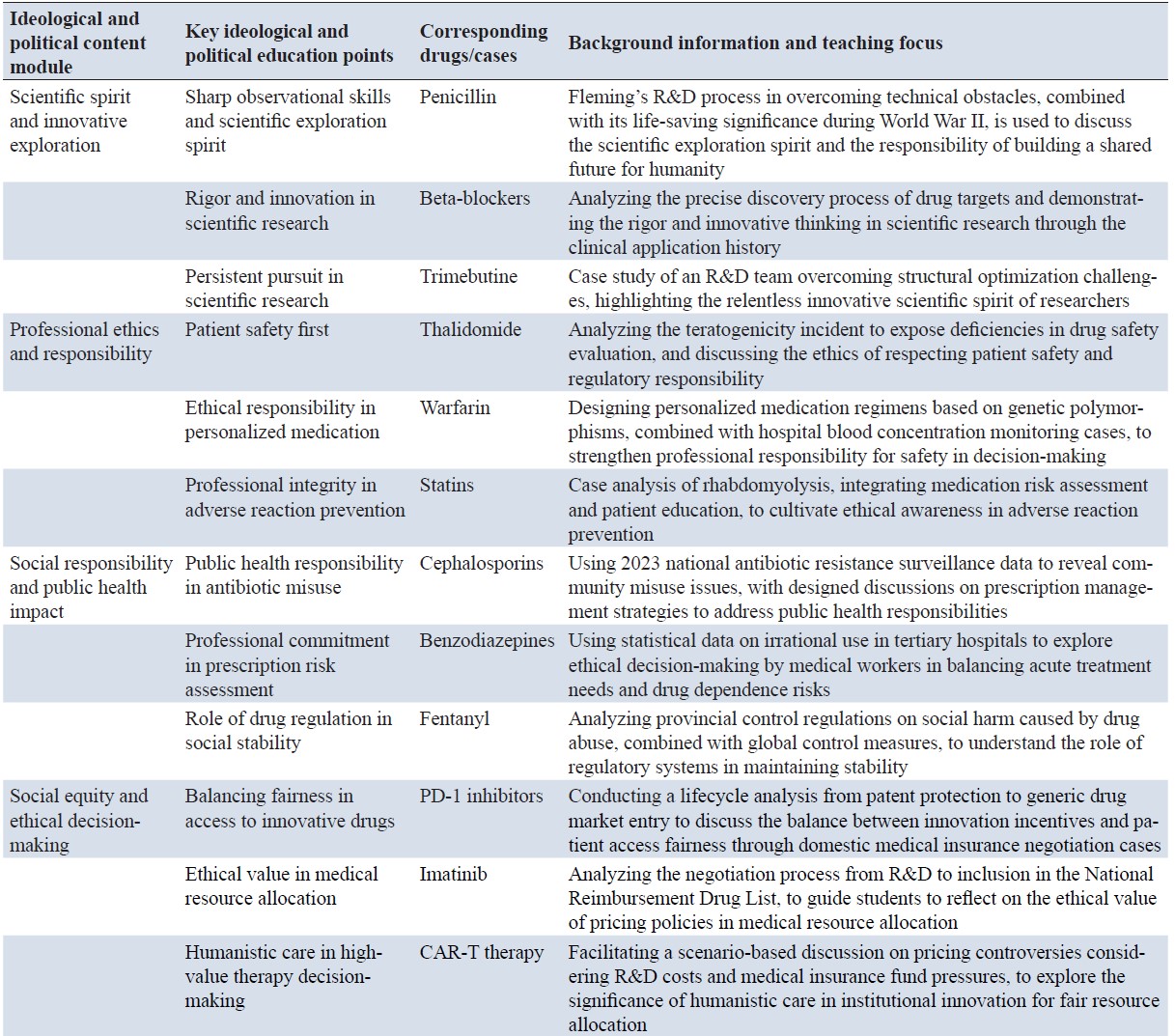
The following section lists some representative cases suitable for inclusion in the pharmacology case repository and their inherent ideological and political elements, which are detailed in Table 1 [17, 18].

3.3.2 Developing diversified supplementary teaching resources for course-based ideological education
A series of supplementary teaching resources has been developed to meet the practical needs of ideological education in pharmacology teaching, including micro-lesson videos, graphic materials, case interpretation manuals, experimental teaching guidance materials, and more [19]. The newly prepared teaching resources should focus on drug knowledge and also reflect ideological elements, with key content areas such as scientific exploration in drug research, ethical issues in drug use, and policy practice in pharmaceutical social governance. In this way, the development of such supplementary teaching resources can broaden classroom teaching formats and support students in multiple dimensions to enhance their understanding and internalization of the course’s ideological elements both in and out of class. In the chapter on pharmacokinetics, a specialized lesson plan titled “Monitoring of drug blood concentration” has been designed. Through the analysis of blood concentration monitoring data for vancomycin in a tertiary hospital, this lesson highlights the professional responsibility of clinical pharmacists in formulating individualized drug administration regimens. In the teaching unit on adverse drug reactions, a guidance manual entitled “Analysis of an atorvastatin-induced rhabdomyolysis case” has been compiled. Combining aspects such as adverse reaction monitoring, medication risk assessment, and patient education on medication use, the manual helps students foster a sense of responsibility in drug safety. Through the development of teaching guidance with ideological depth, systematic teaching references can be provided for instructors to ensure the effective implementation of ideological education in the teaching process.
This paper has established a pedagogical reform framework for pharmacology based on curriculum-based ideological and political education. Through systematically restructuring instructional content, methodologically innovating pedagogical approaches, and strategically optimizing resource systems, the framework addresses core deficiencies—including the lack of value orientation, methodological singularity, and insufficient resource support—inherent in conventional pedagogy. At the content level, the framework deeply explores the scientific spirit in the history of drug research, innovative thinking in teaching drug mechanisms, and ethical responsibility in drug safety evaluation, achieving the organic integration of professional knowledge and ideological elements. At the method level, it adopts clinical case teaching and problem-oriented teaching to construct practical scenarios for understanding social responsibility. At the resource level, it builds a case library for ideological education covering core areas of pharmacology and develops corresponding supplementary tools to provide systematic support for value guidance.
Looking to the future, further reforms can be carried out in the following areas: establishing a multi-dimensional evaluation system for the effectiveness of ideological and political education, integrating tools such as student behavior observation, case analysis reports, and career values questionnaires, and tracking graduates’ professional behaviors—such as prescription decisions—through school-enterprise cooperation platforms, to form a quantifiable evaluation mechanism. Furthermore, promoting technology-driven pedagogical innovation necessitates the application of virtual reality to simulate scenarios such as the social consequences of substance abuse, thereby enhancing instructional responsiveness to contemporary demands [20]. In summary, continuous attention must be paid to the evolving requirements of medical technology innovation and changing social demands for ideological and political education in the course. Through systematic iterative optimization, pharmacology teaching can become a model field for implementing the fundamental task of fostering virtue and cultivating talents.
Author contributions
Jiaxi Zhang collected and analyzed the cases and drafted the manuscript. Panpan Hu provided teaching cases for the theoretical courses. Tianying Xu conceptualized and designed the study, provided critical revisions to the manuscript, and approved the final version for submission. Haiyan Wang guided the writing of the manuscript and provided the analytical cases.
Funding
This work was supported by Collaborative Education Project of the Ministry of Education of China (250101414020206) and Planning Project of Shanghai Higher Education Association (2QYB24158).
Data availability
Not applicable.
Ethics approval and consent to participate
Not applicable.
Consent for publication
Not applicable.
Competing interests
The authors declare that they have no competing interests.
Acknowledgements
Not applicable.
[1] Ministry of Education of the People's Republic of China. Guidelines for the construction of ideological and political education in college courses (No. 3 [2020]) [Internet]. Beijing: The State Council; 2020 May 28 [cited 2026 Mar 3]. Available from: http://www.gov.cn/zhengce/zhengceku/2020-06/06/content_5517606.htm
[2] Yu Y. Premise issues in the methodological research of ideological and political education discipline. Ideal Theor Educ. 2025 Jun 30;(07):56-62. https://doi.org/10.16075/j.cnki.cn31-1220/g4.2025.07.011
[3] Luo W. Research on teaching reform of ideological and political theory courses in local undergraduate universities from a constructivist perspective. Sci Educ Cult Collect. 2024 Sep 4;(17):46-49. https://doi.org/10.16871/j.cnki.kjwh.2024.17.011
[4] Wan G, Xie W, Le J, Wang J. Case analysis of ideological and political education in courses: Integrating ideological and political education into the teaching of pharmacology specialized courses in colleges and universities. Mod Dist Educ Tradit Chin Med China. 2023 Nov 1;21(21):24-26. https://doi.org/10.3969/j.issn.1672-2779.2023.21.008
[5] Zhang C, Zhou X, Lu Y. Integrating curriculum-based ideological education into pharmacology teaching in universities. Med Theory Pract. 2025 Sep 25;38(18):3224-3227. https://doi.org/10.19381/j.issn.1001-7585.2025.18.055
[6] Gan L, Luo D, Luo T, Guo B. The initial path of ideological and political work in pharmacology courses for clinical medicine majors in higher vocational colleges: Taking penicillin and aspirin as examples. Mod Vocat Educ. 2022 Dec 12;(41):56-59.
[7] Lin B. Discussion on integrating ideological and political education into college courses: Taking the "pharmacology" course as an example. Educ Teach Forum. 2025 Jan 15;(03):125-128. https://doi.org/10.20263/j.cnki.jyxltt.2025.03.013
[8] Yang J, Ma D, Huang D, Zhang Y. Exploration of ideological and political content in the "pharmacology" course. Guangdong Chem Ind. 2023 Feb 21;50(03):223-224.
[9] Zeng L, Zhang C, Liu H. Exploration of ideological and political education in pharmacology courses for clinical medicine specialists to strengthen moral education and talent cultivation. Res High Eng Educ. 2019;(S1):300-302.
[10] Li L, Zhou E, Lu W, Zhou X, Tian Q. Teaching design and element mining of ideological and political education in pharmacology course based on case teaching. Mod Bus Trade Ind. 2025 Mar 12;(08):231-233. https://doi.org/10.19311/j.cnki.1672-3198.2025.08.072
[11] Li C, Wang J, Yan M, Wang D, Yang T, Yin X, et al. Exploration of ideological and political practice in clinical pharmacology courses in medical colleges and universities. Contin Med Educ China. 2023 Dec 12;15(21):29-33. https://doi.org/10.3969/j.issn.1674-9308.2023.21.007
[12] Lu F. Exploration and practice of ideological and political teaching reform in higher vocational nursing pharmacology course. University. 2021 Aug 20;(32):74-76.
[13] Guo L, Ye C, Zhang D. How to guide medical students in effectively learning 'antibiotics'. Basic Clin Med. 2013 May 5;33(05):639-642. https://doi.org/10.16352/j.issn.1001-6325.2013.05.003
[14] Shen Y. Research on China's rare disease issues and comprehensive safeguard mechanisms. Health Econ Res. 2024 Dec 5;41(12):1-6. https://doi.org/10.14055/j.cnki.33-1056/f.2024.12.006
[15] Liu B. Typical case analysis of pharmacist participation in ethical review of new drug clinical trials for cancer patients. Chin J Hosp Pharm. 2021 Jun 30;41(17):1756-1759. https://doi.org/10.13286/j.1001-5213.2021.17.10
[16] Chen J, Fang Y, Wang S. Research on the construction of ideological and political case library for pharmacology course. University. 2025;(S1):109-111.
[17] Miao Q, Zhao J, Chen X, Li J, Yan C, Su S, et al. Exploration and practice of integrating ideological and political education into pharmacology teaching. High Med Educ China. 2024 Nov 13;(09):93-94.
[18] Chen X, Wang H, Wei B, Yao Y, Zhuo D, Zhao H. Exploration and practice of ideological and political education in pharmacology course for pharmacy majors. J Henan Med Coll. 2024 Jun 15;36(03):389-392. https://doi.org/10.20261/j.cnki.2097-6089.2024.03.026
[19] Xu J, Zang L, Wang G, Qiao A. Practical exploration of integrated online and offline pharmacology teaching reform. Pharm Educ. 2025;41(01):121-125. https://doi.org/10.16243/j.cnki.32-1352/g4.2025.01.022
[20] Zeng J, Zhou Y, Li F, Li X, Chen Y, Wei M, et al. Innovation and practice of a four-dimensional collaborative teaching model in pharmacology guided by ideological education and empowered by digital intelligence. China Med Her. 2025 Oct 5;22(28):110-114. https://doi.org/10.20047/j.issn1673-7210.2025.28.19
ISSN: 3007-0007
Volume 2, Issue 1
April 2026
Pages: 1-63


 Log In

 On This Page
 CITE
CITE