 Log In
Search




 Open Access
 hayyzhp@njmu.edu.cn
Peng Zhang, Department of Critical Care Medicine, The Affiliated Huai'an No. 1 People's Hospital of Nanjing Medical University, No. 1 Huanghe West Road, Huaiyin District, Huai'an 223300, Jiangsu, China. E-mail: hayyzhp@njmu.edu.cn.
Received February 5, 2026; Accepted April 14, 2026; Published June 2, 2026
Open Accesshayyzhp@njmu.edu.cnPeng Zhang, Department of Critical Care Medicine, The Affiliated Huai'an No. 1 People's Hospital of Nanjing Medical University, No. 1 Huanghe West Road, Huaiyin District, Huai'an 223300, Jiangsu, China. E-mail: hayyzhp@njmu.edu.cn.
Received February 5, 2026; Accepted April 14, 2026; Published June 2, 2026
Sepsis remains challenging to teach in the intensive care unit (ICU), not due to a lack of guidelines, but because clinical priorities must be continually reassessed as patient physiology evolves. Although trainees are familiar with guideline recommendations, they often hesitate at the bedside when multiple time-sensitive decisions compete for attention. To address this gap, we implemented a time-axis-based framework to structure sepsis case discussions during routine ICU teaching, including bedside rounds and formal case reviews. This approach organizes management into four sequential yet overlapping decision phases, helping maintain focus on immediate priorities while anticipating subsequent changes. In our experience, trainees demonstrated improved ability to articulate decision prioritization and escalation of care. Rather than introducing new guideline content, the framework enhances the visibility of temporal prioritization and clinical reasoning during discussion. By centering on timing and prioritization, it complements guideline-based teaching and provides a clearer structure for time-critical decision-making in ICU training.
Keywords: Sepsis, Medical education, Intensive care unit, Clinical reasoning, Teaching framework
Sepsis remains a major contributor to global morbidity and mortality and represents a core competency in intensive care medicine [1, 2]. In practice, effective management requires early recognition, timely prioritization of interventions, and continuous reassessment as patient physiology evolves [2, 3]. These same features also make sepsis difficult to teach. Trainees must make rapid decisions under uncertainty while responding to alarms, incoming laboratory data, and competing demands in the intensive care unit (ICU).
Sepsis education is commonly delivered through lectures, guideline summaries, or algorithm-based teaching [3, 4]. While these approaches establish diagnostic criteria and recommended therapies, they may appear static when applied to patients whose conditions change dynamically. In clinical settings, experienced intensivists continuously re-prioritize actions based on evolving physiology, resource constraints, and anticipated downstream risks [5, 6]. Although guidelines specify what should be done, they rarely make explicit how experts determine sequencing, deferment, or escalation.
In routine teaching, this decision-making process often remains implicit. Faculty may perform appropriate actions without consistently articulating the rationale for prioritization or escalation at a given moment. As a result, trainees observe outcomes but struggle to reconstruct the temporal organization of decisions [7, 8]. This expert–novice gap is well described in the clinical reasoning literature and is particularly pronounced in fast-paced environments such as intensive care [9, 10].
When early sepsis management is presented as a checklist, learners may focus on task completion rather than sequencing. This can lead to indiscriminate action without clear prioritization or escalation logic. Over time, such patterns may hinder the development of adaptive reasoning required in situations of diagnostic uncertainty or treatment failure [7, 11].
Case-based learning is widely used to support clinical reasoning by linking knowledge to authentic clinical contexts [12, 13]. However, case discussions vary across instructors and may drift toward retrospective explanation rather than real-time decision logic. A practical organizing structure is therefore needed to anchor discussion in time and make shifting priorities explicit as new information emerges [5, 14].
The framework is informed by educational perspectives that emphasize learning through participation in authentic clinical practice and through expert modelling in context [12, 15]. In ICU training, clinical reasoning involves not only knowing recommended interventions but also recognizing how the “main problem” evolves over time. This requires an understanding of temporal priority—what demands immediate action, what can be deferred, and what must be reassessed following initial interventions.
Experienced intensivists develop this temporal awareness through repeated clinical exposure and feedback [9, 10]. For example, they learn when a borderline blood pressure should prompt escalation and when it can be monitored while addressing a more urgent issue. These judgements are shaped by anticipated consequences, as early decisions create constraints and opportunities for subsequent actions [6, 16]. Sepsis reasoning is therefore inherently cumulative and time-dependent.
However, such reasoning is not easily acquired through observation alone. During rounds, faculty often act rapidly, and the rationale underlying prioritization may remain implicit [7, 8]. In addition, the pace of ICU work limits opportunities for reflection. Without an explicit scaffold, trainees may struggle to organize cases in real time and to link early decisions with later escalation [11].
Accordingly, our teaching aim is to make the temporal structure of decision-making explicit. By organizing sepsis management along a time axis, the framework externalizes the questions that experienced clinicians often apply implicitly. This approach enables trainees to practice reasoning in the same sequence as bedside decision-making, rather than relying solely on retrospective explanations of care [5, 14].
The framework organizes sepsis management into four sequential yet overlapping phases. Rather than functioning as a rigid checklist, these phases serve as a scaffold to guide attention toward priorities, uncertainty, and escalation triggers during case discussion. The overall structure is illustrated in Figure 1.

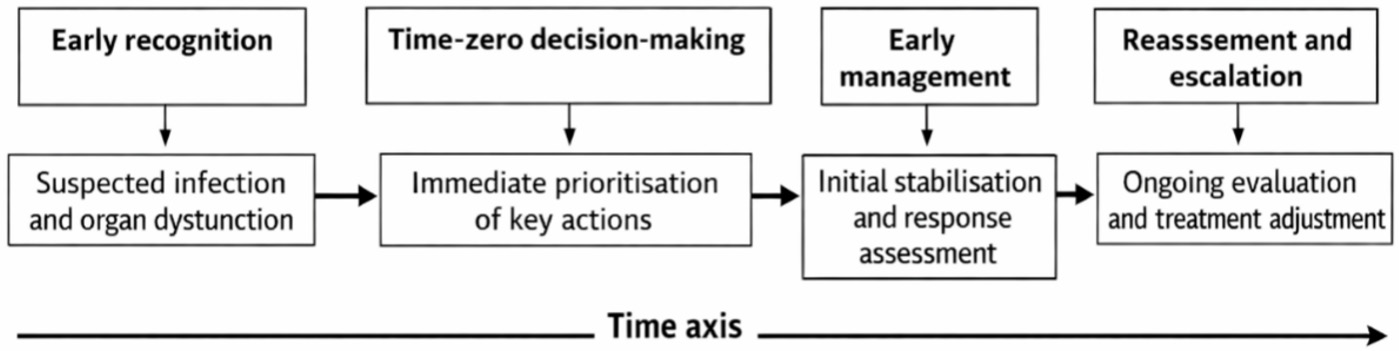
Figure 1. Time-axis–oriented teaching framework for sepsis management in intensive care training. The framework organises sepsis management into four sequential but overlapping phases—early recognition, time-zero decision-making, early management, and reassessment with escalation—highlighting how clinical priorities and decision-making evolve over time during routine ICU practice.
3.1 Phase 1: Early recognition
This phase focuses on identifying suspected infection and acute organ dysfunction. Teaching emphasizes pattern recognition (e.g., evolving respiratory rate, changes in mental status), interpretation of trends, and diagnostic vigilance in non-specific presentations [1, 2]. Trainees are prompted to explain why sepsis is plausible at that moment, rather than enumerating differential diagnoses.
3.2 Phase 2: Time-zero decision-making
Once sepsis is recognized, attention shifts to time-critical actions. The focus is not only on what to do, but why a given action takes priority. Trainees are asked to justify initial decisions (e.g., antibiotics, cultures, hemodynamic support) and to consider the potential consequences of delay [3, 5]. The concept of “time zero” is also contextualized within local practice (e.g., recognition during rounds versus overnight handover).
3.3 Phase 3: Early management
This phase addresses initial hemodynamic optimization, response monitoring, and interpretation of dynamic clinical data. Trainees are guided to identify expected response signals and appropriate time frames for reassessment. Discussion emphasizes linking early responses—or lack thereof—to subsequent decisions, rather than viewing interventions as isolated steps [2, 6].
3.4 Phase 4: Reassessment and escalation
Although reassessment is continuous, escalation reasoning is treated as a distinct teaching focus. Trainees are encouraged to define what constitutes an inadequate response, reconsider alternative explanations, and determine when escalation is warranted (e.g., vasopressors, source control, expanded diagnostics) [5, 16]. Particular attention is given to how early decisions constrain later options, a common challenge for novice learners.
A central feature of the framework is the deliberate faculty verbalization of expert reasoning during case discussions. Faculty are encouraged to “think aloud”, making explicit their prioritization, uncertainty, and anticipation of downstream consequences [7, 8]. In our experience, trainees benefit not only from hearing decisions, but from understanding the trade-offs and temporal logic underlying them.
Figure 2 illustrates how expert reasoning—often compressed into brief bedside statements—can be unpacked into explicit, sequential steps for teaching. For instance, rather than stating “let’s start norepinephrine”, an instructor might elaborate: “Adequate fluid resuscitation has been given, mean arterial pressure remains low, lactate is rising, and further delay risks worsening perfusion; initiating vasopressors now allows time for ongoing reassessment of volume status”. Such expansions make the temporal logic of escalation visible and reproducible.
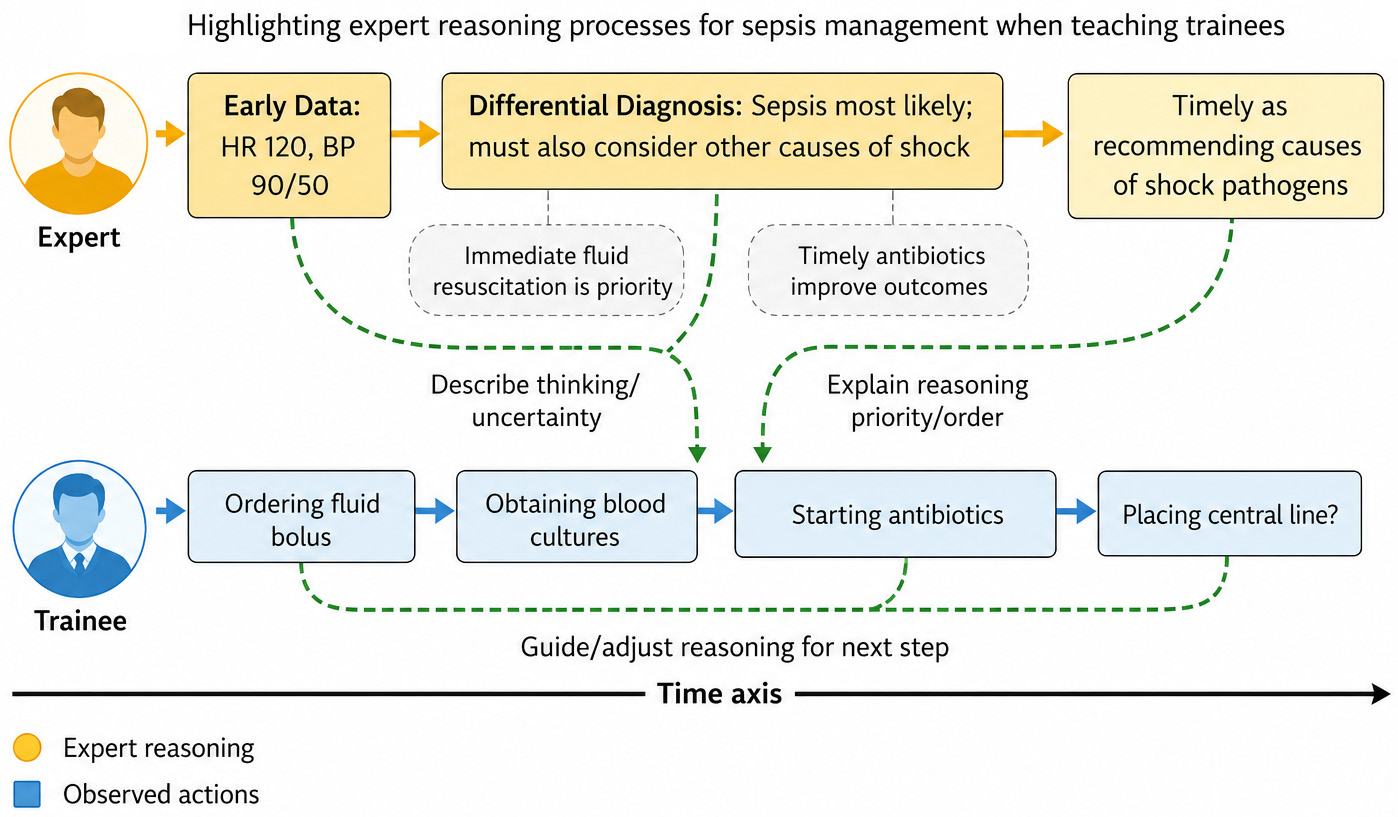
Figure 2. Making expert clinical reasoning visible to trainees in sepsis management. The figure illustrates how expert clinicians externalise temporal priorities and decision-making processes during case-based teaching, enabling trainees to observe, discuss, and gradually internalise time-sensitive clinical reasoning.
The framework is designed to integrate into routine ICU teaching rather than requiring a separate program. It is applied in three common contexts: (1) bedside rounds, (2) brief post-admission case reviews, and (3) scheduled small-group sessions. While the same time-axis-based questions are used across settings, the depth of discussion is adapted to time constraints and trainee level [12, 13].
Teaching cases are typically drawn from recent ICU admissions to ensure clinical relevance. Each case is reviewed chronologically, with trainees asked to identify decision priorities at each phase. Faculty then makes implicit reasoning explicit, particularly with respect to time-zero priorities and escalation triggers. For junior trainees, the focus is on recognizing key clinical signals and articulating a defensible order of priorities. For more advanced learners, emphasis shifts toward trade-offs, management of uncertainty, and the downstream implications of early decisions [11, 18].
Because the framework prioritizes reasoning over assessment, it can be implemented without formal testing or additional data collection, supporting feasibility in time-constrained clinical environments. In practice, this also facilitates adoption across instructors by providing a shared structure for discussion rather than introducing a resource-intensive curriculum [14, 19]. All teaching cases were fully de-identified prior to discussion. According to institutional policy of The Affiliated Huai'an No. 1 People's Hospital of Nanjing Medical University, this study did not involve identifiable patient data and therefore did not require formal ethical approval or informed consent.
This time-axis-based framework provides trainees with a structured approach to sepsis management that more closely reflects real-time bedside decision-making. It does not replace guideline-based teaching; rather, it addresses complementary questions: what matters most now, what should happen next, and what would prompt a change in course? Repeated engagement with these questions across cases may support the development of clearer prioritization and escalation reasoning in time-sensitive care [7, 9].
For instructors, the framework also serves as a shared teaching language. When multiple faculty members supervise the same cohort, variability in case discussions is inevitable. A common time-axis scaffold can enhance consistency while preserving individual teaching styles and clinical perspectives. In addition, it provides a structured basis for feedback, enabling instructors to comment not only on knowledge of guidelines but also on how trainees prioritize decisions and respond to evolving clinical information [15, 17].
Although described in the context of sepsis, this approach may be applicable to other ICU conditions characterized by time-critical decision-making and frequent reassessment, such as undifferentiated shock, acute respiratory failure, and post-cardiac arrest care [5, 16]. Across these contexts, the central educational aim remains the same: to make temporal prioritization explicit and amenable to deliberate practice.
This article presents a conceptual teaching framework without empirical evaluation of educational outcomes. Accordingly, no conclusions can be drawn regarding its impact on trainee performance or patient outcomes. Implementation is also likely to vary across institutions, depending on faculty experience, clinical workflows, and local teaching culture. Future studies could examine how the framework influences clinical reasoning processes, prioritization of decisions, and transfer of learning to practice. At the same time, its flexibility may support adaptation across diverse educational settings.
We describe a time-axis-based teaching framework for sepsis management in ICU training that emphasizes timing, prioritization, and escalation reasoning. By making the temporal dimensions of expert decision-making more explicit during case discussions, the framework offers a practical approach to supporting clinical reasoning in intensive care education. Further research is needed to evaluate its effects on trainee decision-making and its potential integration into routine ICU practice.
Author contributions
Peng Zhang conceptualized the study and drafted the manuscript. Tongkun Zuo and Ying Huang contributed to critical revision of the manuscript. All authors read and approved the final version.
Funding
This research received no external funding.
Data availability
No datasets were generated or analysed during the current study.
Ethics approval and consent to participate
This study did not involve identifiable human participants or patient-level data. In accordance with institutional policy of The Affiliated Huai’an No. 1 People’s Hospital of Nanjing Medical University, ethical approval and informed consent were not required.
Consent for publication
Not applicable.
Competing interests
The authors declare that they have no competing interests.
Acknowledgements
Not applicable.
[1] Singer M, Deutschman CS, Seymour CW, Shankar-Hari M, Annane D, Bauer M, et al. The third international consensus definitions for sepsis and septic shock (sepsis-3). JAMA. 2016 Feb 23;315(8):801-810. https://doi.org/10.1001/jama.2016.0287
[2] Rhodes A, Evans LE, Alhazzani W, Levy MM, Antonelli M, Ferrer R, et al. Surviving sepsis campaign: International guidelines for management of sepsis and septic shock: 2016. Intensive Care Med. 2017 Mar;43(3):304-377. https://doi.org/10.1007/s00134-017-4683-6
[3] Levy MM, Evans LE, Rhodes A. The surviving sepsis campaign bundle: 2018 update. Intensive Care Med. 2018 Jun;44(6):925-928. https://doi.org/10.1007/s00134-018-5085-0
[4] Cecconi M, Evans L, Levy M, Rhodes A. Sepsis and septic shock. Lancet. 2018 Jul 7;392(10141):75-87. https://doi.org/10.1016/S0140-6736(18)30696-2
[5] Croskerry P. A universal model of diagnostic reasoning. Acad Med. 2009 Aug 1;84(8):1022-1028. https://doi.org/10.1097/ACM.0b013e3181ace703
[6] Klein G. Sources of power: How people make decisions. Cambridge (MA): MIT Press; 1998. 352 p.
[7] Norman G. Research in clinical reasoning: Past history and current trends. Med Educ. 2005 Apr;39(4):418-427. https://doi.org/10.1111/j.1365-2929.2005.02127.x
[8] Eva KW. What every teacher needs to know about clinical reasoning. Med Educ. 2005 Jan;39(1):98-106. https://doi.org/10.1111/j.1365-2929.2004.01972.x
[9] Schmidt HG, Rikers RMJP. How expertise develops in medicine: Knowledge encapsulation and illness script formation. Med Educ. 2007 Dec;41(12):1133-1139. https://doi.org/10.1111/j.1365-2923.2007.02915.x
[10] Norman GR, Monteiro SD, Sherbino J, Ilgen JS, Schmidt HG, Mamede S. The causes of errors in clinical reasoning: Cognitive biases, knowledge deficits, and dual process thinking. Acad Med. 2017 Jan;92(1):23-30. https://doi.org/10.1097/ACM.0000000000001421
[11] Ten Cate O, Durning S. Peer teaching in medical education: Twelve reasons to move from theory to practice. Med Teach. 2007 Sep;29(6):591-599. https://doi.org/10.1080/01421590701606799
[12] Thistlethwaite JE, Davies D, Ekeocha S, Kidd JM, MacDougall C, Matthews P, et al. The effectiveness of case-based learning in health professional education. A BEME systematic review: BEME Guide No. 23. Med Teach. 2012;34(6):e421-e444. https://doi.org/10.3109/0142159x.2012.680939
[13] McLean SF. Case-based learning and its application in medical and health-care fields: A review of worldwide literature. J Med Educ Currie Dev. 2016 Apr 27;3:JMECD.S20377. https://doi/10.4137/JMECD.S20377
[14] Young M, Thomas A, Lubarsky S, Ballard T, Gordon D, Gruppen LD, et al. Drawing boundaries: The difficulty in defining clinical reasoning. Acad Med. 2018 Jul;93(7):990-995. https://doi.org/10.1097/ACM.0000000000002142
[15] Collins A, Brown JS, Newman SE. Cognitive apprenticeship: Teaching the crafts of reading, writing, and mathematics. Educ Res. 1989;18:32-42.
[16] Angus DC, van der Poll T. Severe sepsis and septic shock. N Engl J Med. 2013 Aug 29;369(9):840-851. https://doi.org/10.1056/NEJMra1208623
[17] Ericsson KA. Deliberate practice and the acquisition and maintenance of expert performance in medicine and related domains. Acad Med. 2004 Oct;79(2 Suppl):S70-S81. https://doi.org/10.1097/00001888-200410001-00022
[18] Yardley S, Teunissen PW, Dornan T. Experiential learning: Transforming theory into practice. Med Teach. 2012;34(2):161-164. https://doi.org/10.3109/0142159X.2012.643264
[19] Audetat MC, Laurin S, Sanchez G, Beique C, Fon NC, Blais JG, et al. Clinical reasoning difficulties: A taxonomy for clinical teachers. Med Teach. 2013;35(3):e984-e989. https://doi.org/10.3109/0142159X.2012.733041
ISSN: 3007-0007
Volume 2, Issue 1
April 2026
Pages: 1-63


 Log In

 On This Page
 CITE
CITE