 Log In
Search




 Open Access
 cail2024@163.com
Comfort nursing intervention significantly reduced the incidence of incontinence-associated dermatitis in critically ill patients compared to routine nursing.
The implementation of comfort nursing led to a notable decrease in wound infections and muscle soreness.
Patient and family satisfaction with nursing care was markedly higher in the comfort nursing group, indicating improved treatment outcomes.
Comfort nursing offers a comprehensive approach to managing incontinence-associated dermatitis and enhancing patient care in critical care settings.
Open Accesscail2024@163.comComfort nursing intervention significantly reduced the incidence of incontinence-associated dermatitis in critically ill patients compared to routine nursing.
The implementation of comfort nursing led to a notable decrease in wound infections and muscle soreness.
Patient and family satisfaction with nursing care was markedly higher in the comfort nursing group, indicating improved treatment outcomes.
Comfort nursing offers a comprehensive approach to managing incontinence-associated dermatitis and enhancing patient care in critical care settings.
Objective: To evaluate the clinical effect of comfort nursing intervention in preventing incontinent-associated dermatitis (IAD) and related complications in critically ill patients. Methods: This study enrolled critically ill patients from the Intensive Care Unit at Ningxiang People' s Hospital between June 2020 and June 2024. Patients were randomly assigned to a comfort nursing group (n=51) and a routine nursing group (n=53). The comfort nursing group received comprehensive comfort nursing, while the routine nursing group received standard care. The in cidence, classification and area of IAD as well as the incidence of complications and patient / family satisfaction with nursing care, were assessed. Results: The incidence of IAD was significantly lower in the comfort nursing group (8 patients) compared to the routine nursing group (21 patients) (P<0.05). Additionally, the incidences of wound infection and muscle soreness were notably lower in the comfort nursing group (both P<0.05). Patient and family satisfaction in the comfort nursing group was significantly higher than in the routine nursing group (both P<0.05). Conclusion: Comfort nursing intervention is effective in preventing IAD and reducing associated complications in critically ill patients, thereby improving patient and family satisfaction with treatment.
Incontinence-associated dermatitis (IAD) is a form of irritant dermatitis that commonly affects elderly patients with incontinence, where wounds are exposed to urine and feces, particularly following trauma. In severe cases, IAD can result in skin lesions, serious infections, and may even pose life-threatening risks [1, 2]. IAD progresses rapidly, with small skin injuries potentially extending to deeper tissues, including muscles and bones [2, 3]. This not only imposes a financial burden on patients but also deteriorates their health, limiting their social interaction and leaving them in pain and reduced independence.
Currently, IAD management primarily focuses on symptomatic treatments, which aim to prevent the progression of dermatitis and address complications such as infections with antibiotics and pain through analgesia [4-6]. However, symptomatic treatment is reactive and does not prevent the initial suffering caused by IAD, underscoring the need for preventive approaches in clinical practice. Routine nursing may fail to detect patient problems in a timely manner or provide adequate psychological support. In contrast, comfort nursing emphasizes these aspects, focusing on comprehensive care tailored to patient needs, which enhances patient satisfaction both physically and emotionally [7, 8]. Comfort nursing is holistic, personalized, and creative, aiming to help patients achieve the highest possible level of comfort physically, mentally, and socially. Although strengthening skin care has been shown to reduce the incidence of IAD, skin care alone is insufficient for comprehensive prevention [9].
This study compares the clinical efficacy of comfort nursing versus routine nursing in preventing IAD and associated complications in critically ill patients, aiming to provide evidence for the application of comfort nursing interventions in preventing IAD.
General data
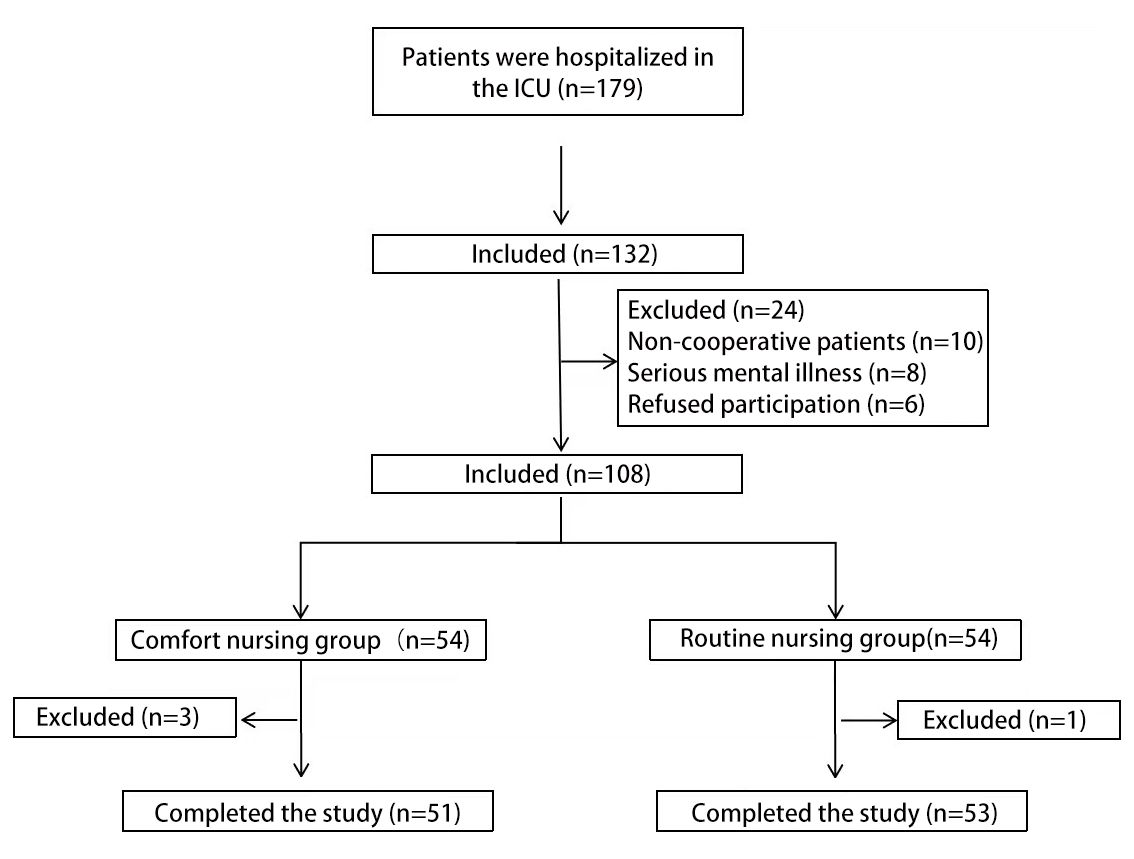
A total of 108 critically ill patients admitted to the Intensive Care Unit at Ningxiang People's Hospital between July 2020 and June 2024 were recruited for this study. Patients were randomly assigned using a computer-generated random number method: 54 were placed in the comfort nursing group, and 54 in the routine nursing group. The comfort nursing group received comprehensive care based on the comfort nursing strategy, while the routine nursing group received standard care according to the routine nursing strategy. During the study, 3 patients from the comfort nursing group and 1 from the routine nursing group dropped out for various reasons, resulting in 51 participants in the comfort nursing group and 53 in the routine nursing group.
Inclusion criteria: Critically ill patients with incontinence who were expected to remain bedridden for more than one week and could not be discharged in the short term, aged between 18 and 85, and those who, along with their families, were willing to cooperate with the study.
Exclusion criteria: Patients with severe damage to vital organs such as the heart, lungs, or kidneys, those with severe mental disorders, patients unable to cooperate with the study, those who withdrew from treatment voluntarily, and those with pre-existing IAD.
The study received unanimous approval from the Medical Ethics Committee of Ningxiang People’s Hospital, and all patients or their guardians provided signed informed consent.
Nursing methods
Routine nursing group: Patients in this group received care based on standard hospital procedures and doctor's instructions. Routine preoperative education and postoperative care were provided. After surgery, dressing changes were performed according to medical advice, and family members were instructed to assist patients with turning over using a turnover pad.
Comfort nursing group: (1) Nursing staff were responsible for maintaining cleanliness in the ward, organizing equipment and materials, and ensuring that items were arranged according to treatment protocols. Workbenches were cleaned and disinfected after each treatment session [10]. Additionally, health education was provided through informational animations to improve patient understanding of disease management.(2) Psychological comfort nursing: Patients or their families will be nervous during diagnosis and treatment, which can easily produce psychological obstacles. Therefore, the nursing staff were arranged to actively and enthusiastically communicate with patients and provide nursing for them, and give necessary help to weak elderly patients and patients with mobility difficulties to improve their comfort. During diagnosis and treatment, patients and their families often experience anxiety, leading to psychological distress. To address this, nursing staff were encouraged to communicate actively with patients, provide support to elderly or immobile patients, and build strong nurse-patient relationships. Staff were expected to answer questions patiently, alleviate psychological stress, and offer professional, compassionate care to enhance patients' comfort. By expressing empathy and helping patients build confidence, nursing staff aimed to minimize discomfort during treatment and reduce pain through tailored nursing plans. (3) Informing Patients of treatment results: Nursing staff closely monitored patients' clinical indicators and promptly communicated daily treatment outcomes, including potential adverse reactions, to alleviate concerns. Listening carefully to patients' needs, offering sufficient care, and sharing successful case examples were strategies employed to help patients accept their situation and adjust their mindset positively. (4) Establishing a Strong Nurse-Patient Relationship: Nursing staff adhered to a patient-centered approach, employing effective communication skills to prevent patient dissatisfaction. Understanding each patient's personality and providing timely, accurate responses helped ease negative emotions such as anxiety. For patients experiencing post-operative pain or heightened emotional distress, pain management interventions were reinforced. Nursing staff guided patients in relaxation techniques, such as deep breathing and muscle relaxation, to improve compliance and emotional well-being. (5) Skin Care for IAD Prevention: To prevent and manage IAD, skin cleansers with weak acidity that do not require rinsing, along with water-based emollients, were applied. Moisturizing emollients, containing ingredients like glycerin, were used to hydrate the skin. Additionally, skin protectants, such as zinc hydroxide, dimethicone, and petroleum jelly, were applied to create a protective barrier, minimizing skin damage from urine and feces. For patients with IAD, regular treatment included wound care, pain relief with sedatives, and antibiotics for infection control. To reduce pressure on affected areas, patients were frequently repositioned or encouraged to get out of bed.
Outcome measures
The incidence, classification, and extent of IAD, as well as the incidence of complications, and patient / family satisfaction with nursing and treatment, were evaluated.
Primary outcome measures: We evaluated the incidence of IAD (number of cases with IAD/total number of cases in the group * 100%) within 15 days of hospitalization. The classification of IAD was assessed upon patient admission and then every 3 days. The extent of IAD was classified as: small (<20 cm²), medium (between 20 and 50 cm²), and large (>50 cm²).
Secondary outcome measures: We recorded the number of cases with related complications, including wound infection, muscle soreness, and malnutrition. Additionally, we assessed patient and family satisfaction with nursing care.
IAD was classified into three categories: (1) Class I: Non-pale red local skin over bony prominences, with well-defined borders and non-blanchable redness ; (2) Class II: Superficial ulceration of part of the epidermis, with a red base and no scab, or the presence of intact or ruptured blood-filled blisters; (3) Class III: Full-thickness skin loss, scabbing, or subcutaneous tunneling, without exposure of muscle, tendon, or bone [11, 12].
Satisfaction score: Before discharge, each patient completed a satisfaction survey developed by the hospital. The total score was 100 points, with high satisfaction defined as 90-100 points, moderate satisfaction as 70-89 points, and dissatisfaction as <70 points. Patient /family satisfaction was calculated as: (number of patients / families with high + moderate satisfaction) / total number of patients / families * 100%.
Statistical analysis
Comparison of general data
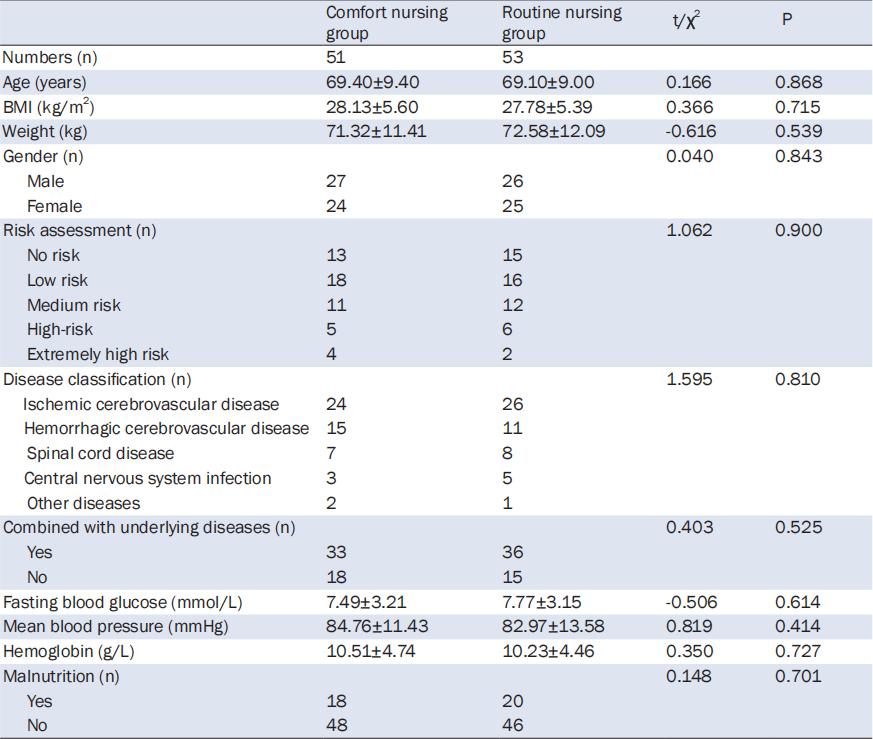
After applying the inclusion and exclusion criteria, 108 out of 179 patients were enrolled in the study. Using a computer-based random number method, 54 patients were assigned to the routine nursing group, and 54 to the comfort nursing group. During the study, 3 patients from the comfort nursing group and 1 patient from the routine nursing group dropped out for various reasons. The remaining 53 patients in the routine nursing group and 51 in the comfort nursing group completed the study without any uncontrollable events (Figure 1). There were no significant differences in baseline characteristics between the two groups (all P>0.05, Table 1).

Comparison of incidence and severity of IAD
Before the intervention, no cases of IAD occurred in either group. After 15 days of hospitalization, 8 cases of IAD were observed in the comfort nursing group, including 5 cases of class I IAD and 3 cases of class II IAD. In contrast, 21 cases were recorded in the routine nursing group, comprising 9 patients with class I IAD, 5 patients with class II IAD, and 7 patients with class III IAD. The incidence of IAD in the comfort nursing group was significantly lower than in the routine nursing group, with a statistically lower severity of IAD in the comfort nursing group (P=0.007, Table 2).

Comparison of the extent of IAD

Comparison of complications

Comparison of satisfaction

Critically ill patients in the ICU often remain bedridden for extended periods due to incontinence, making IAD a common issue. IAD not only increases medical resource consumption but also adds to the nursing workload. If left unaddressed, it can lead to further complications [13, 14]. Therefore, nursing strategies that prevent IAD in a timely manner should be prioritized.
IAD is primarily influenced by factors such as the degree of incontinence, friction, pressure, and the patient's skin condition. Among these, pressure is a crucial factor, with its impact determined by both the magnitude and duration of pressure applied to the body [8, 15]. Studies have indicated that a pressure of approximately 5 kPa sustained for 4 hours can cause changes in local skin tissue, and doubling the pressure shortens the time required for tissue damage by half [16, 17]. Comprehensive comfort nursing emphasizes health education and high-quality care, including the assessment of the patient's general condition and timely, effective nursing, which creates favorable conditions for the prevention of IAD [18, 19].
In this study, comfort nursing, which included actively assisting and encouraging patients to turn over and get out of bed, was shown to significantly reduce both the severity and incidence of IAD. This may be attributed to the comprehensive nature of comfort nursing, which combines psychological support, health education, high-quality care, and nutritional nursing. As a result, patients experience both physical and mental comfort, leading to better therapeutic outcomes [20]. Moreover, as demonstrated by this study, comfort nursing effectively reduces related complications, such as wound infection and muscle soreness, likely due to its holistic approach to both physical and psychological care.
The nutritional status of the skin plays a crucial role in the development and progression of IAD in patients [21]. Nutrition, as a long-term influencing factor, requires targeted nutritional nursing to achieve optimal outcomes. Studies have demonstrated that comprehensive comfort nursing can significantly improve the malnutrition status of long-term hospitalized patients [22, 23]. In some cases, malnutrition in hospitalized patients arises because family members fail to provide adequate care, or nursing staff neglect to guide family members appropriately. This is particularly true for patients with difficulty in food intake; if nurses do not carefully monitor and support their nutritional intake, these patients are at a higher risk of malnutrition. While short-term nutritional care can improve skin conditions to some extent, it is often insufficient to provide the sustained nutritional support required for ideal outcomes [24].
In this study, although there was no significant difference in the rate of malnutrition between the two groups, the number of malnourished patients in the comfort nursing group was lower. This may be attributed to the emphasis on nutritional care in the comfort nursing group, which likely helped reduce the incidence of malnutrition. Additionally, patient and family satisfaction with nursing and treatment in the comfort nursing group was notably higher, possibly due to the significant reduction in complications during hospitalization and the comprehensive nature of comfort nursing. This approach addresses both psychological and physiological factors, incorporating preventive and therapeutic measures that benefit both patients and their families. However, the relatively small sample size and short follow-up period in this study may introduce bias into the results. A prospective study with a larger sample size is needed to confirm these findings.
In conclusion, comfort nursing intervention is effective in preventing IAD in critically ill patients, reducing associated complications, and improving patient and family satisfaction with treatment.
Author contributions
Linlin Zou was responsible for the translation of the manuscript and data statistics. Siting Jiang managed the data analysis and writing of the experimental section. Rong Jiang reviewed and organized the manuscript. Lin Cai conceived the original idea and designed the experiments.
[1] Nelson K. The prevention and treatment of incontinence-associated dermatitis. Br J Nurs 2018;27(19):1101-1102.
[2] Brennan MR, Milne CT, Agrell-Kann M, et al. Clinical Evaluation of a Skin Protectant for the Management of Incontinence-Associated Dermatitis: An Open-Label, Nonrandomized, Prospective Study. J Wound Ostomy Continence Nurs 2017;44(2):172-180.
[3] Hoedl M, Eglseer D. Which Characteristics of Fecal Incontinence Predispose Incontinence-Associated Dermatitis? A Classification and Regression Tree Analysis. Adv Skin Wound Care 2021;34(2):103-108.
[4] Ferreli C, Guicciardi F, Pilloni L, et al. Intertriginous and Seborrheic Dermatitis-Like Lesions in an Endocrine Patient: Answer. Am J Dermatopathol 2019;41(6):457-458.
[5] Winnicki M, Shear NH. A systematic approach to systemic contact dermatitis and symmetric drug-related intertriginous and flexural exanthema (SDRIFE): a closer look at these conditions and an approach to intertriginous eruptions. Am J Clin Dermatol 2011;12(3):171-180.
[6] Arnold-Long M, Johnson E. Epidemiology of Incontinence-Associated Dermatitis and Intertriginous Dermatitis (Intertrigo) in an Acute Care Facility. J Wound Ostomy Continence Nurs 2019;46(3):201-206.
[7] Kolcaba K, Wilson L. Comfort care: a framework for perianesthesia nursing. J Perianesth Nurs 2002;17(2):102-113.
[8] Haug S, Farooqi S, Wilson CG, et al. Survey on Neonatal End-of-Life Comfort Care Guidelines Across America. J Pain Symptom Manage 2018;55(3):979-984.e2.
[9] Park KH, Kim KS. Effect of a structured skin care regimen on patients with fecal incontinence: a comparison cohort study. J Wound Ostomy Continence Nurs 2014;41(2):161-167.
[10] Brown JT. Comfort Care. J Palliat Med 2020;23(12):1684.
[11] Voegeli D. Proceedings of the Global IAD Expert Panel. Incontinence-associated dermatitis: moving prevention forward. Wounds Int 2015.
[12] Beeckman D. A decade of research on Incontinence-Associated Dermatitis (IAD): Evidence, knowledge gaps and next steps. J Tissue Viability 2017;26(1):47-56.
[13] Koudounas S, Bader DL, Voegeli D. Knowledge Gaps in the Etiology and Pathophysiology of Incontinence-Associated Dermatitis: A Scoping Review. J Wound Ostomy Continence Nurs 2020;47(4):388-395.
[14] Kottner J, Kolbig N, Bültemann A, et al. Inkontinenzassoziierte Dermatitis: ein Positionspapier [Incontinence-associated dermatitis: a position paper]. Hautarzt 2020;71(1):46-52.
[15] Ferreira M, Abbade L, Bocchi SCM, et al. Incontinence-associated dermatitis in elderly patients: prevalence and risk factors. Rev Bras Enferm 2020;73 Suppl 3:e20180475.
[16] Chen AT, Huang MH, Chen CC, et al. Using Teamwork to Reduce the Incidence of Incontinence-Associated Dermatitis. Hu Li Za Zhi 2020;67(1):89-97.
[17] Zhang Y, Leng M, Guo J, et al. The effectiveness of faecal collection devices in preventing incontinence-associated dermatitis in critically ill patients with faecal incontinence: A systematic review and meta-analysis. Aust Crit Care 2021;34(1):103-112.
[18] Francis K. Damage control: Differentiating incontinence-associated dermatitis from pressure injury. Nurse Pract 2019;44(12):12-17.
[19] Gates BP, Vess J, Long MA, Johnson E. Decreasing Incontinence-Associated Dermatitis in the Surgical Intensive Care Unit: A Quality Improvement Project. J Wound Ostomy Continence Nurs 2019;46(4):327-331.
[20] Tay C, Yuh AS, Sheau Lan EL, et al. Development and validation of the incontinence associated dermatitis knowledge, attitude and practice questionnaire. J Tissue Viability 2020;29(4):244-251.
[21] Hödl M, Blanař V, Amir Y, et al. Association between incontinence, incontinence-associated dermatitis and pressure injuries: A multisite study among hospitalised patients 65 years or older. Australas J Dermatol 2020;61(1):e144-e146.
[22] Lumbers M. How to manage incontinence-associated dermatitis in older adults. Br J Community Nurs 2019;24(7):332-337.
[23] Citty SW, Cowan LJ, Wingfield Z, et al. Optimizing Nutrition Care for Pressure Injuries in Hospitalized Patients. Adv Wound Care (New Rochelle) 2019;8(7):309-322.
[24] van Wissen K, Blanchard D. Preventing and treating incontinence-associated dermatitis in adults. Br J Community Nurs 2019;24(1):32-33.


 Log In

 On This Page
 CITE
CITE