 Log In
Search




 Open Access
 398429579@qq.com
Ming Hu, Department of Information Management, Shanghai University of Medicine & Health Sciences Affiliated Zhoupu Hospital, 1500 Zhouyuan Road, Zhoupu Town, Pudong New Area, Shanghai 201318, China. E-mail: 398429579@qq.com.
Received February 6, 2026; Accepted April 1, 2026; Published June 17, 2026
Open Access398429579@qq.comMing Hu, Department of Information Management, Shanghai University of Medicine & Health Sciences Affiliated Zhoupu Hospital, 1500 Zhouyuan Road, Zhoupu Town, Pudong New Area, Shanghai 201318, China. E-mail: 398429579@qq.com.
Received February 6, 2026; Accepted April 1, 2026; Published June 17, 2026
Background: Hospital outpatient services handle a large number of patients daily, with busy and standardized processes, making them crucial to the hospital' s daily operations. Approximately one-third of outpatients seek assistance at the information desk daily, with 60% of these inquiries related to department location and the treatment process. Despite the hospital displaying prominent maps and signs, many patients still get lost, repeatedly search for departments, or endure long waits, hindering patient satisfaction. Objective: To design and implement an intelligent indoor navigation system deeply integrated with the hospital information system (HIS). This system helps patients quickly and conveniently plan their routes, improve the overall medical experience, reduce the workload of medical staff and hospital operating costs, and implement the hospital' s "one-phone-for-all" outpatient service process optimization concept. Methods: This study constructed a real-time navigation system integrating Bluetooth iBeacon positioning technology, a 3D electronic map, and a WeChat official account platform. The system architecture is deeply integrated with the HIS to achieve proactive navigation based on the treatment process. This study employed a retrospective cohort analysis to compare the differences in patient time spent on key medical routes before and after the system' s implementation, and analyzed its application effectiveness using actual system usage data. Results: The system provides real-time, intelligent, and dynamic route guidance and path planning, effectively reducing patient navigation time, optimizing the medical experience, and lowering the workload and operating costs of patient guidance services. During the COVID-19 pandemic, the system provided strong support for the implementation of hospital epidemic prevention measures, reduced unnecessary contact between medical staff and patients, and ensured the safety of both.
In recent years, general hospitals have developed rapidly, with their building area and number of departments continuously increasing. This represents an important direction for hospital development [1]. Meanwhile, with the development of medical disciplines, outpatient functional areas have been frequently adjusted, leading to a continuous expansion of hospital layouts and increasingly complex patient routes. These issues pose significant challenges to patient movement within the hospital [2].
In the field of indoor navigation technology, various technical solutions such as Bluetooth, WiFi, and ultra-wideband have been explored and researched [3]. Among them, Bluetooth iBeacon-based technology is convenient to deploy and has a moderate cost [4-6]. However, most existing research focuses on positioning accuracy and technical implementation, and its practical application in hospitals is often disconnected from core business processes, failing to achieve the transformation from “simple static location query” to “dynamic process guidance” [2, 7-9]. To address the above issues, this paper constructs an intelligent in-hospital navigation system and carries out online testing at Shanghai Pudong New Area Zhoupu Hospital. This study makes three key contributions: (1) It designs a process-aware system architecture, which is deeply integrated with the hospital information system (HIS) and links navigation guidance with the real-time progress of patients’ visits, thereby clearly guiding them to the next destination and realizing proactive guidance on “where to go next”. (2) It uses the message push function of WeChat Official Account to automatically send navigation information according to the patient’s subsequent visits [10]. (3) It adopts rule-based dynamic path planning, which can recommend the optimal route for patients and realize one-way traffic control, meeting the relevant requirements of epidemic prevention. This paper combines real application data to fully elaborate on the solution, covering system design, core technologies, on-site deployment and effect evaluation.
2.1 Overall architecture design
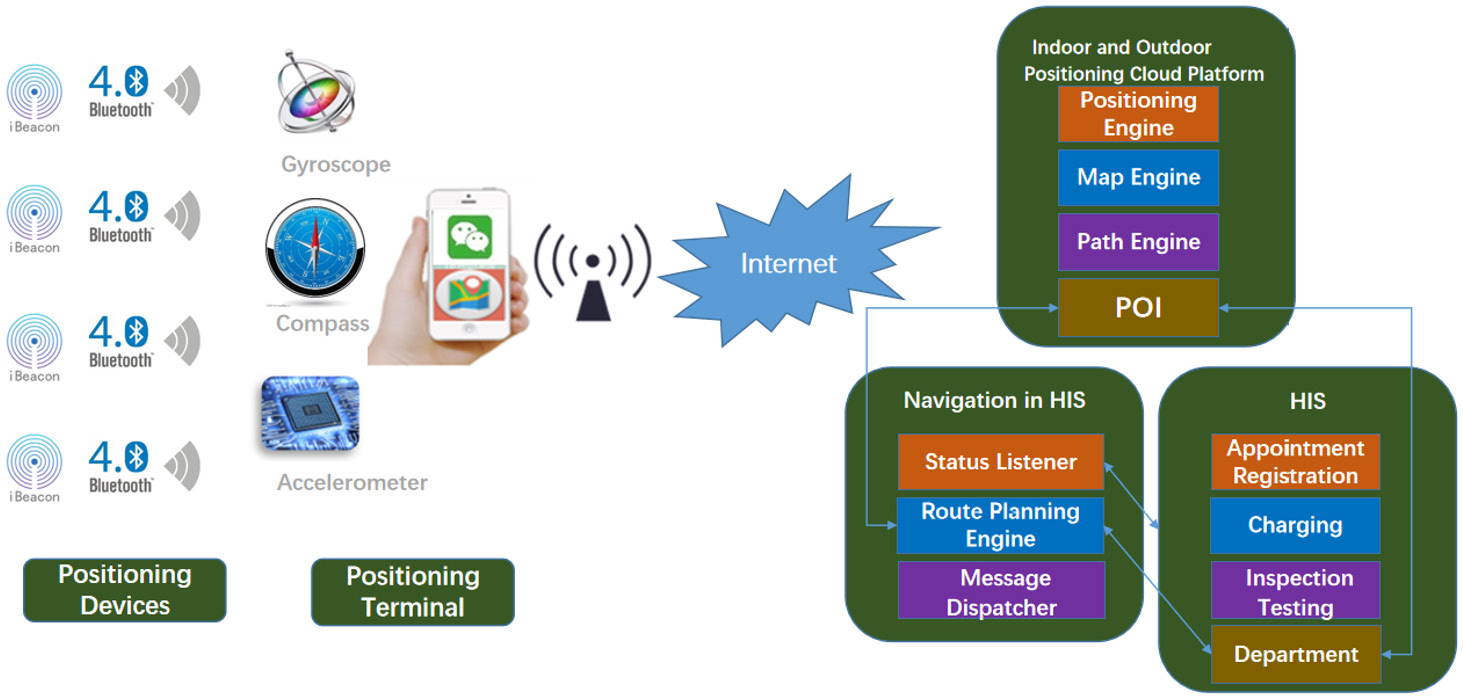
The overall system architecture is shown in Figure 1.

2.1.1 Positioning module
This module includes a positioning device and a positioning terminal (i.e., the patient’s smartphone), primarily employing iBeacon Bluetooth beacon technology [4-6]. To ensure the continuity of indoor positioning, this technology is also combined with the smartphone’s inertial navigation function and an improved pedestrian dead reckoning algorithm [3, 8, 11]. Positioning is achieved through two methods: received signal strength indicator (RSSI)-based fingerprint matching and pedestrian dead reckoning (PDR).
2.1.2 Indoor/outdoor positioning cloud platform
2.1.3 Business logic module (core)
2.1.4 Human-computer interaction module
2.2 Process-aware navigation mechanism
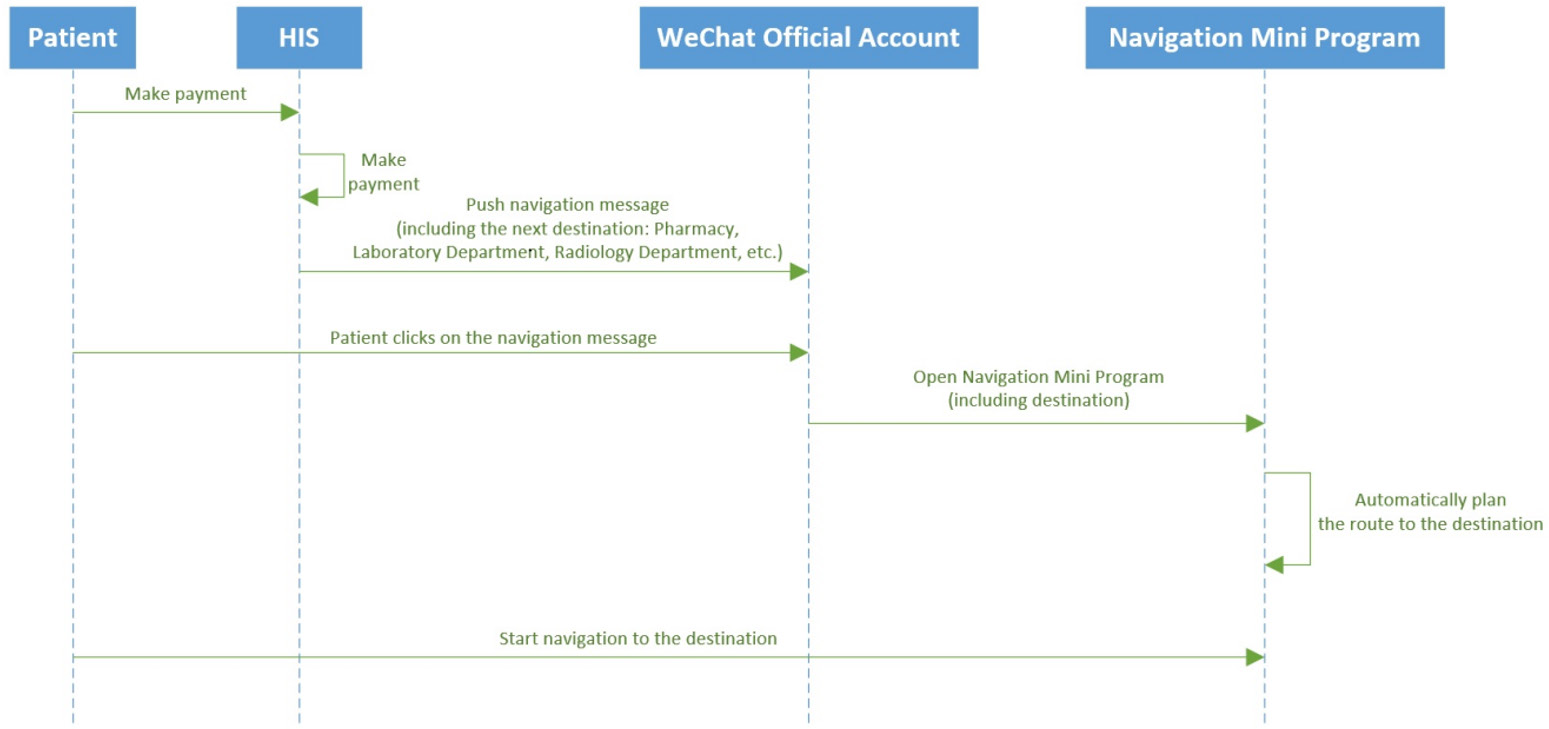
The core innovation of this system lies in the process-aware navigation mechanism, which is consistent with the goal of process optimization in the construction of smart hospitals [1, 2]. Figure 2 shows the system sequence diagram. When the patient information changes in the HIS, the business logic module automatically performs path planning based on the patient’s current location and destination, and actively pushs navigation messages to the patient’s WeChat through the human-computer interaction module [10]. This design effectively realizes the transformation of the service model from “people seeking tasks” to “tasks finding people”.
2.3 Path planning strategy
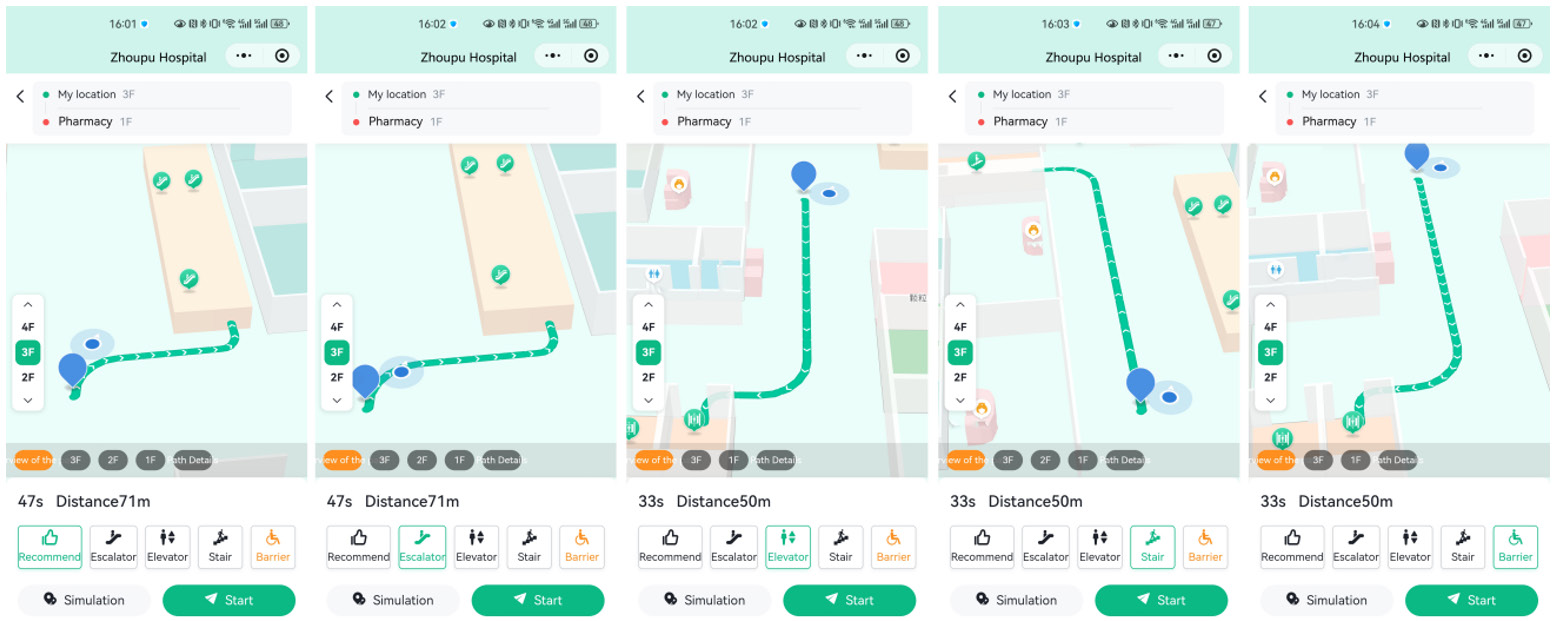
The path planning is based on an improved algorithm that not only calculates the geometric shortest path, but also incorporates business rule weights (such as prioritizing the planning of accessible pathways and elevators for wheelchair users) and management rules (such as setting up one-way electronic fences during the pandemic) to generate an optimal path with context-aware capabilities. Figure 3 shows the navigation results, which presents examples of optimal paths generated under four different travel preferences (escalator, elevator, stair, and barrier-free access), including the default recommended route.
3.1 System deployment and usage overview
3.2 Visit efficiency evaluation
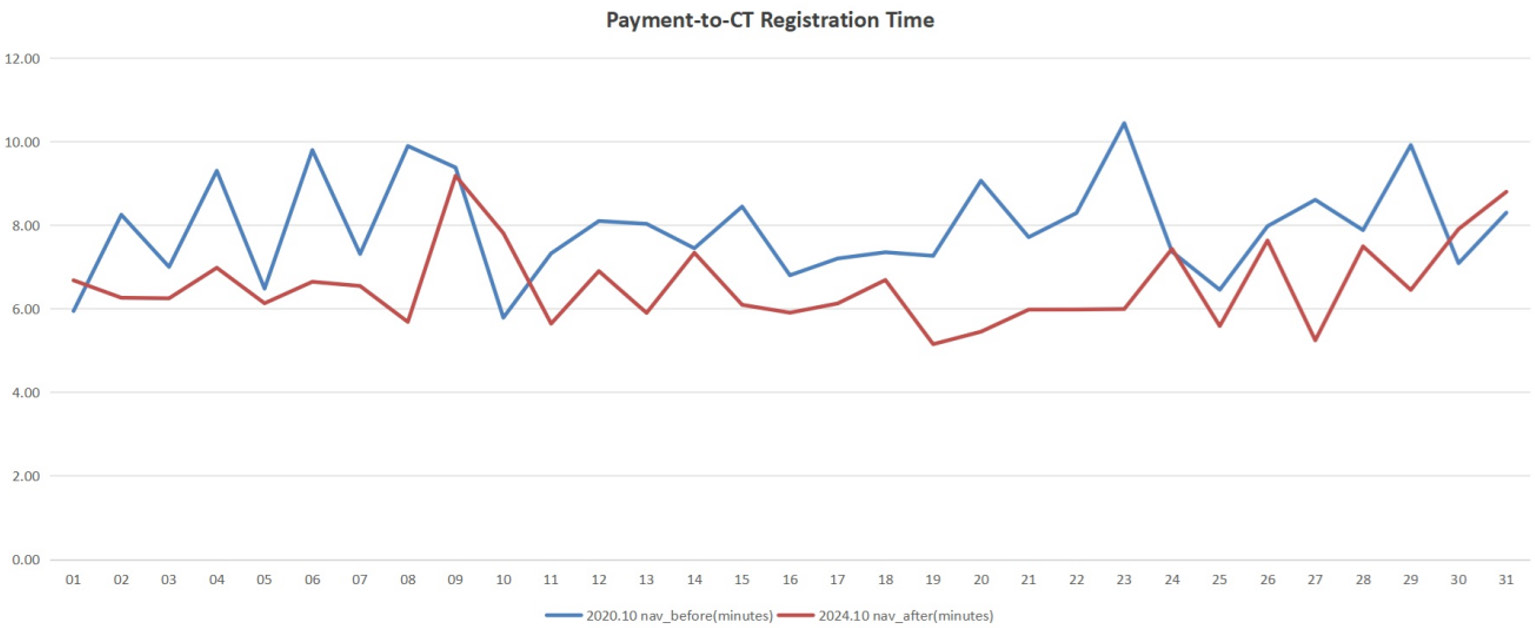
To quantify the impact of this system on patient visit efficiency, we conducted a retrospective cohort study. Anonymous patient process timestamp data was extracted from the HIS, covering before system implementation (October 2020) and after implementation (October 2024). The typical patient visit process of “payment → examination registration” was selected, and the average time for this process was calculated for all patients before and after the system implementation. After the system implementation, the total time from payment to completion of examination registration decreased by 17%. This is showed in Table 1.

Note: The interval from payment completion to radiology registration was used as a surrogate for patient travel and waiting time. This interval was compared before and after system deployment, using data from October 2020 (pre‑deployment) and October 2024 (post‑deployment). Only patients who completed both payment and CT registration on the same day were included. In October 2020 (pre‑deployment, n=7,482), the mean interval was 7.95 minutes. In October 2024 (post‑deployment, n=10,144), the mean interval decreased to 6.57 minutes. The reduction was 1.38 minutes, representing a 17% decrease.
This paper designs an in-hospital intelligent navigation system that is deeply integrated into the entire patient visit process. It has been successfully deployed and tightly integrated with the HIS. This integration achieves process-aware proactive navigation, fulfilling the design goals of a new generation of hospital navigation systems, and also aligns with the core objective of optimizing outpatient process management [2].
This study conducted a retrospective cohort analysis, which provided reliable empirical evidence: patients using the system spent significantly less time finding their way than those who did not use it. The system operates stably and has received positive feedback from users. All of these factors confirm that the solution is feasible, effective, and practical in real medical scenarios.
The main contribution of this study is the successful transformation of a navigation tool: from a technology-driven tool to a patient-centered, process-aware intelligent service system. This achievement aligns with national policies on high-quality hospital development and provides an effective practical case for improving outpatient efficiency and enhancing patients’ medical experience [1, 2].
In the future, we will utilize the trajectory data generated by this system to further study patient flow patterns and explore predictive navigation and crowd management solutions based on artificial intelligence.
Author contributions
Zhigang Sun: Conceptualization, Methodology, Investigation, Writing—original draft, Writing—review & editing, Software, Data collection, Formal analysis. Feifei Gu: Methodology, Validation. Bei Tian: Supervision, Writing—review & editing, Project consultation. Ming Hu: Supervision, Writing—review & editing, Project administration. All authors read and approved the final manuscript.
Funding
This work was supported by Pudong New Area Outstanding Young Scholars Program (PWRq2024-52).
Data availability
The data used in this study comes from two sources: one is the usage statistics from the in-hospital navigation system backend; the other is the time data of patients’ payment for examinations and test registration extracted from the Hospital Information System (HIS). The time difference between payment and registration was calculated to indirectly reflect patients’ wayfinding time and evaluate the effectiveness of the navigation system. Only anonymized time information was collected, without any personal identifiable sensitive data of patients, ensuring data security and compliance.
Ethics approval and consent to participate
Not applicable.
Consent for publication
Not applicable.
Competing interests
The authors declare that they have no competing interests.
Acknowledgements
The authors thank Zhoupu Hospital for supporting this research and the staff for their assistance in data collection.
[1] General Office of the State Council of the People's Republic of China. Opinions of the General Office of the State Council on promoting the high-quality development of public hospitals (No. 18 [2021]) [Internet]. Beijing: the State Council; 2021 [cited 2026 Jan 11]. Available from: https://www.gov.cn/gongbao/content/2021/content_5618942.htm
[2] Liu R. Research on hospital information systems and outpatient process optimization. China Plant Eng. 2019;9:65-66.
[3] Xiao C. A review of indoor localization methods based on wireless signals. Heilongjiang Sci Technol Inf. 2017;12:62.
[4] Shen S. Research and implementation of indoor positioning system based on iBeacon technology. Hunan: Hunan Normal University; 2016. 49 p.
[5] Shi Z, Xu T, Liu T, Liu M. Research on indoor positioning technique based on iBeacon base station. Mob Commun. 2015;39(7):88-91. https://doi.org/10.3969/j.issn.1006-1010.2015.07.019
[6] Liu M, Liu T, Ye Y, Wu L. The application research of indoor positioning based on low-power bluetooth technology. Int J Wirel Commun Technol. 2015;3:19-23.
[7] Deng Z. Research on indoor location technology based on RFID [master's thesis]. Changchun: Changchun University of Science and Technology; 2017. 50 p.
[8] Peng Y. Research and implementation of indoor bluetooth positioning based on android platform [master's thesis]. Xi'an: Xidian University; 2017. 50 p.
[9] Luo C. Bluetooth positioning measurement. Straits Sci. 2007;10:56-57,67.
[10] Qi G. A brief discussion on the operational skills of push messages for hospital WeChat public accounts. Radio TV J. 2018;5:162-163. https://doi.org/10.19395/j.cnki.1674-246x.2018.05.089
[11] Wu J, Wang X. Design of PDR enhanced indoor location under iBeacon. J Fuzhou Univ Nat Sci Ed. 2017 Oct;45(5):646-651. https://doi.org/10.7631/issn.1000-2243.2017.05.0646
ISSN: 2957-5524
Volume 2, Issue 1
June 2026
Pages: 1-6


 Log In

 On This Page
 CITE
CITE